stopmidtownburnerstar

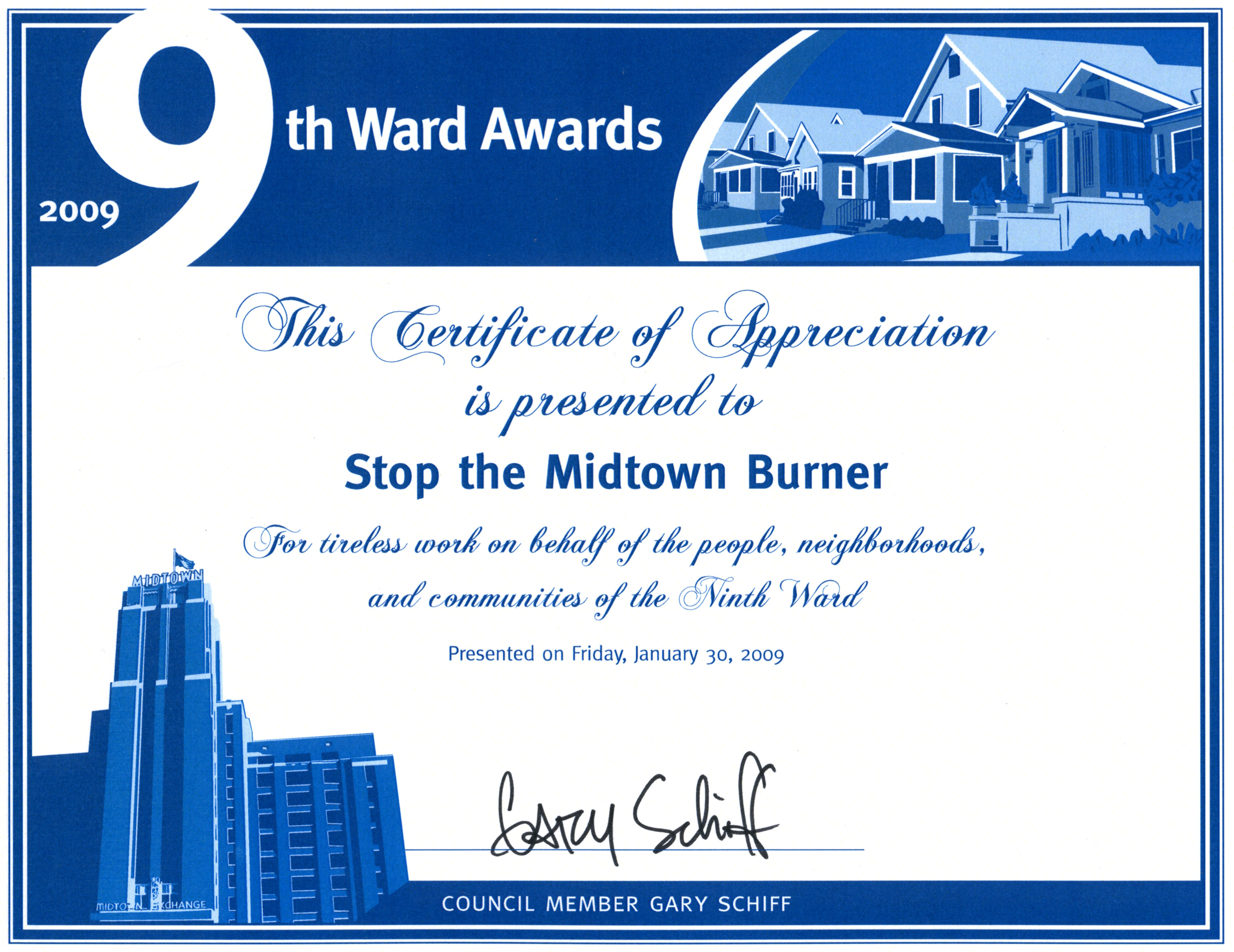
It’s dark and hard to see… but the good news is clear — The Minneapolis 9th Ward Award for Neighborhood Project of the year went to all of us who worked against Kandiyohi’s Midtown Eco-Energy incinerator, or as I call it, the Midtown Eco-Crapper.

DRUM ROLL, PLEASE…. the 2009 9th Ward Neighborhood Project of the Years is:

Stop the Midtown Burner

Each year, there are awards for Project of the Year, Leader of the Year, Youth Leader of the Year,  Block Club of the Year:

CLICK HERE FOR PAST AWARDS

This year’s Award for Neighborhood Project went to “Stop the Midtown Burner” which was a project involving several groups and hundreds of individuals who all got together and made sure this project went down in flames 9as all burner projects should!).

Hearing of the Award, one instrumental fighter said:

After that meeting in the library [August, 2007], I thought it was late in the game, maybe too late, but people stepped up to the plate, worked through personal differences, and made it happen.

That’s something to celebrate…..

And another instrumental fighter said:

They did not know who they were messin’ with — HAH! SO THERE!
TAKE THAT! AND THAT AND THAT! YOU BIG BULLIES!!!

Here’s the Stop the Midtown Burner award:
stopmidtownburner

GO TEAM GO!!!

mapptransmissionoverview

Delmarva Power has been hosting meetings about its proposed Mid-Atlantic Power Pathway.   The next meeting is:

Wednesday, February 4 @ 6 p.m.

Millsboro Civic Center

322 Wilson Highway

This is an electrical superhighway through Delaware, the map makes that much clear.

What’s interesting is that Rep. Tom Carper seems to be taking an enlightened and informed position on this:

Carper said the question of the power line needs to be considered in a larger context. He harkened back to the construction of Del. 1 to handle an increase in north-south travel, noting that along with the new road came a look at expanding public transit, car-pooling, and other alternatives to driving.

“Upgrading power lines on the Delmarva Peninsula may be necessary, but I hope Delawareans will take this opportunity to look not only at where a power line might go, but also at how they could help reduce the need for a new line in the first place,” Carper said.

Today, there’s a long piece in the News Journal about it, with the above quote from Carper:

Power-line plan stirs environment fears

Bluewater Wind hails pathway for clean energy

By AARON NATHANS
The News Journal

Environmentalists are divided over the merits of a Pepco Holdings plan to string a 500-kilovolt power line through the heart of Delaware to better connect southern power plants with growing demand in the mid-Atlantic region.

Pepco’s proposed Mid-Atlantic Power Pathway would be like an interstate highway of electricity, designed to make more space on the often-choked power grid for electricity to flow to growing population centers on the East Coast.

Clean-air advocates say it could help carry clean wind power to the homes and businesses that need it, even as they worry it will also import dirty coal-fired power from the South and Midwest.

Wildlife and property-rights advocates are afraid the line will be a blight on the landscape, running through fragile areas along the Delaware River and Bay.

The most controversy in Delaware about the power line, which is now being examined by the public in a series of public hearings, is likely to focus on an eight-mile stretch of land in southern New Castle County.

The utility would need to acquire an easement through an area near the Delaware River that includes many wetlands and state-designated critical natural areas.

Officials at Pepco Holdings, the parent company of Delmarva Power, said the specific path there has not yet been chosen.

The planned power line would start in Dumfries, Va., cut through Maryland and across the Chesapeake Bay, then run through southern Delaware to the Indian River Power Plant. The line then would continue up the length of the state and across the Delaware River, ending in Salem, N.J.

It’s one of several large lines planned in this region to shore up electrical reliability. Utility officials say it’s especially needed on the Delmarva Peninsula, where power lines currently run only from the north. This would add a second path from the west.

Although power demand is down because of the recession, utility representatives say that won’t last, and demand will one day overtax the existing grid.

By connecting three regional nuclear power plants, the new high-capacity line will spread power along the coast as well as bring in power from the coal-rich Midwest.

The $1.425 billion line is expected to add 40 cents to the average residential monthly electric bill. The costs would be borne by all electric users in the 13-state PJM Interconnection regional power grid.

The immediate need for the line is to move current through Delaware, but it also could be a useful outlet for the thousands of megawatts of renewable electricity that could one day be generated by wind turbines off the state’s coast, said Joseph Minott, executive director of the Clean Air Council, an area environmental group.

Bluewater Wind plans to build a small wind farm off Rehoboth Beach and sell the electricity to Delmarva Power, but the firm also hopes to expand that farm in the future to feed more power to the grid.

If the transmission grid is strong enough, Delaware could export power throughout the region, Minott said, explaining why he favors the project.

“If you’re going to create a vibrant market for wind energy, you need to be able to transmit it further than the town at the end of the beach,” said Minott, who added that he had “trepidation and concerns” about the lines being used also to expand the reach for coal-generated power.

Rob Gramlich, policy director for the American Wind Energy Association, said a better transmission system is needed for onshore wind farms to carry their output to the wider populace.

Offshore wind is different, he said. Although it’s more expensive than onshore wind, its appeal is in its proximity to population centers, he said. It doesn’t take very many miles of transmission to get the power where it’s needed, he said — a problem for generators of wind power in the nation’s more sparsely populated heartland.

Nick DiPasquale of Delaware Audubon said he would rather see small, localized, mainly renewable power sources instead of big lines that carry power from big coal-burning power plants. He’s concerned about where the Power Pathway would go.

“If it means converting protected land to developed land — even if the profile is relatively small — I would find that a very troubling precedent,” he said.

Utilities lose power when current is transmitted over long distances, said Carol Overland, a Minnesota attorney and electrical consultant who has been active on Delaware environmental issues. She said conservation and renewable-energy projects, using the existing power grid, should be sufficient.

State Sen. George Bunting, D-Bethany Beach, expressed concern that electromagnetic force, or EMF, from power lines has been investigated as a cause of childhood leukemia.

In a letter to Sen. Tom Carper, D-Del., he wrote, “There is a grave concern amongst many Delawareans” about the line.

The Centers for Disease Control and Prevention says there is no scientific consensus on the health effects of EMF.

Pepco Holdings owns the rights to much of the land it needs. It’s planning to build the larger line along a right of way that already features smaller power lines.

But within the section of the line that runs from Indian River north to Salem, there will be areas where the right of way needs to be widened, the utility has said.

And there’s a yet-to-be-specified section in southeast New Castle County where the Pathway would break from the existing power line along Del. 9 and head toward the Delaware Bay, where it would cross and connect with the Salem/Hope Creek nuclear plant.

That will require Pepco Holdings to acquire eight miles of new right of way, company officials said last week.

“Whether it’s dry land, wet land, high land, I wouldn’t want to answer that question right now,” said Vince Maione, pathway project manager for Pepco. He added that the company wants to minimize impacts on the environment and the population.

PJM is still reviewing Pepco Holdings’ application for the portion of the line running north from Indian River. Once that confirmation comes, Pepco Holdings will develop the path in greater detail, Maione said.

To cross the Delaware River, the utility wants to build a second overhead crossing, about six to eight miles south of its current line.

The company has not been in touch with Delaware landowners regarding easements, said Matt Likovich, a Delmarva spokesman.

Delaware state government has little control over the portions of the line for which Delmarva already has rights of way. Unlike in Maryland, this state’s Public Service Commission does not have the authority to approve the location of a transmission line.

One of the few categories where state government has oversight is where a planned power line would cross natural areas like bodies of water and wetlands. Pepco Holdings has not been in touch to request a permit, said Philip Cherry, a state Department of Natural Resources and Environmental Control policy manager.

But Delmarva lacks leverage, at least on the state level, when it comes to expanding beyond its rights of way.

The state eminent-domain law doesn’t give the utility the right to seize land for a power project. Likovich said if the company can’t reach an agreement with a landowner, “we will have to construct the line by going around the property in question.”

But the utility may hold a trump card: the U.S. Energy Department last year designated Delaware part of a region where the federal government can order an electricity project finished if states fail to do so.

Delmarva officials say they’ll work hard to negotiate with landowners to avoid the issue of eminent domain.

“It doesn’t benefit anyone to take anyone’s land,” Maione said. Pressed about whether the utility would be OK with the government seizing land for the project, he said, “We’ll have to cross that bridge when we come to it.”

Meanwhile, in Sussex County, Pepco Holdings held a community meeting in Gumboro on Thursday night, attracting 50 members of the public. The next meeting is Wednesday night in Millsboro.

Carper said the question of the power line needs to be considered in a larger context. He harkened back to the construction of Del. 1 to handle an increase in north-south travel, noting that along with the new road came a look at expanding public transit, car-pooling, and other alternatives to driving.

“Upgrading power lines on the Delmarva Peninsula may be necessary, but I hope Delawareans will take this opportunity to look not only at where a power line might go, but also at how they could help reduce the need for a new line in the first place,” Carper said.

He said that could come by saving electricity, installing solar panels on their homes, adding insulation, purchasing Energy Star appliances, or taking other steps to save electricity.


Additional Facts
IF YOU GO

The next community meeting about the power line will be held Wednesday at the Millsboro Civic Center, 322 Wilson Highway, 6 p.m.

xcel-logo

Poor Xcel, getting picked on… a City of Minneapolis resolution to delay the route application for the Hiawatha Project transmission line, and a unanimous preference for undergrounding if it should be built.  SNORT!

LET’S SEE THE SOUTH MINNEAPOLIS LOAD SERVING STUDY (which the Hiawatha Project is supposedly based on) and the SOUTH MINNEAPOLIS ELECTRIC RELIABILITY PROJECT STUDY which is shooting in a 345kV line from Hwy. 280 to the new Hiawatha substation… “100 MW need” my ass…

Here are 16 questions posed by Midtown Greenway to Xcel and 9 answers:

List of 16 Questions for Xcel

9 Answers from Xcel

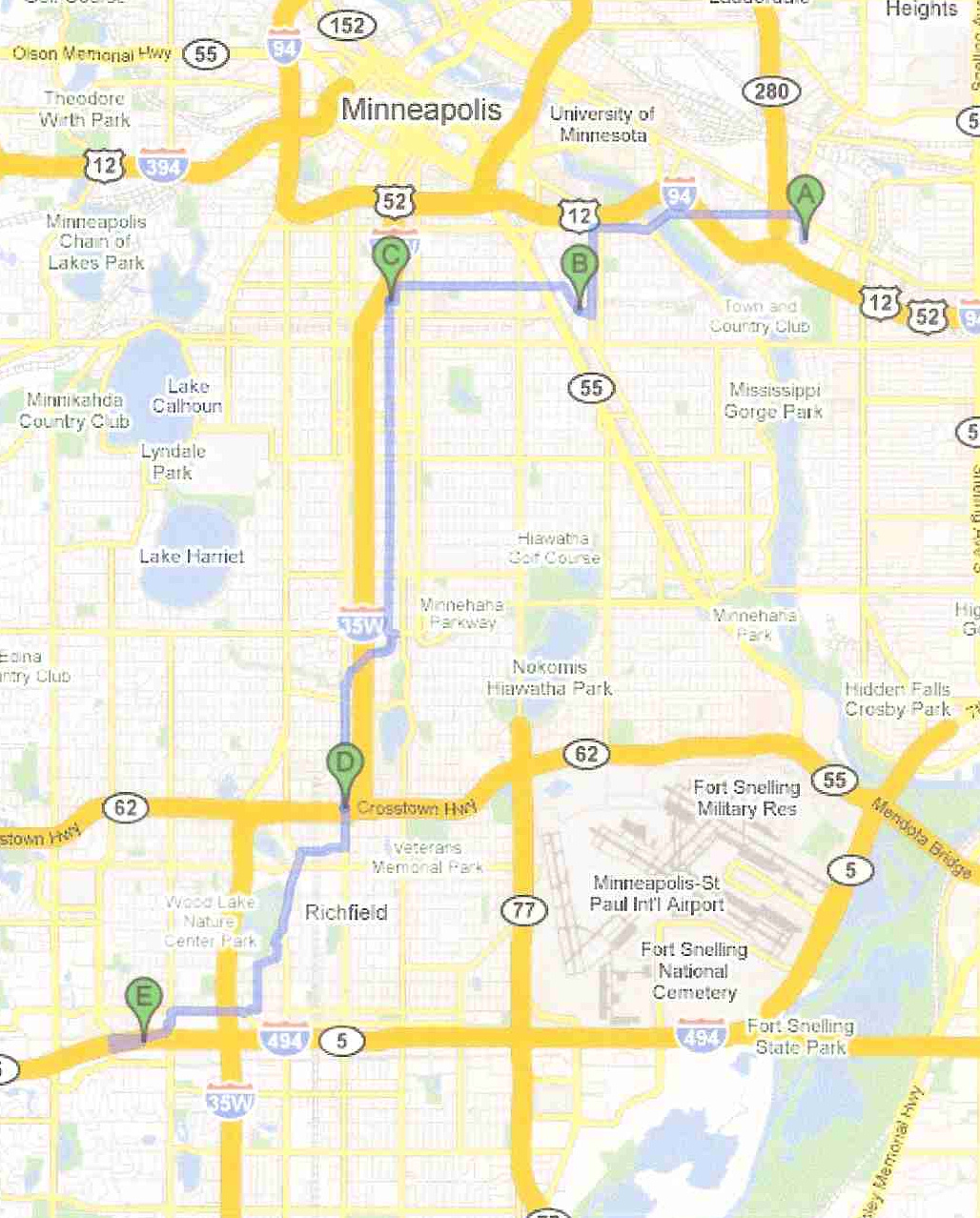
Piecing together studies found on line, here’s what I think Xcel is up to:
hiawathaprojectplusmap-31

Xcel’s plans for power line run into opposition

By STEVE BRANDT, Star Tribune

January 26, 2009

A resolution asking Xcel Energy to delay its proposed high-voltage transmission line in south Minneapolis and offering an alternate route advanced Monday at City Hall.

The resolution sent to the full council is a rebuff to Xcel’s preferred route for the power line along the rim of the Midtown Greenway recreational corridor.

It was approved without opposition by the council’s Health, Energy and Environment Committee and is due for a Feb. 6 council vote.

The language approved Monday asks Xcel for more study of electrical needs in the central Lake Street corridor that the line would bisect and urges that alternative ways to supply those needs be investigated.

Bury the line?

But if the line is needed, it should be buried under E. 28th Street, according to the resolution by Council Members Gary Schiff, Robert Liligren and Cam Gordon. Xcel has said burying the line would add nearly $16 million to the cost.

Xcel spent much of its presentation arguing that localized power-generation projects or conservation measures alone won’t come close to negating the need for an additional 100 megawatts of power to the area to assure reliable service.

The utility proposes to build the line mostly on the south rim of the greenway, crossing its bike and walking paths four times.

The $15 million project would also include a substation on the east side of Hiawatha Avenue at 28th, where an existing transmission line now runs, and another on Oakland Avenue.

The Midtown Greenway Coalition, an advocacy group for the corridor, also has opposed Xcel’s preferred route and has sought more study of alternatives.

Betty Mirzayi, Xcel’s project manager, said the company forecasts growth in demand for electricity of 1.5 percent annually for the area to be supplied by the proposed line.

She called the proposed line essential to meeting demand caused by redevelopment in the area that has “stretched our capacity to the limit.”

Wanting more proof

But speakers among the many residents who appeared in support of the resolution said they want more proof that the power line is the only way to improve service.

They also argued that the line would stunt planned housing development along the greenway because potential residents would be leery of living near the line.

One legislator, Rep. Karen Clark, DFL-Minneapolis, said later Monday she’s considering legislation that would require additional analysis by the state and Xcel of any health effects associated with the high-voltage line in areas with high poverty or high minority concentrations, which describes portions of the proposed route.

Mirzayi said the permitting process, which will be under the authority of state agencies, provides an arena for analysis of the issues raised by those opposed to the line. Xcel plans to submit its proposal to the Minnesota Public Utilities Commission by the end of March and wants to begin using the new facilities in the first half of 2011.

Take your transmission line and go home, Xcel…

midtown_greenway-11

bigstoneiiproject1

EEEEEEE-HAAAAAAAA!  A big stake in its slimy little heart…

Hot off the press from Sierra Club and Clean Water Action, who have been working tirelessly against Otter Tail Power’s Big Stone II coal plant, the Big Stone II air permit is upende

Big Stone II – EPA Objection to Air Permit

Here’s their press release in toto:

FOR IMMEDIATE RELEASE:

CONTACT:

Virginia Cramer, Sierra Club 804-519-8449
Darrell Gerber, Clean Water Action 612-802-5372

Date: January 23, 2009

Big Stone II Sent Back to the Drawing Board
U.S. Environmental Protection Agency Concerned About Pollution, Global Warming

Washington, DC – Less than three days after the Bush Administration left office, the Environmental Protection Agency (EPA) has overturned the State of South Dakota’s approval of the massive Big Stone II coal-fired power plant.  The EPA’s decision comes after the state failed to require state-of-the-art pollution controls for the coal plant that would address concerns about harmful soot, smog and global warming pollution.

“This is a great day not only for clean energy and people’s health, it’s a victory for the rule of law,” said Bruce Nilles, Director of the Sierra Club’s Move Beyond Coal Campaign. “EPA is signaling that it is back to enforcing longstanding legal requirements fairly and consistently nationwide,” added Nilles.

As the first major coal plant decision by the EPA since President Obama took office, this decision signals that the dozens of other coal plant proposals currently in permitting processes nationwide will face a new level of federal scrutiny. Sierra Club and Clean Water Action have been working to stop the Big Stone II project and ramp up clean energy investments in for more than three years.

“Today EPA took the first step toward restoring science and integrity to its work and recognizing the very real need to reduce air pollution from coal-fired power plants,” said Darrell Gerber, Clean Water Action Program Coordinator.  “Downwind residents and the region’s natural resources will be better protected.”

This decision likely spells the end of Otter Tail Power’s Big Stone II coal plant.  While for the past eight years the Bush Administration has refused to regulate global warming pollution, even after being ordered to do so by the US Supreme Court, President Obama has pledged that the US will cut global warming pollution and do its part to avoid the worst consequences of climate change. With coal-fired power plants accounting for almost 30% of our nation’s carbon dioxide emissions, burning less coal and investing in clean energy such as wind and solar instead is a common sense approach to helping meet global warming pollution reduction goals. The proposed Big Stone II 500-megawatt coal plant would have emitted more than 4 million tons of global pollution annually.

At a minimum, Otter Tail Power will have to go back to the drawing board and redesign the project to incorporate the best and maximum available control technology for pollution like soot and smog.  Sierra Club and Clean Water Action will be pushing for EPA to set limits also for carbon dioxide, the main contributor to global warming.

“Otter Tail Power will now have to be responsible for the cost of its pollution,” said Nilles. “We hope that this increasing cost of coal will encourage Otter Tail Power, along with Governors Pawlenty and Rounds, to harness the clean and affordable wind resources available in the region. Minnesota and South Dakota should be leaders on the path to renewable energy independence, not laggards proposing 19th century coal plants.”

###

Now, can we get them to end Excelsior Energy’s Mesaba Project?


Gas in wells in Dimock Twp. PA

January 22nd, 2009

A while back, in Dimock, PA, a woman’s well blew up just a little down the road from where they were doing gas drilling… funny how that works.  Now it seems they’re admitting a relationship between the two, and are giving people water, those who took their water, shook it up, and LIT IT!  They “just felt unsafe,yeah, I guess…  It seems it’s taking a LONG time for anything to happen here.

“Dimock residents, meanwhile, are learning what it’s like to live over the middle of a developing natural gas field.”

From: Wells tested, cause of explosion sought in gas exploration in Susquehanna County

Yeah, just a bit of an understatement…

norma9619920_bg11

Breaking news: Gas mining company provides water after methane found in private wells

By Laura Legere
STAFF WRITER

Published: Thursday, January 22, 2009 12:47 PM EST

DIMOCK TWP. — Cabot Oil and Gas installed fresh water supplies this week at four residences where methane has been found in private water wells.

The company, which is extracting gas from the Marcellus Shale in the region, also hired a water well installer to inspect wells at two additional residences today where the state Department of Environmental Protection has found a “significant presence” of gas, a Cabot spokesman said.

The actions come as part of an ongoing investigation into the cause of an explosion that blew apart a concrete slab above a water well in a township resident’s front yard on Jan. 1. In the weeks since the blast, DEP, Cabot and the local fire department have inspected about a dozen homes for the presence of gas and have taken samples from at least six wells that indicated gas in vapor form had gathered in the well casings. So far, no gas has been discovered in homes or basements.

The Cabot spokesman, Kenneth Komoroski, said the company decided to install temporary water tanks at the four homes after hearing reports that residents were able to light gas vapors– causing a “puff of flame”– after they captured, shook, then uncapped a bottle of their well water.

“The residents all had a concern about using the water and just felt unsafe, so we decided to supply them with a water supply while we investigate the situation,” he said.

The Department of Environmental Protection has not determined the provenance of the gas in the water wells, but Mr. Komoroski said “Cabot is not ruling out the possibility that its activities could have caused or contributed to the presence of gas in the water supply.”

DEP is currently analyzing laboratory results for both water and gas samples taken by department inspectors this month, DEP spokesman Mark Carmon said this week. The analysis may reveal the geology where the gas originated.

Mr. Komoroski said Cabot has hired a hydro-geologist to help evaluate how gas might be migrating into the water supply. Cabot crews are also working on a gas well site today near the four affected homes on Carter Road “to evaluate whether or not that’s a pathway,” Mr. Komoroski said.

“We felt it best to take a step back and take a comprehensive look,” he said.