New York Regional Interconnect WITHDRAWN!!!
April 3rd, 2009
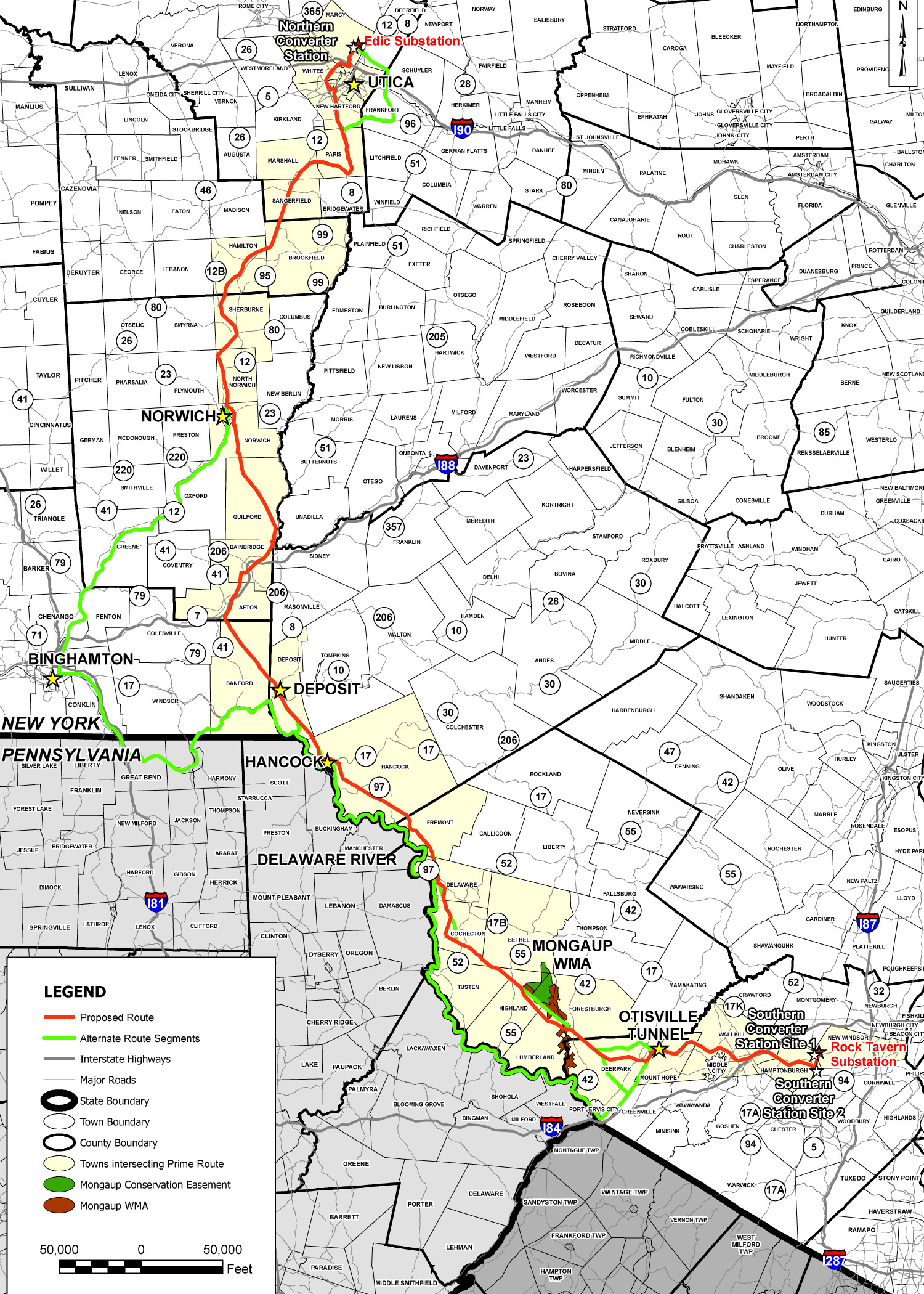
TRANSMISSION INTERRUPTUS
The New York Regional Interconnect has been withdrawn… withdrawn in the middle of cross-examination… like WOW!
This from a missive from Troy Bystrom, Project Manager for Communities Against Regional Interconnect (CARI) just a bit ago:
WE WON!!! NYRI PROJECT WITHDRAWS APPLICATION!!!
Today following a mid-day break in the Article VII certification proceeding, NYRI announced it will withdraw its application from consideration by the Public Service Commission. Counsel for NYRI explained that in the wake of a decision by the Federal Energy Regulatory Commission earlier this week, NYRI’s investors decided to end their pursuit of an Article VII Certificate of Environmental Compatibility and Public Need. Earlier this week, FERC denied NYRI’s request for rehearing in a proceeding relating to the recovery of transmission system upgrade costs.
The announcement that NYRI is withdrawing its application occurred in the midst of cross examination of NYRI Witnesses and immediately following CARI’s cross examination on demand side management and economics.
The presiding officers asked NYRI to confirm in writing their withdrawal no later than Monday, April 6, 2009. The Judges also made clear that if NYRI were to seek approval for a similar project in the future, NYRI would be required to once again start at the beginning of the Article VII process.
Communities Against Regional Interconnect, on behalf of the counties of Sullivan, Orange, Delaware, Broome, Chenango, Madison, Oneida, Herkimer, Otsego and the Upper Delaware Council, Stop NYRI, Upper Delaware Preservation Coalition, Say No to NYRI and the Upstate New York Citizens’ Alliance, would like to thank all of those who participated in opposing this ill-conceived Power Line Project in our region.
Thank you to everyone who sent donations, wrote letters, provided testimony, attended public meetings, County planning departments, communities, legal experts, the Attorney General’s Office, DEC, Department of Public Service, consultants, media, organizations, activists, local, state and federal elected officials who all participated in this unprecedented regional effort.
Together, we made a difference. However, the work is not over! We must secure intervener funding to protect the public interest if similar projects are proposed in the future and make sure the 4th District Court’s decision regarding FERC’s authority is not overturned!
And from Scott Olson, of Susquahanna-Roseland “Route B” fame, here’s a collection of today’s news flashes about it:
* APRIL 3, 2009, 4:21 P.M. ET
NY Regional Interconnect Suspends 190-Mile Transmission Project
-By Ian Talley, Dow Jones Newswires; 202-862-9285; ian.talley@dowjones.com“FERC’s March 31 ruling essentially admits that the process may be biased, but it chose not to intervene,” the company said in a statement.
Officials from FERC and NYISO weren’t immediately able to comment.
… and on the scene, from the Pike County Courier:
NYRI calls it quits — the flying horse is dead
National Park Service on Susquehanna-Roseland transmission
April 2nd, 2009
Susquehanna-Roseland is but a small part of a much bigger plan:
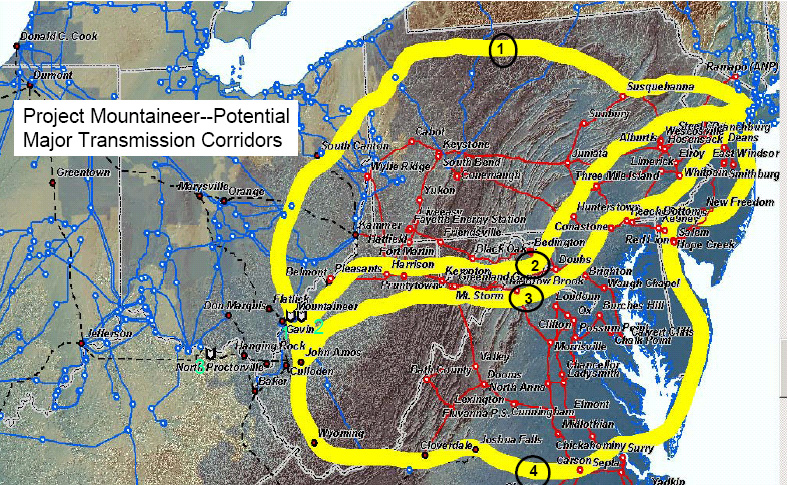
For more information on the Ssuquehanna-Roseland transmission line, see:
STOP THE LINES
The National Park Service seems to be taking a rational approach — a thorough review of impacts on public lands:
National Park Service plans power line study
bscruton@njherald.com
The National Park Service wants a full environmental impact study done on how construction of new 500-kilovolt electric transmission lines will affect the Delaware Water Gap National Recreation Area, the river itself and the Appalachian Trail, a designated national heritage trail.
Just more than four miles of the proposed route crosses through the recreation area on its way from Susquehanna, Pa., to Roseland in Essex County. The Pennsylvania section is being proposed by PPL and the New Jersey section would be built and owned by Public Service Electric & Gas, the state’s largest power utility.
The National Park Service had the option to cede oversight to the utility-regulating agencies of the two states, but announced that “the NPS will adhere to its own regulatory and approval process” regarding the lines.
The proposed route follows an existing right-of-way which contains 230-kilovolt lines which were built in the late 1920s and pre-dates the recreation area. But when the federal government purchased the properties, it also became the party to the rights-of-way. In addition, to construct the new towers, the utilities will need additional, temporary rights-of-way.
Construction over environmentally sensitive areas along other parts of the route has given rise to much of the public opposition to the project.
Read the rest of this entry »
Mesaba spinnin’ it against gravity
April 2nd, 2009

THE MESABA PROJECT IS DEAD, DEAD, DEAD! Coal gasification is not happening. IGCC ist zu ende! How many silver stakes through its slimy heart will it take?
Once more with feeling:
This is from Charlotte Neigh, Co-Chair of Citizens Against the Mesaba Project, who, having reviewed the recent spin-doctoring of Excelsior Energy, and their tentacle-reach toward Minnesota Municipal Utilities — they’re trying to make it look like they’ve got something they haven’t got:
It is not correct to say that the federal government would back 73 percent of the total cost, or that the federal government has “pledged” $800 million in loan guarantees, or that municipal utilities would have to raise only 27 percent of the project costs to secure ownership of Unit 1 of the Mesaba Project.
Excelsior Energy has not yet been awarded any loan guarantees. It is one of eleven final applicants to share in a pool of $4 billion. Excelsior admits that its negotiations with DOE will continue throughout 2009. DOE stated in October 2007 that projects relying upon a smaller guarantee percentage will be given greater weight. Despite this statement, Excelsior repeatedly misled the media and even the PUC about the status of the loan guarantees, suggesting that they would cover 80 percent of the project costs.
Apparently Excelsior is now seeking 73 percent but this is a long way from becoming reality. A key requirement for qualifying is to have an assurance of revenues to be generated from sale of the product. This means a long-term commitment from a customer to purchase the energy. This is why the failure to achieve a PPA with Xcel Energy is critical. Other obstacles are DOE requirements for: credit assessment without a loan guarantee; approval of environmental and other permits; reduced greenhouse gases; and relative amount of cash contributed by the principals.
Now Excelsior is trying to entice municipal utilities into purchasing ownership interests by suggesting that 100 percent ownership can be obtained by raising 27 percent of the costs. Municipal utilities should carefully assess the likelihood that this amount or any loan guarantees at all will be awarded for the Mesaba Project before issuing bonds to finance such a purchase.
More information and analysis about the federal loan guarantees can be found by scrolling down to the October 8, 2007 entry on the CAMP website: www.camp-site.info/
Charlotte Neigh, Co-Chair
Citizens Against the Mesaba Project
Here’s an example of the bogus spin, from Business North — note she can’t even get the announcement time-frame right… Excelsior announced Mesaba in December, 2001, that’s EIGHT years ago:
No customer for controversial energy project
Excelsior Energy targets municipal PUCs in search for a buyer as key May 1 deadline looms.
4/1/2009
by Beth BilyAbout six years ago in the wake of the permanent closing of LTV Steel Mining in Hoyt Lakes, momentum began to develop behind a project concept, one since celebrated and renounced.
That proposed Mesaba Energy project with a price estimated at $2 billion has moved through various phases of public review to a potentially new location further west. Along the way it has become one of the most vigorously debated economic development initiatives proposed for Minnesota’s Iron Range.
Meanwhile, an important deadline looms that could make or break the project. The Minnesota Public Utilities Commission had ordered talks between Mesaba’s parent, Excelsior Energy, and power giant, Twin Cities-based Xcel Energy. The two sides were directed to negotiate a Power Purchase Agreement (PPA) for the approximate 600 megawatts of electricity Mesaba’s proposed Unit One would produce. That ordered negotiation period ends on May 1 and there is no evidence an agreement will be reached.
GSDs – out from under CapX 2020!
April 2nd, 2009
Here are the most adorable German Shepherds, available now. Just so happens that they’re in the planned CapX 2020 transmission preferred route, in a substation siting circle! So, rather than “Buy the Farm,” get these little grrrrrrrls away from CapX! “Buy the Shep!” They’re all females and are such sweeties. They’re from a litter of 11, 2 males and 9 females, and now there’s only 6 looking for homes. They’re just west of New Prague, at Union Hill.
GERMAN SHEPHERD PUPS 8 wks, 6 F healthy, farm rsd, both parents on site $450
952-393-1121 952-564-1082


Xcel not happy camper
April 1st, 2009

April Fools! Well, maybe not…
The Prairie Island Nuclear Generating Plant uprate and dry cask docket is sparking a bit, warm, and maybe getting hot!
Just in, this Xcel Energy response to City of Red Wing’s Intervention and request for extension of schedule:
Here’s Red Wing’s Motion, filed with their Intervention, that’s got Xcel hopping:
In Xcel’s letter, you can feel them jumping and twitching…
