City of Red Wing asks the right questions
April 25th, 2009
Remember Xcel isn’t too happy about the City of Red Wing intervening? See “Xcel not a happy camper” from last month.
Maybe it’s because Red Wing has a stake in this, as host to Xcel’s Prairie Island nuclear generating plant.
Here we see that in Information Requests in the Prairie Island uprate and dry cask docket at the PUC, the City of Red Wing is asking the right questions:
Here’s a couple that I find extremely amusing, starting with IR-21:
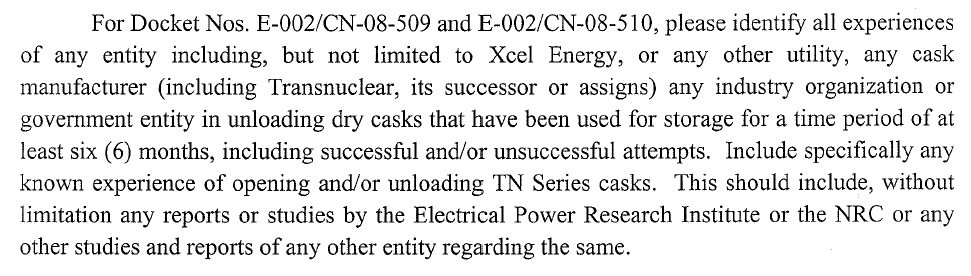
or this one… IR-22:

and IR-23:

and IR-24:

Yes, we are having fun now.
I wonder… will they give the City of Red Wing a copy of EPRI’s “The TN-24P PWR Spent-Fuel Storage Cask: Testing and Analyses” report? That’s EPRI report NP-5128. Let’s see the results of that “Three Stooges” INEL unloading attempt where the assembly got stuck half out, half in, and wouldn’t move… HILARIOUS, I’ve never seen such a rip-snortin’ report, hard to read between the lines without busting a gut!
David Morris on PUC process and Capx 2020 decision
April 24th, 2009
Once more, it’s David Morris, Institute for Local Self Reliance, telling it like it is. The PUC process is long over do a complete revamping. It is based on laws and rules that grew out of the 1970s-1980s transmission fights, and gave people a useful and meaningful way to participate in these proceedings. But that’s gone, gone with the 2001 changes, gone with the 2005 Transmission Omnibus Bill from Hell, and we’re left with just about nothing. In other states, there’s Intervenor Compensation which allows Intervenors the ability to pay for expert witnesses, there are free transcripts as a matter of course, and there’s encouragement and support of Intervenors, not a drive to push them out of the process that we see here, that we saw in this CapX proceeding, when the ALJ tried to boot out U-CAN; that we saw in the Excelsior Energy docket (scroll down to “Fourth Prehearing Order”).

David Morris: If it’s citizens vs. utilities, utilities win
The PUC has an approval process that stacks the deck against the public.
By DAVID MORRIS
Last update: April 23, 2009 – 6:50 PM
A few days ago, the Minnesota Public Utilities Commission (PUC) approved a massive high-voltage transmission project known as CapX that will cost Minnesotans an amount equal to the projected biennial state budget deficit and four times the total bill to taxpayers for the Twins and Gophers stadiums.
With respect to the stadiums, Minnesotans were able to actively participate in the decisions, both directly and indirectly through elected representatives. Both those in favor and those opposed to using tax dollars to pay for the stadiums engaged in a spirited public debate. The Legislature is currently just as vigorously debating ways it can eliminate the budget deficit.
The PUC process, on the other hand, is much more hostile to citizen participation and influence. Indeed, the deck is stacked against the average citizen. Utilities have a virtually unlimited budget to argue their positions — a budget they raise from their ratepayers. Citizens, on the other hand, must raise their own money, and lots of it, to participate effectively.
The rules under which the PUC operates are established by the Legislature. Utility lobbyists are powerful there. But they’re not all-powerful. Thus, over the years, Minnesotans have been able to enact rules to help level the playing field for citizens. For example, the law requires the PUC to reject an application to build a large power plant or a high-voltage transmission line unless the utility proves it is needed to improve reliability or meet increased demand or achieve renewable-energy goals. As part of the application, the utility is expected to thoroughly and completely explore alternatives to its proposal, including no-build options. The burden of proof on whether a project is needed rests with the utilities.
The PUC, regrettably, has interpreted this rule so as to turn it on its head. At the PUC, the burden of proof rests with those opposed to a new power plant or high-voltage transmission line. It is up to the people whose homes and farms may be seized by utilities if a project is approved to make the case for alternatives. Doing so requires an extremely high level of technical expertise. A serious technical and economic examination of alternatives can cost $100,000 to $200,000 or more.
Even if citizens are able to raise that kind of money, they face other hurdles. To analyze alternatives, they must access data that only utilities possess. In many cases, the utilities call that data proprietary and argue that to make the information public is to give a possible advantage to a competitor. One would think that this would be a hard argument to make. After all, Minnesota utilities have a monopoly on the sale of electricity. Apparently, however, it is not a hard argument to make at the PUC.
A formal proceeding, such as a judicial proceeding, involves the cross-examination of witnesses. In many proceedings, utilities again tax their customers by using ratepayer money to acquire a transcript. One would think that since the transcript is in electronic form, the PUC would post it and make it freely available to the public. Astonishingly, the PUC rules state that court reporters own the transcript! Citizens and other intervenors must pay for their own copies of transcripts, which, for controversial projects, could mean $5,000 to $10,000 per copy.
In the recent CapX transmission case, the PUC went one step further in denying citizens. The need for the transmission lines was based in large part on a projection of significantly increasing demand. That projection was largely made in forecasts completed in 2004. It has already proven to be vastly overstated. Moreover, the current economic collapse is translating into shrinking, not growing, electricity demand. Hundreds of citizens asked the PUC to take this new information into account and keep the proceeding open. The PUC decided the current economic free fall doesn’t make a difference.
Utilities are gearing up to ask the PUC to spend billions more for even higher-voltage transmission lines. These will be built to send electricity from the Dakotas to Chicago and New York while running right through Minnesota. If these lines are approved, Minnesotans will probably pay most of the costs, while receiving little if any benefit.
Imagine if legislators proposed taxing us to build a sports stadium in Chicago. The proposal would be dead on arrival. Citizens have influence and even power in the Legislature. The process and rules at the PUC must be redesigned to allow them similar access and influence over energy decisions.
David Morris is vice president of the Institute for Local Self-Reliance, based in Minneapolis and Washington, D.C.
First Dog!
April 24th, 2009

Looks like somebody needs a Gentle Leader!
Can you tell I’ve been dealing with mother stuff? It’s like taking on a part-time job, nearly full time, something every day and sometimes all day. AAAAAAAAAGH! So this has been suffering, and there’s a lot of good stuff waiting. SO, let’s see how the next hour goes and what gets posted…
PJM demand decrease 3.6%
April 16th, 2009
A quick post before heading off to the PUC for more CapX 2020…

A new little birdie sent some delightful PJM info, all about decreased demand, keep in mind, this is 2006-2007, and NOTE IT WAS ALREADY DROPPING THEN.
From FERC – Electric Power Markets PJM:
All time peak demand: 144,644 MW (set August 2, 2006)
Peak demand growth (2006-2007): Peak demand declined 3.6%
| 2006 | 2007 | |
|---|---|---|
| Summer Peak Demand (MW) | 144,644 | 139,438 |
| (Source: PJM) | ||
There, you’ll find PJM State of the Market, Vol. 1 & 2
PJM State of the Market Report Volume 1
Pg 12: “Aggregate supply increased by about 15 MH when comparing the summer of 2008 to 2007 while aggregate peak load decreased by 9,328 MW …”
Pg 22: ” In the Real Time Market in 2008 there were net exports at 16 of PJM’s 20 interfaces …”
Pg 31: “Imports & Exports Net exchange decreased 248.5 MW …..)
Pg 45 : ” Demand … It is not clear why the demand identified in the market solution is consistently less than the demand identified by the system operators.”
Pg 50: discussion on Congestion & its costs
PJM State of the Market, Vol. 1
PJM State of the Market, Vol. 2
adsfad
Bent Tree Wind and Safe Wind in Freeborn County
April 13th, 2009
In the news in Albert Lea!
Wind farm group forms
Safe Wind in Freeborn County now is an official entity
By Tim Engstrom | Albert Lea Tribune
Published Monday, April 13, 2009
A group in Freeborn County has concerns with the setbacks for the proposed Bent Tree Wind Farm, the health impacts of living close to wind turbines and the route planned transmission lines need to connect the turbines to the power grid.
“It is not safe to put this size of turbines by residents,” said Katie Troe, a resident of rural Clarks Grove who is spearheading a group called Safe Wind in Freeborn County.
She said the advocacy group doesn’t oppose wind farms so much as opposes having them close to residences. It started last November with a mailing to tell the 381 homeowners in the area of the proposed wind farm that they had until Dec. 3 to comment to the state about the site permit and until Jan. 8 to comment about the certificate of need.
Troe said there is no membership requirement so she doesn’t know how many people are part of the group. But there is another way to estimate it.
The Minnesota Public Utilities Commission’s Office of Energy Security received 28 comment letters for the December deadline. Twenty-five of them were from locals with concerns and who likely had seen Troe’s mailing.
Two letters were from people in state agencies, and one was from Alliant Energy, which owns Wisconsin Power & Light.
Larry Hartman of the Office of Energy Security said it was more letters than most wind farm projects receive. The letters can be found online at the PUC’s site. Many of them are form letters, but a few are original.
In March, Safe Wind got a federal identification number and a bank account and filed as a public safety advocacy group.
Wind turbines rotate at the Top of Iowa Wind Farm near Joice. The Bent Tree Wind Farm is proposed for the Hartland and Manchester area in Freeborn County.
At present Wisconsin Power & Light needs four primary documents for its Bent Tree Wind Farm: a certificate of need from Wisconsin (because the energy the wind farm produces is to be for that state), a certificate of need from Minnesota, a site permit from Minnesota and a conditional-use permit from Freeborn County for transmission lines to connect the wind turbines to the Hayward electrical substation.