PUC’s wind turbine noise docket in the news
August 4th, 2009
It’s out today, Dan Gunderson at MPR has done an extensive piece on the Minnesota Public Utilities Commission “investigation” of wind turbine noise and health impacts, looking at, per the PUC:
The Commission is gathering information to determine if current permit conditions on setbacks remain appropriate and reasonable.
PUC – Notice WITH SERVICE LIST
Here’s the audio — full text is way below:
What concerns me is that, again, they only gave notice of this docket to the wind industry, and not the people intervening or commenting in PUC wind dockets who raised this issue in the first place, and my comment on that to the PUC, urging them t expand the Notice:
Overland Comments – Request for Broader Distribution of Notice
To see the PUC’s wind turbine setback docket, go to www.puc.state.mn.us, click “eDockets” on lower right, and search for docket 09-845.
And here’s the MPR piece in writing:
Wind turbine noise concerns prompt investigation
by Dan Gunderson, Minnesota Public RadioIn Minnesota, those complaints prompted the Public Utilities Commission to investigate.
Soon after they moved in, dozens of wind turbines sprouted in a neighbor’s nearby field.
In Minnesota, a handful of groups have organized to demand tougher regulation. They want the state to require more distance between wind turbines and homes. A report by the Minnesota Department of Health concluded there are potential health concerns.
Read the rest of this entry »
South Heart coal gasification is alive ‘n’ kickin’
August 1st, 2009

The South Heart North Dakota coal gasification is now going to be an ELECTRIC GENERATION plant. DUH! The 800 pound gorilla has just started jumping around the room. This IGCC plant will be up and ready just in time to use CapX 2020 transmission — DUH! And if you’re surprised, you’re in the wrong business.
A change in plant plans
By: Jennifer McBride and Beth Wischmeyer, The Dickinson Press
The plant will be located four miles south and two miles west of South Heart and will be a
coal-to-hydrogen electrical generation plant.
The cost to build Great Northern’s plant is estimated at $1 billion.
Are we going to let them get away with this? I love it when my hunches are right, but I hate it when anyone has the audacity to propose something so utterly stupid as this. It will be hard for them to get it up and running… except who has a power plant application ready to rock (except that it’s a joke, but it takes some time to prove that to the PUC)? Drat… and here I thought Tom would be down in Honduras trying to build Mesaba down there…

Metachem meeting in Delaware City Tuesday
July 30th, 2009
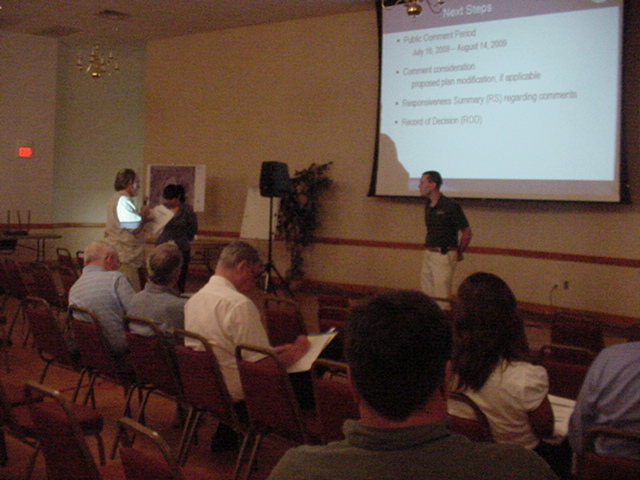
Alan Muller, Green Delaware, questioning and commenting at the meeting
Tuesday night, there was a meeting in Delaware City regarding the “Standard Chlorine of Delaware, a/k/a Metachem Superfund Site.” This meeting was to gather comments on the “OU3 Proposed Plan.”
Here’s a link to the News Journal article about it — and the full story is below:
EPA: Metachem toxins will linger
Comments must be sent in by August 14, 2009, postmarked if mailed by that date, to:
thornton.hilary@epa.gov Hilary Thornton, Mailcode 3HS23 US EPA, Region 3 1650 Arch Street Philadelphia, PA 19103
****************************************
Here are my comments, sent just now:
Now, take a few minutes and work on yours!
****************************************
The way they handle these proceedings, it’s misleading and diversionary, a false, technical compartmentalization of the problem and solutions, which leads to a preordained, incomplete, and probably ineffective “clean-up.” Part of the problem is that it’s not clear that cleaning up is a priority. My impression is that they’re just interested in “dealing with it” in some way, the CHEAPEST way, checking off the “OU3 box” and moving on.
Their plan, their PREFERRED plan, is to cover it up and move on to “OU4.” Their “Preferred Plan” is, direct from their powerpoint slide 8:
2A. Surface Cap/Institutional Controls Impermeable Surface CapInstitutional Controls
- Cap materials TBD during Remedial Design Phase
- Cap materials and thickness would vary depending on future land use
Five-Year Reviews
- Future land use must not interfere with ongoing remedies
Est. $11.5 – 18.5 Million
- Required for any Superfund Site where contaminants remain
Why look! Imagine that! This is the CHEAPEST of the options. All options are “cap” crap, with “materials TBD” and, based on prior past bad experience with DNREC’s “hare-brained” ideas (yes, that’s a direct quote)for “beneficial use” and using coal ash and sewage sludge to cap the dump next to the river:
- I asked whether they’d use coal ash in the “TBD” cover material, and they would NOT commit to rejecting coal ash.
- I asked whether they’d use sewage sludge in the “TBD” cover material, and they would NOT commit to rejecting sewage sludge.
This is where that compartmentalization becomes a problem. They said that was not an issue for “OU3” and that it would be addressed in the “design phase.” Uh-huh, and the public is involved in that exactly HOW? And hello — WHAT the impermeable surface is has much to do with the appropriateness of using an impermeable cover. Rainfall on the impermeable cover will trickle off the cover over the edge, onto and into the ground, groundwater, etc. Even if it’s asphalt, that should be considered. Isn’t the EPA is in the process of addressing coal ash, and a rule pending?
Cost… Their “preferred” option 2A costs $11.5-18 million. The others?
The other options, from their powerpoint:
2B Surface Cap/ICs, with Soil Vapor Extraction Same surface cap and ICs as mentioned in 2A, plus an in Situ SVE system:2B Surface Cap/ICs, with ISTD Same surface cap and ICs as mentioned in 2A, plus in Sit thermal Desorption:
- Est. 200-500 air extraction wells at 50′ depth
- Treat contaminated air from beneath the cap
- treat off-gas from SVE system before discharge
- Additional sampling to identify “hot spots”
- Pilot study first, to test effectiveness
- Est. $19.1-20.2 Million
- Est. 2,800 heater and 1,400 heated vapor extraction wells, 8-12′ apart through 330,000 sq. ft. area
- Additional sampling to identify “hot spots” within 10′ of barrier wall
- Pilot study first, to test effectiveness
- Est. $92.8-99.8 Million
Let’s see… $11.5-18.5 v. $19.1-20-2 & $92.8-99.8. Doesnt’ take a rocket scientist to see that the cheapest “option” is “preferred,” and since when is cost the primary driver? Is this an indication of how they value those living here, drinking the water, breathing the air?
Oh, and did I mention they admitted, finally, that the contamination goes down at least 140 feet! That’s something they haven’t wanted to talk about before.
These options are the only ones looked at, the only ones that are under consideration.
CONSIDER THIS: One other option I want them to consider is to dig up part of the site, the cleaner part, and put a liner down there and take the contaminated dirt from the rest of the site and bury it there with the solid multi-layer liner, and then cover it.
Here’s an example of that in Minnesota, showing that it can and should be done. This is a scenario where it’s been sitting there since before the mid 70s, it has contaminated ground water in Lake Elmo and Oakdale, Minnesota. They’re using three layers of liner over packed clay and another three layers of plastic, plus sand with a collection and draingae system. In the Metachem case, they know groundwater is contaminated, that it’s seeping down, so what, short of this, will stop it? Take a look — Tom Meersman did a very good job on this:
History-making landfill do-over in Washington County
PUC to address setbacks and impacts of wind turbines
July 29th, 2009
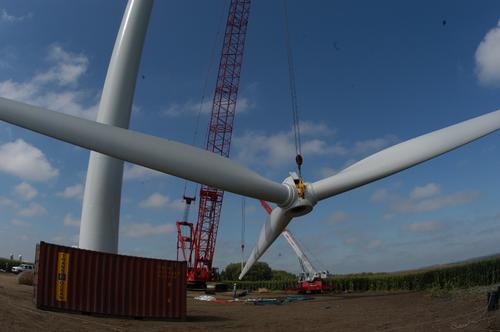
Carleton’s wind turbine goes up (this photo may have been taken by Jonathan Larson, Bruce Anderson or ??? and not moi).
YEAAAAAAAAAA – The Minnesota Public Utilities Commission is going to address the concerns that many groups and individuals have raised about wind turbines, particularly the setbacks required to protect the health and safety of those living nearby. First, the Minnesota Department of Health release a white paper:
Now, following up on that, the PUC has issued notice of a comment period to address “PermitConditions on Setbacks and the Minnesota Department of Health Environmental Health Division’s White Paper on Public Health Impacts of Wind Turbines.” And here’s their notice — LOOK AT WHO IS ON THE SERVICE LIST, LOOK AT WHAT SERVICE LISTS THEY USED:
The service list used are the ones for 04-1616, a docket regarding multi-state tracking and trading system for Renewable Energy Credits; and 03-869, a docket for electric utilities subject to Minn. Stat. 216B.1691. Yup, that really gets it out there, doesn’t it… and the service lists for Bent Tree, Kenyon Wind, Clay County, New Ulm Utilities were NOT used… hence my first comment to be filed!
Overland Comments – Request for Broader Distribution of Notice
It’s very good that they’ve opened this docket, that they even did that White Paper on Public Health Impacts of wind turbines, BUT that they’re only giving notice of this docket to industry parties is problematic to say the least. Let’s do it right, PUC!
California – looking at DG as xmsn alternative
July 27th, 2009
Let’s hear it for California!
They’re getting the message — transmission is not needed and transmission is not wanted. If they try to push it through on the landowners across the state, well, they’re in trouble. And so they did a study of what’s necessary to accomplish their Renewable Energy Standard and here it is.
Here’s a statement from p. 10 of the Executive Summary that leads me to think they’re on the right path — just the simple recognition of this point:
California IOUs are currently on a procurement path that in effect prioritizes long-term market transformation over other policy objectives.
Here’s the full report:
And here’s a Power Point that hits the highlights: