… and PEPCO demand is down too…
August 10th, 2009

(gotta get some mileage out of it, what with the same theme today on NoCapX and Legalectric)
PEPCO’s 2nd Quarter 2009 8-K popped into the inbox today (if you register at the SEC site, they’ll show up the minute they’re filed), and here’s a couple choice graphics:
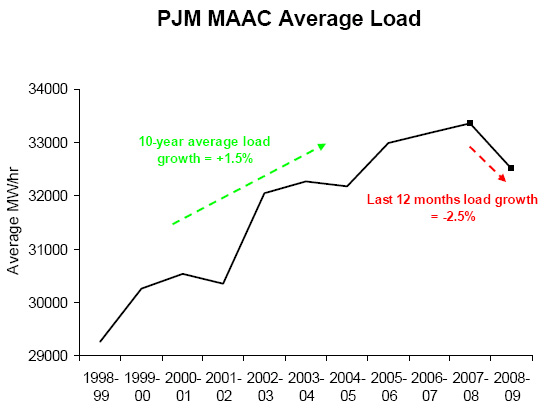
This is PJM, no PEPCO specific info anywhere. Note the scale here, it starts at 29,000, and note that the downward trend for PJM starts the same time as Xcel’s — in 2007. This is not a little blip of last fall’s economic implosion, it’s a longer-term symptom of our economic disaster that is capitalism.
And here’s the PEPCO dollar specifics:
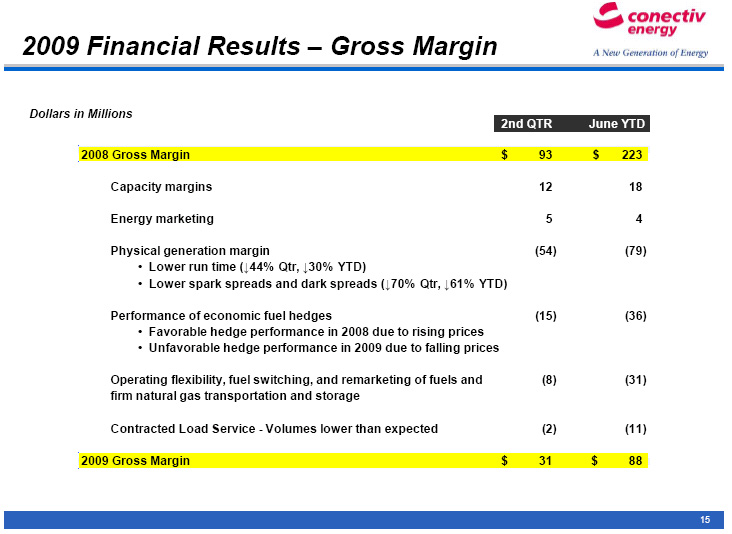
Is that hilarious or what…
Prairie Island EIS – NEW Comment Period
August 10th, 2009

That’s Ken, hanging out at Lock & Dam #3, and if you look way in the background, over her butt, there’s the Prairie Island plant… this was back when her snout was still black…
UPDATE ON XCEL ENERGY’S PRAIRIE ISLAND NUCLEAR UPRATE & DRY CASK STORAGE DOCKETS
FINAL EIS AVAILABLE HERE
COMMENT UNTIL 8/21/09
Comments on the adequacy of the Final EIS will be accepted until Friday, August, 21, 2009. Comments should be sent by e-mail or U.S. mail to:
Bill Storm, Project Manager
Minnesota Dept. of Commerce
85 7th Place East, Suite 500
St. Paul, MN 55101-2198email: bill.storm@state.mn.us
*************************************************
This just in from Kristen Eide-Tollefson, a succinct & concise update on where this docket is at and a “TO DO” list to weigh in on this mess. I’ve not kept up, though I was invited in to the first Prehearing Conference, I was so frustrated by the two Citizen Advisory Task Force meetings, plus CapX 2020 ramped up, so I crossed that right off my list. But living with this nuclear reactor (and I get one in Port Penn too, Salem & Hope Creek are right across the river), well, it just won’t go away, SOOOOOOO, here’s what’s up from Kristen:
All:
If you did not get a hardcopy you can:
1. view it on line at the link – FEIS HERE
2. view it at the libraries identified in the link
3. call or e-mail Bill Storm to have a copy sent or picked up. bill.storm@state.mn 651-296-9535,
Good news!
We have an unexpected opportunity to comment on the Final EIS. This was not expected. But public hearings revealed that the communities felt that the EIS did not adequately reflect the impacts, issues, and concerns that they hoped would be developed in the EIS. So there will be a comment period!
Comments are due August 21st. They should be sent to bill.storm@state.mn.us
More good news!
1. OES staff has put all non-edit changes in BOLD in the document. This radically reduces the time needed to ‘scan’ for changes that you wish to comment on.
2. A new section has been added — section 3 — which specifically addresses PUBLIC COMMENTS that were received on the draft EIS and in public hearings. This is a major requirement of the final EIS, that it adequately respond to and address public comments.
Comments are due August 21st. You may send any kind of comment about the “adequacy of the EIS”.
Below find 4 key purposes of Environmental Review with some questions that might help you frame or target your comments.
1. Identifying, evaluating potential impacts: Will the EIS be adequate — as a resource and analysis — for decision makers to make these major decisions about:
a. Part 1 – Certificate of need for UPRATE (running the plant with hotter fuel to increase capacity) ,
b. Part 2- Expanding dry cask storage (and extending operations, or relicensing – which is not possible without agreement from MN to store waste on site indefinately)
Does it provide sufficient information and analysis to allow decisionmakers to calculate and balance the cost and benefits of the proposed project, or project alternatives?
2. Response to public comments: Did the OES staff respond adequately to YOUR comments/ public comments/ community concerns — Review part 3 of the Final EIS.
3. Social/Economic impacts: Does the Final EIS adequately describe and evaluate social and economic issues and impacts to the communities? Does it provide sufficient information and analysis to allow decisionmakers to calculate and balance the cost and benefits of the proposed project, or project alternatives?
4. Comparing alternatives: Does the Final EIS adequately describe, evaluate and compare:
a. The impacts of the proposed projects to both natural and socio-economic resources and ecosystems
b. Alternatives to the proposed project
c. (For the legally minded) Compatiblility with state policy and legal precedent
5. Mitigation: Part of an environmental impact statement is to consider what steps could be taken to “mitigate” the natural and socio-economic system impacts of a proposed project — and safeguard important resources. Does the EIS adequately consider “mitigations”. Does it reflect public/community concerns and suggestions for safeguarding resources and reducing impacts identified in the task force, public hearing and comment processes.
Any Questions about process or content?
Bill Storm wrote Part 1 of the EIS on the uprate
Ray Kirsch is our Public Advisor for OES — He wrote the part of the EIS on dry cask storage. ray.kirsch@state.mn.us 651-296-7588
Mike Kaluzniak is the PUC staff public advisor. “Mike Kaluzniak” <Mike.Kaluzniak@state.mn.us>,
Deborah Pile is the staff manager 651-297-2375 at OES deborah.pile@state.mn.us
Bob Cupit is PUC staff manager bob.cupit@state.mn.us 651-201-2255
COMMENTS ON THE FINAL EIS
Comments on the adequacy of the Final EIS will be accepted until Friday, August, 21, 2009. Comments should be sent by e-mail or U.S. mail to:
Bill Storm, Project Manager
Minnesota Dept. of Commerce
85 7th Place East, Suite 500
St. Paul, MN 55101-2198
email: bill.storm@state.mn.us
Excelsior Energy files Mesaba Project appeal
August 7th, 2009
Oh happy day…
Here’s the Excelsior Energy Mesaba Project appeal, hot off the “press” from a little birdie:
I’d love to weigh in, but the freight’s a little steep for recreational pleadings…
Thanks, little birdie!

Minn. Stat. 117.189 Legislative History
August 6th, 2009
This is one of those things that’s been bugging me for a long time, and I’m finally getting around to looking it up. There are a few twists and turns, and this is a long post, with a lot of links and a lot of audio listening for you to dig in if you’re interested. If you’re a landowner, you sure better be! If you’re a landowner affected by utility infrastructure, this is required reading and listening!
Here we go!
History of Minn. Stat. 117.189
Here’s the statute (the specific statutory cites below are linked):
117.189 PUBLIC SERVICE CORPORATION EXCEPTIONS.
Sections 117.031; 117.036; 117.055, subdivision 2, paragraph (b); 117.186; 117.187; 117.188; and 117.52, subdivisions 1a and 4, do not apply to public service corporations. For purposes of an award of appraisal fees under section 117.085, the fees awarded may not exceed $500 for all types of property.
History:
Short version – this bill was a bipartisan sell-out that exempted CapX 2020 and any other public service corporation project from eminent domain that every other entity must comply with. Why on earth would they do this… or rather, what innocent explaination is there for this 117.189 section of the bill?
So far that I’ve heard (only ~6 hours thus far), Sen. Scott Dibble is the only one asking “Why exempt public service corporations?”
The only Senators who voted against this were:
Anderson, Cohen, Dibble, Hottinger, Marko, Moua, Pappas, Ranum, Skoglund
The only Reps who voted against this were:
Davnie, Ellison, Goodwin, Hausman, Hornstein, Huntley, Johnson, S., Kahn, Lanning, Lenczewski, Mahoney, Mariani, Mullery, Paymar, Thao, Wagenius, Walker
Please take a few minutes and send them a thank you note! Here’s a link to their emails:
*****************************************************
First, some more history, going back to my all time favorite bill:
Remember, this was the bill that grew from the deal the enviros did in 2003, incorporating the material terms of that deal into the 2005 Omnibus bill.
And… why… look, there’s language in the 2005 Transmission Omnibus Bill from Hell mandating an “Eminent Domain Landowner Compensation — Landowner Payments Working Group!”
55.35 ARTICLE 1155.36 EMINENT DOMAIN LANDOWNER COMPENSATION56.1 Section. 1. [LANDOWNER PAYMENTS WORKING GROUP.]56.2 Subdivision 1. [MEMBERSHIP.] By June 15, 2005, the56.3 Legislative Electric Energy Task Force shall convene a landowner56.4 payments working group consisting of up to 12 members, including56.5 representatives from each of the following groups:56.6 transmission-owning investor-owned utilities, electric56.7 cooperatives, municipal power agencies, Farm Bureau, Farmers56.8 Union, county commissioners, real estate appraisers and others56.9 with an interest and expertise in landowner rights and the56.10 market value of rural property.56.11 Subd. 2. [APPOINTMENT.] The chairs of the Legislative56.12 Electric Energy Task Force and the chairs of the senate and56.13 house committees with primary jurisdiction over energy policy56.14 shall jointly appoint the working group members.56.15 Subd. 3. [CHARGE.] (a) The landowner payments working56.16 group shall research alternative methods of remunerating56.17 landowners on whose land high voltage transmission lines have56.18 been constructed.56.19 (b) In developing its recommendations, the working group56.20 shall:56.21 (1) examine different methods of landowner payments that56.22 operate in other states and countries;56.23 (2) consider innovative alternatives to lump-sum payments56.24 that extend payments over the life of the transmission line and56.25 that run with the land if the land is conveyed to another owner;56.26 (3) consider alternative ways of structuring payments that56.27 are equitable to landowners and utilities.56.28 Subd. 4. [EXPENSES.] Members of the working group shall be56.29 reimbursed for expenses as provided in Minnesota Statutes,56.30 section 15.059, subdivision 6. Expenses of the landowner56.31 payments working group shall not exceed $10,000 without the56.32 approval of the chairs of the Legislative Electric Energy Task56.33 Force.56.34 Subd. 5. [REPORT.] The landowner payments working group56.35 shall present its findings and recommendations, including56.36 legislative recommendations and model legislation, if any, in a57.1 report to the Legislative Electric Energy Task Force by January57.2 15, 2006.
Now, let’s take a look at who was on that Committee:
REPRESENTATIVE MEMBERS
1. Jim Musso (Xcel Energy) representing transmission owning investor-owned utilities
2. Bob Ambrose (Great River Energy) representing electric cooperatives
3. Mrg Simon (Missouri River Energy) representing municipal power agencies
4. Chris Radatz-representing the Minnesota Farm Bureau
5. Tim Henning (farmer) representing the Minnesota Farmers Union
6. Jack Keers (Pipestone County Commissioner) representing county commissioners
7. Robin Nesburg (Rural Appraisal Services) representing real estate appraisers
AT LARGE MEMBERS
8. Beth Soholt (Wind on the Wires)
9. John Nauerth III (farmer)
10. George Crocker (North American Water Office)
11. Bob Cupit (Public Utilities Commission)
12. Bill Blazar (Minnesota Chamber of Commerce)
Here’s the report of the Work Group:
LANDOWNERS’ PAYMENTS WORKING GROUP
REPORT TO THE LEGISLATIVE ELECTRIC ENERGY TASK FORCE (LEETF)
Laws 2005, chapter 97, article 11, required the Legislative Electric Energy Task Force (LEETF) to create a landowners’ payments working group to study alternative methods of remunerating landowners on whose land high-voltage transmission lines have been constructed.
The group was created, met twice, and this is a report of its findings and recommendations.
LANDOWNER PAYMENTS GROUP FINDINGS
1. Farm owners in southwestern Minnesota want compensation for high-voltage transmission line easements to be paid annually as a percentage of the current value of the land so that as land values rise or drop, the payments rise or drop accordingly.
2. Easement acquiring utilities are not in favor of the proposal described in item #1 and do not want to fundamentally change the current method of payment for easements, which consists of a onetime payment based on a percentage value of the land over which the easement is acquired.
3. The Legislature has the authority to mandate the payment system described in item #1.
4. There are no jurisdictions that have the payment system described in item #1.
5. The payment system described in item #1 would be more expensive than the current payment system, assuming the percentages proposed by the landowners with attendant upward pressure on rates.
6. There is a social value to having a harmonious, nonadversarial process to acquire high-voltage transmission line easements that has an economic value that is hard to quantify.
7. There is a sense that the process for negotiating an easement and/or contesting it by a landowner is too expensive and complicated and it may be helpful to search for legislative ways to ensure that all similarly situated landowners receive the same just compensation without being intimidated by the process or forced to great expense by the process.
8. While this group was formed due to farm landowner concerns, the scope of the charge extends to all landowners. Guidance from the task force is necessary as to the scope of the charge because the scale of the issue is altered if any easement over any land is the subject of the discussion.
9. While the direct parties in interest–the landowners and utilities–are stalemated, the current push to acquire easements for new lines makes the issue one that should have a firm handle kept on it.
RECOMMENDATIONS
1. If further work is to be done on this topic, the task force should provide the guidance described under finding #8.
2. If the task force wants to continue work on this topic and wants more public input, it should consider utilizing the same persons who are on the current study group.
3. The task force may wish to consider whether there are flaws in the current easement acquisition process related to its expense to landowners to contest and perceived intimidating qualities.
*****************************************************
Let’s look at the eminent domain bills the following session, Senate bill, SF 2750 and the House bill, HF 2846.
SF 2750
Senate Authors, none added after introduction: Bakk ; Kiscaden ; Bachmann ; Chaudhary ; Kubly
Bill as introduced, had the Public Service Corporation exemption AND the appraisal fee limitation:
On the Senate side, there are some interesting statements in the first Committee hearing, Judiciary, discussion about limiting who can speak at county meetings about eminent domain (!!!), limitations of attorneys’ fees… and there’s a discussion that I’m trying to transcribe … will post soon…
Senate Judiciary – March 9, 2006 – PART I
Senate Judiciary – March 9, 2006 – PART II
Senate State and Local Government Operations – March 13, 2006 – Part I
Senate State and Local Government Operations – March 13, 2006 – Part II
Here’s Sen. Dibble questioning, in State and Local Government Operations – March 13, 2006 Part I (linked):
Senate State and Local Operations Committee
Chair: We’ll ask Senator Bakk to address this question.
*****************************************************
HF 2846
As introduced it had the Public Service Corporation exemption:
*** The sentence about appraisals did not appear in it as introduced or in the 5 engrossments online.
Here’s the House Research explanation of that paragraph:
12 Public service corporation exception. Provides that the provisions for attorneys’ fees (section 4 ), compensation for loss of going concern (section 8 ), minimum compensation (section 10 ), and limitations (section 11 ), do not apply to public service corporations.
*****************************************************
Conference Committee
04/12/2006 Senate conferees Bakk, Murphy, Betzold, Higgins, Ortman
04/12/2006 House conferees Johnson, J.; Abrams; Davids; Anderson, B.; Thissen
*****************************************************
Here are the reports of House and Senate adoption of Conference Committee Report, including votes:
Baron’s recovering from surgery
August 4th, 2009
Yesterday, Baron, one of our German Shepherd buddies, had emergency surgery. He’d had a bump, his owner thought he might have a hernia or something, and she brought him to the vet, nada, she and the vet couldn’t find a thing. Then, a couple of weeks later, he was acting like he was hurting, whimpering and laying around, and she found it again, what felt like a small bump, and brought him in again. They took an X-ray and OH MY DOG! It looked “bigger than a softball, maybe soccor ball size!” He was instantly scheduled for surgery on Monday.
Here’s what they found attached to his spleen:

EEEEEEEEEEEEEUW, that tumor weighed in at 7.5 pounds. It’s as if the poor dear had a cesarean. WOW! What more is there to say. It’s a good thing his owner was persistent. He’ll be a lot happier pup now that that’s gone. WOW! YEOW! Oh, it hurts to think about…