Getting railroaded?
February 2nd, 2010
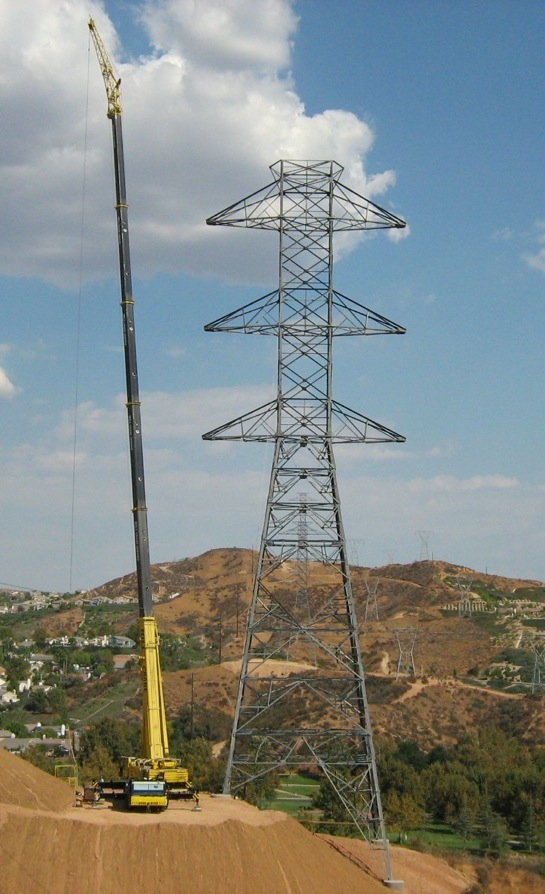
We all know what a pain in the patoot siting transmission is (particularly when it’s not needed). And now for something completely different — an interesting and seemingly probable theory:
ARE Y’ALL PAYIN’ ATTENTION??!!!?!?!?!
This is one of those pieces that I want to preserve to take out and reread in the not too distant future:
Buffett’s Semaphore Signal: Should Burlington Northern Shareholders Think Again Before Saying ‘Yes’ To Berkshire Hathaway?
Author: Daniel Sinclair
Reasons commentators ascribe to Buffett’s offer to acquire one of North America’s largestrail networks, Burlington Northern Santa Fe (BNSF) are now familiar. Growing global trade, continued reliance on (especially low sulphur) coal, a resurgent and growing US economy (without needing to pick product ‘winners’ and ‘losers’), a low risk way to gain exposure to any rising process for commodities, a hedge against inflation given rail’s pricing power, a competitive advantage in rail’s oligopoly and high barriers to entry, more productive rail with more efficient and technologically advanced operations and a rise double-decker railway carriages, a way to play higher oil prices and cap and trade or carbon tax laws given that rail is 3 to 4 times more fuel efficient than trucks.
Those reasons are all good, and they have been part of the core investment thesis for rail. But, it is submitted, there may be something extra that offers compelling upside to rail that has Buffett excited. Think about all the land that rail owns. BNSF, for example, operates one of the largest railroad networks in North America with about 32,000 route miles of track plus an additional 23,000 miles for other rail related infrastructure and property. Much of this land is of relatively little value beyond the use of rail. No one is going to build condos or hotels or new subdivisions along side railways.
Now think again. You think Boone Pickens has an ambitious plan for wind farms? Wait until you see what Buffett could do right across the US with his investment in BNSF. This land might become prime property for alternative energy generation including from wind and solar farms either side of rail tracks. With much of rail land in the middle of nowhere, there are few worries about the ‘not-in-my-back-yard’ crowd and more difficult regulatory approvals. Small wind mills and solar panels might be placed on the trains themselves to generate energy.
Live from the PUC!
February 1st, 2010
Except that now there’s a delayed start, we’re missing a Commissioner…
Here’s some notes, we’re taking a break — I’m missing some parts, but here we go:
OK, the “ROUGH notes” are their in toto, but hey, I’ve got something better:
HERE’S THE MEETING – February 1 Agenda Meeting
You may have to download “Silverlight” to view the meeting.
K-K-K-Kady…
January 28th, 2010
And did I mention we got a new doggy? She’s from Sixth Angel Shepherd Rescue, was fostered way way out on Long Island, and before that, Georgia, where she was rescued from a kill shelter in the nick of time. This dog is the sweetest, lickingest little wiggle-butt, despite the Rescue’s concerns, she is NOT an aggressive dog, doesn’t have that GSD looking-askance edge to her. She was supposed to be dog aggressive, but when we went to meet her, with Ken, they squabbled a bit at first and next thing you know, there’s Kady, jumping in the van ready to go. Dog aggressive… right… here she is with Ken:
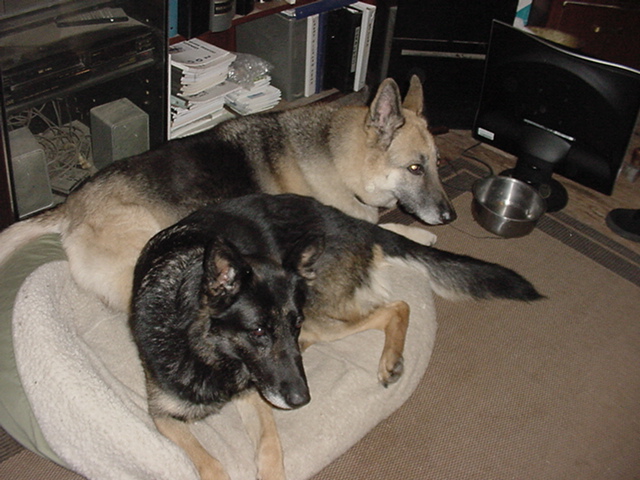

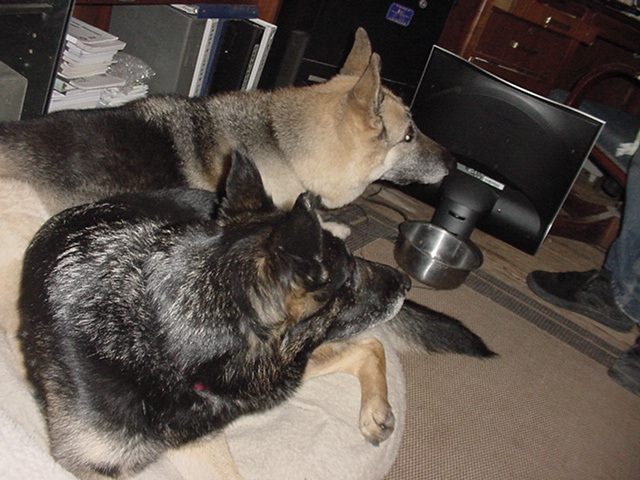
And yes, Kady can sit up, stand, run, but lately, Ken doesn’t really do any of that, needs help to get outside and spends most of the day reclining on her doggybed eating bon-bons, well, carrots and “sawdust bones” and having Azodyl stuffed down her gullet, all considered, she’s doing well, and Kady likes to keep her company, but yes, she can and does get around a bit:

And if you want to hear her howl, sing this!!
K-K-K-Kady, beautiful Kady,
You’re the only g-g-g-girl that I adore;
When the m-m-m-moon shines,
Over the cowshed,
I’ll be waiting at the k-k-k-kitchen door.
K-K-K-Kady, beautiful Kady,
You’re the only g-g-g-girl that I adore;
When the m-m-m-moon shines,
Over the cowshed,
I’ll be waiting at the k-k-k-kitchen door.
Susquehanna-Roseland reopened!
January 27th, 2010

The Susquehanna-Roseland hearing has been reopened. And off we got to FERC. It’s been quite a hectic week, with a “flurry” of filings, and here’s the update. First, remember the NJ BPUat a special 1/15 meeting said they were NOT going to decide on PSE&G’s Susquehanna-Roseland transmission line and said they’d be asking for more information from PJM. Well, they asked PJM to answer a few questions (though not specific enough, not the right questions):
Here’s what PJM had to say:
Suffice it to say, the letter is … ahem… INSUFFICIENT!
And then the responses started coming in, first the Municipal Intervenors, then :
Municipal Intervenors response to PJM Letter
And the BPU issued an Order reopening the docket and first scheduled a hearing for February 2, 2010, and then THANKFULLY changed it to February 4, 2010:
The concept is that PJM is coming in as a witness regarding the assertions of their January 21, 2010 bullshit letter, and what does that mean? Is Steve Herling THE witness, or are there others? Is whatever witness/es coming with a truckload of exhibits that they’ll dump on us the day of the hearing? Is he going to be prepared in any way to back up his conclusory and unsupported statements? So I fired off a couple missives, first Discovery to get the requests in quick and let them be on the record of ignoring or refusing to answer, and then a letter to the BPU with my view of the fine mess we’re in:
As a sidebar, the escrow that PSE&G had to put out for the Municipal Intervenors is gone, this has been an intense case, and so they’re reasonably asking for more:
Meanwhile, back at the ranch, remember that great 7th Circuit decision tossing out the cost allocation for this project? Everything’s been up in the air since then, because if they can’t settle how they’re going to allocate the costs, this sucker won’t be built:
It was remanded to FERC and after some wrangling, just like in the BPU case, where the utilities were saying, “It’s all there in the record, you don’t need anything more to make a separate decision” and Illinois said quite succinctly, “AHEM, WE DON”T THINK SO!” and FERC issued an Order stating that the record was not sufficient, needed more information and directed PJM to provide some information and also provided some questions for parties to mull over in their comments:
Here’s the fun part – what they asked PJM to provide (hee hee hee hee hee hee), starting on p. 5 of the above Order:
10. PJM should provide the following information:
A. The total costs that have been approved through PJM’s Regional Transmission Expansion Plan (RTEP) process for facilities that operate at or above 500 kV (and necessary lower voltage facilities), and whose costs are assigned pursuant to Opinion No. 494. For these projects, calculate the total costs that have been assigned to each PJM zone, and estimate the total costs that would be assigned to each zone using PJM’s DFAX methodology.
B. PJM manuals require that, in planning projects, it seek to optimize projects in order to reduce the cost of addressing individual reliability criteria. Describe how the optimization process is performed. Also, explain how PJM determines the relative priorities of resolving numerous reliability issues with one project. For 500 kV and above facilities, explain whether PJM could accurately determine the beneficiaries of a project that resolves numerous reliability issues using its DFAX methodology.
C. PJM’s most recent RTEP report (2008), at P 5 states that:
Baseline thermal and voltage analysis encompasses an exhaustive analysis of all Bulk Electric System (BES) facilities for compliance with NERC Category A (TPL-001), Category B (TPL-002) and Category C (TPL-003) events. In addition, consistent with NERC standards TPL-004, a number of extreme events including those judged to be critical from an operational perspective as well as those defined in Table I of TPL-004 were evaluated for risk and consequence to the system. Describe the types of anticipated reliability requirements addressed by the PJM RTEP (i.e., voltage, thermal, stability). Explain whether and how the DFAX analysis applies to the NERC reliability analyses listed above and any other reliability requirements. Explain whether the RTEP upgrades designed to address these reliability requirements also will address other reliability concerns. In particular, explain whether the geographic location or voltage level of an RTEP upgrade makes that upgrade more likely to address broader reliability concerns.
Provide any relevant studies.D. In this proceeding, PJM recommended the adoption of a postage-stamp rate design for new 500 kV and above facilities.
1. Describe the benefits generated by such facilities that are not captured in the DFAX methodology used by PJM to allocate costs for lower voltage facilities. Indicate whether such lines provide reliability or economic benefits to the areas producing electricity.
2. Provide engineering or other studies showing any differences in regional benefits between 500 kV and lower voltage facilities (e.g., 345 kV
and 230 kV).E. Provide any existing engineering or other studies that indicate whether the modeling assumptions used in the RTEP analysis, such as the direction of flow,
remain consistent or vary over time.
The Municipal Intervenors sent in a Motion to FERC, PSEG objected, and then Stop the Lines sent in a Motion for Limited Intervention:
Municipal Intervenors – Motion to Intervene
PSEG Response to Munis FERC Intervention
Stop The Lines! Motion for Limited Intervention
PSEG’s response to our Motion to Intervene… yeah… (yawn)… what-ev-er…
And just now, hot off the press, the Municipal Intervenors have filed a Motion to Depose PJM’s Steven Herling! Oh, yes, this is much needed, so we can get an idea where they’re going and what they plan to present (I doubt they’d produce the pre-filed testimony I requested!):
As you can see, it’s been an intense few days, and isn’t letting off anytime soon. More to follow as it develops.
PUC’s Health Impacts of Wind Turbine Docket
January 26th, 2010
9:30 a.m. on February 1, 2010
Minnesota Public Utilities Commission
Large Hearing Room
121 – 7th Place E., 3rd Floor
St. Paul, MN 55101
Remember the PUC’s docket that they opened after release of:
Apparently they’re looking at doing something — and here’s what the staff Briefing Papers say:
Here’s how staff defines the issue before the PUC:
Should the Commission find that current permit conditions regarding setbacks remain appropriate and reasonable in light of recent concern and the Minnesota Department of Health’s White Paper, Public Health Impacts of Wind Turbines?
And here’s the bottom line, what staff thinks should happen:
Staff recommends that the best approach to mitigate the issues discussed above would be comprised of two modifications to our current process.
1) Increase setbacks from non-participating landowner residences
a. Continue to use the existing 500-foot or noise standard residential setback (whichever is greater) to allow participating landowners to maximum their land use.
b. Increase the setback required from non-participating landowner residences to 1,000 feet or the state noise standard (whichever is greater) or some other number deemed appropriate by the Commission.
2) Require additional information from developers during the siting process to provide accurate and specific information to the Commission on the impacts of the project. Staff will continue to work on refining the specifics of these requests, additional information is anticipated to be (at a minimum, but could be subject to change):
a. During the application process:
I. noise modeling report (at different frequencies and at various distances from the turbines at various wind directions and speeds) throughout the project area;
II. if flicker is to occur on non-participating residences, shadow flicker modeling report, indicating anticipated maximum;
b. Preconstruction (submitted at time of final site layout):
I. final noise modeling report of final layout and noise monitoring proposal (both at different frequencies and at various distances from the turbines at various wind directions and speeds) throughout the project area;
II. final shadow flicker modeling report;
c. Post construction:
I. noise monitoring reports of the development (at different frequencies and at various distances from the turbines at various wind directions and speeds) throughout the project area.
To check out the whole docket and look at the various comments, CLICK HERE FOR PUC SEARCH PAGE , then scroll down a bit to the “Search” button and below that enter 09-845 and then click “Search.” Voila, there it all is!
So, be there or be square.