Spring Creek & Gro Wind projects in Rice County
October 28th, 2010
As you know, Goodhue County passed a Wind Ordinance earlier this month:
And on Monday, Wabasha’s Planning Commission reviewed its own Wind Ordinance (sorry about the format of this, but it’s how it is on their site):
And now, on to Rice County. There’s a project proposed in Rice County… well, it’s a revisitation of a project started in Dakota County and which went over like a lead balloon:
Greenvale Wind Farm – Sparks Energy & Medin Energy – Project Docket
This was an 11MW project, and the main objection was that the wind farm was proposed for Dakota County, a pretty populated area, and the project was quickly withdrawn:
And now it’s BAAAAAAAAAACK!
Here are the specifics:
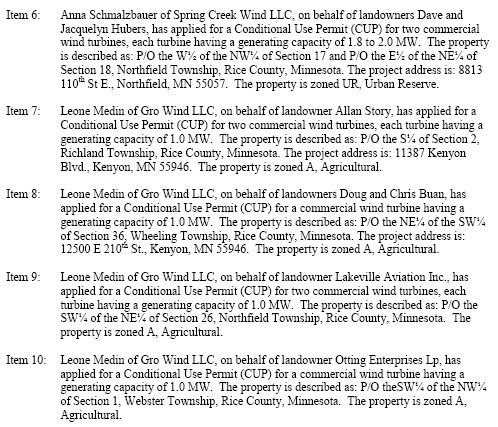
The same people who proposed that Greenvale Wind project, Anna Schmalzbauer and Leone Medin, a mother/daugher duo, are the ones behind the proposed “five” projects in Rice County, which totals the same MWs as the Greenvale project — they’re all on the agenda at the same time, all to be built the same time, one is under “Spring Creek, LLC” which is a Jeff Paulson creation (that alone should raise eyebrows and trigger scrutiny) and four are “Gro Wind, LLC” with cookie cutter cut and paste “applications” with only minor changes, like the parcel location. And this time… filed separately. The Gro Wind cookie-cutter cut and paste applications, all filed “separately,” total over 5MW.
Any wind project proposed must apply to the state for a “Size Determination” under Minn. Stat. 216F.011. The state then proceeds to determine the size of the project, taking into account projects in geographic proximity, the timing, the project developer, the financing, the power purchase agreements, to determine whether it’s one project, many separate ones, and how many MW, and essentially the state then issues its “Size Determination” and tells the developer where to go! The County has jurisdiction over those projects under 5MW, and from 5-20MW the developer can choose to go to the county, and 20MW and over goes to the Public Utilities Commission. In the 5-20MW range, the developer can choose to go to the county for a siting permit, BUT when they do, they need to notify the state that that is what they’re doing, notify them of their “Size Election” when they make the application! Minn. Stat. 216F.012.
Schmalzbauer and Medin, Spring Creek and Gro Wind, didn’t get a “Size Determination” and didn’t notify the state of a “Size Election.” They did NEITHER.
It looked fishy when I saw it, so I emailed the County staff and Deb Pile, EFP, MOES, Dept. of Commerce asking for some documentation that the applicants had followed the law. And nope, didn’t do it, and worse, the county didn’t know that is what they should do! Direct from Deb Pile, EFP, MOES, Dept. of Commerce:
Dear Ms. Overland,
Thank you for bringing these Rice County projects to my attention. The Office of Energy Security has not evaluated these projects or made a size determination pursuant to Minn. Stat. 216F.011. I have discussed the situation with the county and anticipate receiving further information about the projects from the applicants shortly.
Sincerely,
Deborah Pile
Oh my… that is a problem. So … there goes Overland… and I sent this this morning for the Planning Commission:
Letter to County Staff – for Planning Commission
Exhibit A – email re: Gro Wind application
Exhibit B – Greenvale Wind Withdrawal Letter – August 31, 2010
Exhibit C – DRAFT Wabash County Wind Ordinance
Exhibit D – Goodhue County WECS Ordinance
Exhibit E – Recommended Wind Noise Ordinance – Rick James, INCE
Exhibit F – MISO Queue – Rice County Wind Projects (Excel spreadsheet)
Exhibit G – Public Health Impacts of Wind Turbines – Mn Dept of Health
Exhibit H – Direct Testimony of Rick James – Goodhue Wind Docket 08-1233
Exhibit I – Additional Testimony of Rick James – Goodhue Wind Docket 08-1233
Now it’s wait and see…
Wabasha County’s Draft Wind Ordinance
October 26th, 2010
The Goodhue Wind Truth crew is off to Stearns County today in search of an improved wind siting ordinance.

Last night there was a meeting of the Wabasha County Planning Commission on the new Wabasha County Wind Ordinance proposed:

You’ll see some of it is similar to the new Ordinance in Goodhue County:
More as I find out about it — couldn’t get to the meeting last night because another proposed wind project further west needed attention.
Goodhue Wind at the PUC yesterday
October 22nd, 2010

Wow, what a day… with an exciting turn of events that tells me that the issues raised by Goodhue Wind Truth are being taken seriously.
In the Beagle this morning:
It turned on the Goodhue County Wind Ordinance, passed in early October:
Everyone’s taking this seriously, except MOES of course:
… where they said:
OES EFP staff is not able to provide any additional information about what may have transpired in Goodhue County regarding development of regulations and would refer the Commission to the appropriate representative of Goodhue County for additional information.
GIVE ME A BREAK!!! Of course it’s good to go to the source for information, but to state that “OES EFP staff is not able to provide any additional information about what may have transpired in Goodhue County regarding development of regulations” is beyond absurd. I was at the Subcommittee meeting that Deb Pile, OES EFP, attended, and in the discussion that ensued, it was stated that there had been ongoing discussions between county staff and subcommittee members (and I think at least one County Board member), and all the county subcommittee, Planning Commission and County Board information had been filed by Goodhue Wind Truth and probably other parties as well.
The bottom line is that they] Minnesota Public Utilities Commission put the Certificate of Need (09-1186) on hold, and sent the Siting Permit (08-1233) over to OAH for a hearing, Findings of Fact and Recommendation, on the Goodhue County Ordinance. Specifically, to build a factual record regarding whether the PUC should adopt the Goodhue County standards, the question of good cause, and to examine whether there is sufficient scientific evidence to support a 10 Rotor Diameter setback.
But let’s not get too excited — the PUC’s intent and the result could go either way. Hard to tell whether this is a fishing expedition to scrounge up “good cause” to IGNORE the ordinance or whether it’s butt covering to make sure they’ve got a supportable decision if they DO implement the Ordinance in the permit, but it means more work for us and dashed hopes of getting permits by year end for the applicant. It was a roller coaster all day long, I felt good about it going in because Goodhue Wind Truth has done such a good job of making their case, my bet was that it would be good for us, but THE SUSPENSE…
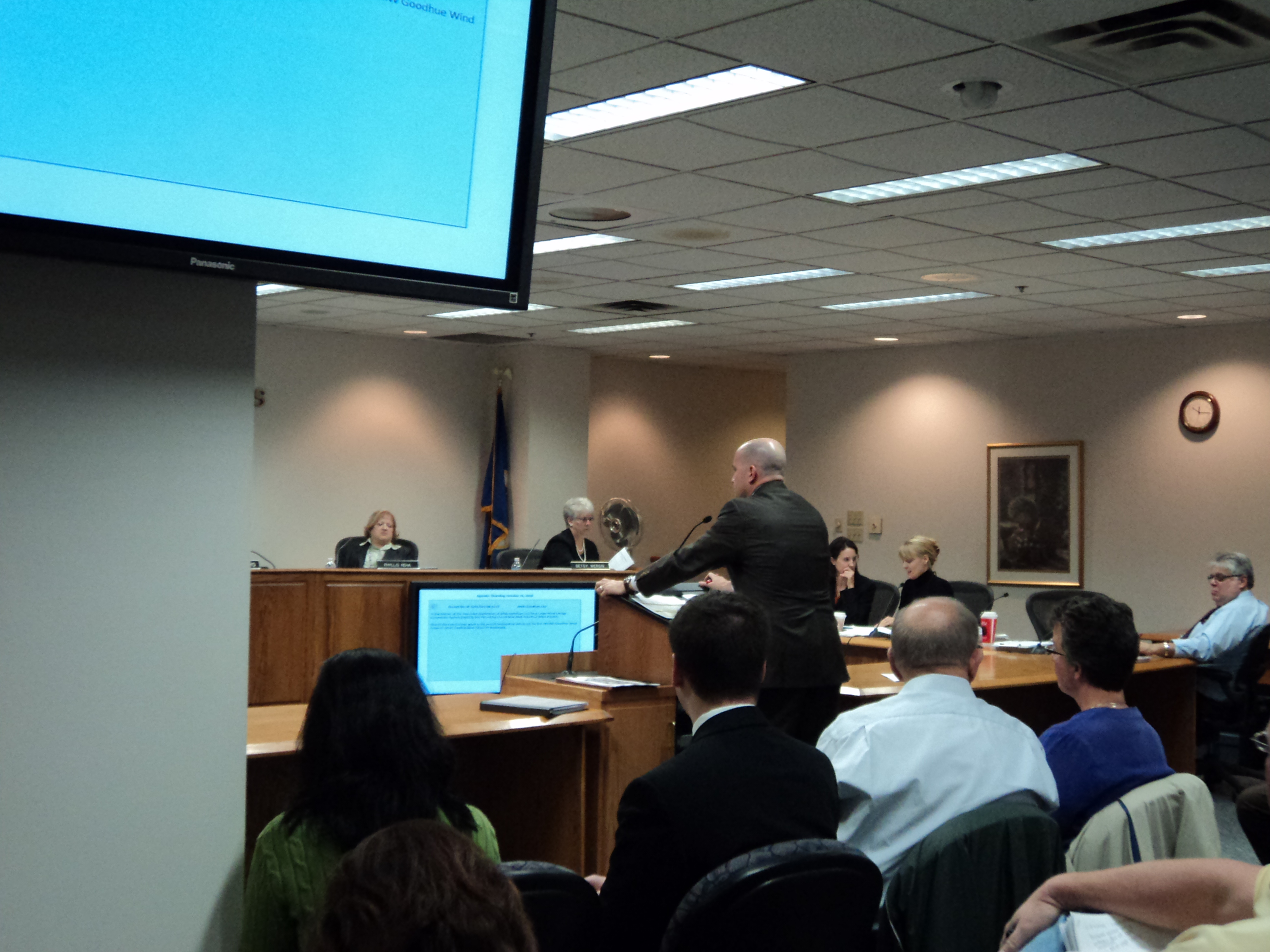
…and Todd Guererro, representing AWA Goodhue, or whatever their name is, he paced a rut in the back of the room yesterday. I’m sure they’re spinning, saying “HEY! Where’d that come from?!?!?!”
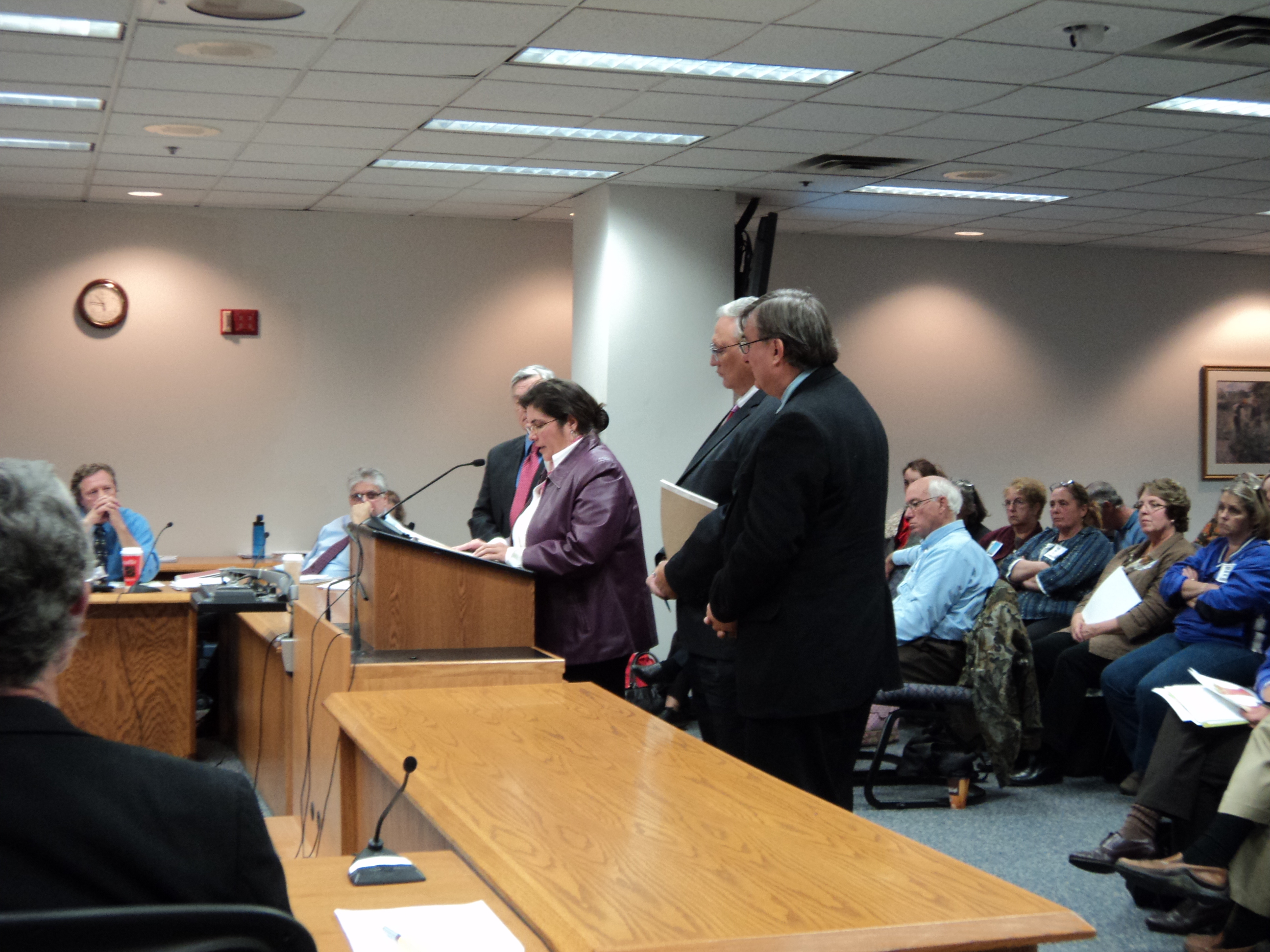
The best part for me was Goodhue County’s presentation. You all know I’ve had serious problems with Goodhue County since Nuclear Waste Daze, and that’s a story for another day, or perhaps the book… but yesterday the County, as a united front explaining their Ordinance, was very impressive. Each County representative there told a part of the story, detailing the county’s long process in wrestling with the ordinance, the purpose, the intent, in a way that was impossible for the PUC to ignore.
To look at the full dockets, go to www.puc.state.mn.us and then to “Search eDockets” and then search for dockets “08-1233” and “09-1186” for the rest of the story.
So what to do? Well, that’s simple — keep on it.
And I wish the PUC would order some nitrous oxide for that “security” guard, the way he glares is enough to chill public participation — and that the PUC thinks that having a security guard is necessary, or appropriate, is disturbing.
In the Rochester Post Bulletin:
Commission deals setback to Goodhue Wind project
By Brett Boese
The Post-Bulletin, Rochester MN“I think you could buy Goodhue Wind stock pretty cheap right now,” Ryan quipped.
Delaware’s O’Donnell… OH MY DOG!
October 20th, 2010
We’ve been in Minnesota since late April, thankfully, because if I were in Delaware right now, it’d be hard to not flee for the border. So is Alan going back to vote? Chris or Christine, either way Delaware loses…
Listen to the guffaws and watch her expression, she is clueless, utterly clueless, what a nutwad:
GRE & Xcel are hustling for $$$$$
October 20th, 2010

Apparently Great River Energy and Xcel Energy are outlooking for money. Gee, I wonder why? I remember the snorts and hoots that broke out in the room way back during the CapX Certificate of Need hearing when they admitted to presenting their CapX 2020 financing dog & pony show to Lehman Brothers.
As for GRE, from Monday’s article in Finance & Commerce:
Xcel just made an SEC filing that shows some creative efforts:
“Secondary purpose of the Plan…” (click the quote for the full filing) “Secondary purpose…”
Yup, uh-huh… …WHAT… EVER!
Here’s the full article from Finance & Commerce about GRE’s capital raising efforts:
Great River Energy to sell $450M in mortgage bonds
Posted: 4:35 pm Mon, October 18, 2010
Faced with declining power-usage revenues and rising utility-plant costs, Maple Grove-based Great River Energy (GRE) on Monday issued $450 million in taxable first mortgage bonds to meet costs and pay down debt.
The mortgage bonds are intended to fund capital spending for the utility’s power generation and transmission as well as paying off $325 million of GRE’s $2.4 billion outstanding debt, said Susan Brooks, GRE treasury director.
“It’s part of our long-range plan to meet member costs in the most cost-effective manner,” said Brooks, who expects bond pricing to be set today.
The mortgage bond sale is the second such transaction in 2010 by GRE, which in April announced it would sell $106 million in tax-exempt first mortgage bonds issued by McLean County, N.D.
It’s not unusual for utilities to sell mortgage bonds to help make ends meet at a low cost. Such financing makes sense because GRE is making additions to its system and paying for generation and transmission improvements in the wake of the recession.
For example, GRE’s 2009 revenues fell $42.1 million to $787.8 million at the same time the utility was paying to develop a coal-fired plant in North Dakota and helping develop the CapX2020 system of transmission lines with 10 other state utilities.
Fitch Ratings assigned an A- credit rating to the $450 million mortgage bond sale. Fitch noted that, “while GRE’s debt level remains a concern, (it) has been effective in managing the higher debt loads, even in what has been a difficult operating environment.”
Background information on GRE’s mortgage bond offering from Fitch stated that GRE is working to lessen its debt-load by paring its five-year capital spending plan by $350 million.
GRE serves more than 645,000 residential and small-commercial customers through 28 member cooperatives. The utility maintains 3,647 megawatts of generation capacity, of which 2,751 megawatts is owned by GRE.
Additional capacity is expected to come online in 2012 when Spiritwood Station, a coal-fired plant near Jamestown, N.D., begins operation.
The start-up of Spiritwood, which has a peaking capacity of 99 megawatts, was delayed until early 2012 earlier this year because plans for an ethanol plant to use steam from the nearby coal plant failed to materialize.
Therese LaCanne, GRE spokeswoman, said Spiritwood also will provide steam for a Cargill Malt plant in the industrial park.
Of GRE’s 2009 power generation, 78 percent was coal-fired, with the remaining 22 percent coming from 7 percent renewable energy, 1 percent natural gas and 14 percent other energy sources.
Combined with the planned firing up of Spiritwood and wind energy contracts, GRE projects it will have adequate capacity to meet its member needs beyond 2020.
The utility projects compounded average annual peak load growth of 1.4 percent from 2010 to 2020, according to Brooks.