Private company can’t condemn for transmission line
December 14th, 2010

It’s about time… a judge in Montana has declared that a private entity that is building the MATL transmission line does NOT have the power of eminent domain! Well DUH a lot of us will say, this is a PRIVATE company, they’re not a regulated utility, so of course they wouldn’t have power of eminent domain.
But wait… what about CapX 2020, and their transmission plans from hell across the Midwest. Let’s be clear — there is NO entity organized under the laws of the state of Minnesota named “CapX 2020,” and they have NOT declared, and refuse to declare what entity will own it. At the same time, the Minnesota PUC agenda lately has had Xcel transferring its transmission assets to ITC. So, what do you think they’ll do with CapX 2020 transmission after it is built USING THE POWER OF EMINENT DOMAIN TO DO IT? $50 says they’re transferring it to ITC, or TRANSLink or whatever transmission only company they can find. It’s a shell game, we know what they’re doing, but try to get the PUC to care!

Judge denies MATL use of eminent domain
By KARL PUCKETT • Tribune Staff Writer•
December 14, 2010A district judge in Montana ruled Monday that a Canadian developer of a high-voltage power line has no authority to condemn private property for the project.
The decision, filed Monday, is a victory for landowners trying to limit the impact of the Montana Alberta Tie Line. It also could carry ramifications for other developers proposing transmission projects to meet demand from wind developers asking for additional shipping capacity.
“Larry Salois only wanted to protect his mother’s property from the transmission line going through historic Indian archaeological sites,” said Salois’ attorney, Hertha Lund. “He never wanted a legal battle.”
Salois is the guardian of his mother, Shirley Salois, the property owner. They live east of Cut Bank.
In July, a Montana subsidiary of Tonbridge Power Inc. of Toronto filed a complaint to condemn their land in Glacier County District Court after Salois argued the proposed route should be adjusted across his property farther from tepee rings and a wetland.
Lund argued Tonbridge could not exercise the right of eminent domain because it is not an agent of the state that has been given express legislative authority to acquire private property.
District Judge Laurie McKinnon agreed and granted Salois’ motion to dismiss the company’s condemnation complaint.
“No judicial decision that this court is aware of provides authority for MATL’s position that a private merchant transmission line, without express or implied authority for condemnation, may pursue eminent domain proceedings,” she wrote.
The Legislature’s grant of eminent domain power to governmental bodies must be strictly construed, the judge said.
Private individuals and corporations, like state agencies, have no inherent power of eminent domain, McKinnon said, and their authority to use it must be derived specifically from the Legislature.
Years ago, condemnation by a public utility for the purpose of constructing electrical power lines was authorized by legislation, the judge said. That authority allowed the former Montana Power Co. to acquire property by eminent domain.
But that legislation has since been repealed “and MATL can cite no legislative authority for its pursuit of land acquisitions by eminent domain, either expressly or by necessary implication,” the judge said.
Tonbridge had asserted that an electrical transmission line is a public use, giving the company the right of eminent domain. Three wind farm developers have purchased capacity on the line. Poles started going in the ground in August with the company working around the Salois property.
Bob Williams of Tonbridge said the company was surprised and disappointed with the decision. Tonbridge is considering an appeal, he said.
Voluntary deals with landowners remain the company’s goal, he said. The Salois complaint was the company’s first condemnation action in Montana.
“That said, projects such as this that are in the public interest have to be able to fall back on eminent domain as a last resort,” Williams said.
“Even when we have exhausted all other options, it still means that landowners are compensated fairly.”
The MATL project was permitted under the Major Facilities Siting Act and the public need for it was determined during the review process, said Johan van’t Hof, Tonbridge’s CEO.
He argued the judge’s decision “doesn’t square with the reality” of private companies building cable, telephone, transmission and pipelines.
As a result of the decision, Lund, Salois’ attorney, expects other businesses planning transmission lines to seek a “legislative fix,” giving companies the power to condemn land for transmission lines.
NorthWestern Energy, the state’s largest utility, is planning the $1 billion Mountain States Transmission Intertie, which also would ship wind power. Tonbridge and renewable energy developer Gaelectric are jointly planning the “Green Line” between Great Falls and Townsend.
“I hope the Legislature protects the interest of the landowner and the small guy in this process,” Lund said.
The 215-mile transmission line will connect the electricity grids in Montana and Alberta between Great Falls and Lethbridge, Alberta.
Tonbridge still is negotiating easements with landowners along the southern half of the project from Cut Bank to Great Falls, where construction has yet to begin. Lund also represents 20 landowners along that stretch in easement negotiations. Those landowners have been pushing for tweaks in the line as well.
“This obviously puts them in the driver’s seat,” Lund said of the Salois decision.
Salois pushed the company to alter the location of poles planned for his property, outside of the 500-foot approved corridor, because he said the line was planned too close to Blackfeet tepee rings and a wetland.
In October, the Blackfeet Business Council agreed to write a letter in support of Salois’ efforts. The council said the land involved was once Blackfeet land and told Salois that he had the support of the nine-member council “in your efforts to fend off this incursion by a multinational company.”
“For now, things are protected,” Larry Salois said.
Tonbridge initiated settlement discussions with Salois a few weeks ago and hopes to reach an agreement before Christmas, van’t Hof said.
PEPCO is falling down on the job
December 12th, 2010

Nearly two years ago, I attended a hearing for the Delmarva Power Integrated Resource Plan, which was the most bizarre hearing I’ve ever experienced. At that time, I raised issues about decreasing demand, entered into the record the PJM demand documents that we’d used in the Susquehanna-Roseland transmission docket in New Jersey (also PJM), and raised concerns that no SAIDI, SAIFI and CAIDI reliability info was reported. After that meeting, I presented Delmarva Power’s attorney Todd Goodman with a well-deserved “Horse’s Ass” award for his performance at that meeting. The points I’d raised at that meeting about what was missing in their “IRP” were oh-so-valid:
It took a while, but last week, the Washington Post featured an article showing that PEPCO, utility in D.C. and Maryland, and the corporate parent of Delmarva Power, has an inexcusably miserable record for outages. That’s something that’s demonstrated in the SAIDI, SAIFI and CAIDI reports! And folks, don’t go conflating transmission with distribution as the cause for the outages, as utilities would have you do. Anyway, here’s that article:
Washington Post Analysis: Why PEPCO can’t keep the lights on
As you read the article, note there’s not a word on D-E-R-E-G-U-L-A-T-I-O-N as a contributory factor, much less the primary reason.
Washington Post analysis: Why Pepco can’t keep the lights on
Moreover, Pepco has long blamed trees as a primary culprit for the frequency and duration of its outages, implying that the problem is beyond its control. But that explanation does not hold up under scrutiny, The Post analysis found. By far, Pepco equipment failures, not trees, caused the most sustained power interruptions last year.
Read the rest of this entry »
PUC Denies Kenyon Wind Extension!
December 9th, 2010
After four years, finally, the Public Utilities Commission has denied an extension of the old, old permit. Kenyon Wind was first applied for way back in 2006. To see the full PUC record, go to www.puc.state.mn.us and go to “Search eDockets” and then search for “06-1445.” Recently, because their permit was expiring, it was granted and then two years was extended for two years, they came back to the PUC for yet another extension.
Here’s the report from the Red Wing Republican Eagle:

Kenyon Wind project in doubt after state denies permit extension
They haven’t built this project, despite being issued a permit on July 18, 2007, nearly a year after they’d applied. Since that time, much has changed. Goodhue County passed its Goodhue County Wind Ordinance. The laws for Community Based Energy Development (C-BED) have changed, amended each year since it was passed. And the Kenyon Wind Project has changed:
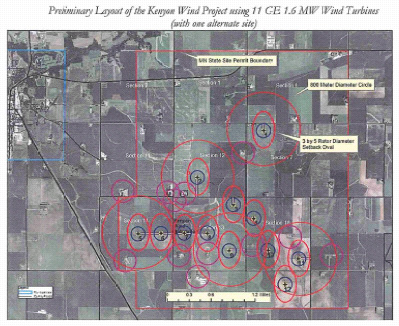
Here’s the CFER’s Comment:
Here’s Kenyon Wind’s comments:
And the PUC denied the permit, 3-2. Commissioners Pugh, O’Brien and Wergin voting to Chair Boyd and Judge Reha were the two voting against denial of Kenyon Wind’s request for extension.
EEEEEEEEEEEEE-HA!!! It took four years, but this vaporware project is finally dead!
Seen on a North Dakota highway!
December 8th, 2010
Yes, it’s a roadside black lung testing station:


And did I mention we got the house???
December 2nd, 2010
They accepted our offer… and it’s my birthday present this year, and the garages are Alan’s holiday largess… or should I say large ass?