And MPCA’s Brad Moore goes to PolyMet
January 25th, 2011

Brad Moore, former Commissioner at the Minnesota Pollution Control Agency has signed on with PolyMet.
He left the MPCA in December, 2008, for Barr Engineering. Here’s a page from Barr Engineering about his visit there June 22, 2010 (job interview, eh?) and his presentation:

And yesterday’s press release from PolyMet:
PolyMet Names Brad Moore Executive VP – Environmental and Governmental Affairs
Walton’s Bill Grant – Deputy Commissioner of Energy?
January 25th, 2011

Just when I thought it couldn’t get any worse… and after yesterday’s Executive Order 11-04, oh my, that was pretty awful, then Dayton makes the choice of Bill Grant, Izaak Walton League, as Deputy Commissioner of Energy.
Bill Grant headed the Midwest Izaak Walton League, the “environmental” organization that through the years has given the utilities everything they want, and has received foundation grants (it is his last name after all) to promote the most reprehensible things… particularly transmission, transmission, transmission. They intervened in the CapX 2020 Certificate of Need (PUC Docket 06-1115) in favor of the project, what more need be said?
So did Dayton make this appointment with knowledge of, or not knowing:
$8.1 Million Wind on Wires grant from McKnight/Energy Foundation
“Wind on the Wires” website – remember, this is a subset of Walton’s, they’re on Walton’s payroll
Bill Grant – Sawmill Presentation – Promotion of Coal Gasification
And remember, Bill Grant has been on that Renewable Development Fund that gave Excelsior Energy $10 million in state money… and he’s the one who talks about “low carbon coal.” Give me a break…
How is this appointment in the public interest?
Izaak Walton League official tapped to head state energy division
Environmentalists happy he supports renewable energy
Dayton “streamlines” for corporate interests!
January 24th, 2011
“Streamline” is code for “ram it through.”
Another one of those “change!” moments — look at what we’re getting:
So do tell, was this done to help push approval of Paul Aasen as Commissioner of MPCA? Show that Dayton will roll for big business over environmental review? There are such horrendous projects in the pipeline, ones that require a serious look, and ones that shouldn’t be permitted, period. P-O-L-Y-M-E-T! Need I say more? Oh, OK, how about 3M’s Cottage Grove Incinerator? Hennepin County’s HERC Incinerator?
Here’s his Press Release:
Dayton is right in line with Rep. Drazkowski — how scary can it get?
Chronic Wasting Disease in Minnesota Deer
January 21st, 2011


In the STrib:
Chronic wasting disease seen in SE Minn. deer
By DENNIS ANDERSON, Star Tribune
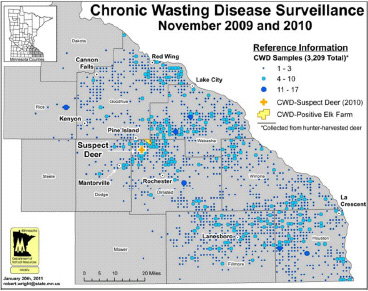
A deer killed by an archer in southeast Minnesota last fall is believed to have been infected by chronic wasting disease, the first wild whitetail in the state to be stricken.
Preliminary tests show that a doe felled Nov. 28 near Pine Island in Olmsted County carried the disease. Very little of the animal has been eaten by the hunter or his family, the Department of Natural Resources reported Friday morning, and authorities will pick up the butchered meat for further testing.
CWD is not believed to pose a danger to humans, though hunters and others who eat venison and elk meat are warned that an animal’s brains and spinal cord should be avoided.
The deer was killed about three miles from a captive elk farm near Pine Island that had been shut down recently after CWD was identified in its herd, which subsequently was “de-populated,’’ or killed in its entirety.
DNR big game coordinator Lou Cornicelli said Friday there is no way to determine how the wild deer became infected.
Before it was shot, the animal appeared thin, the archer recalled, but otherwise behaved normally. CWD can gestate in an infected animal for as long as four years before clinical signs of the disease are detected and the animal dies.
The archer has asked state authorities to remain anonymous.
Read the rest of this entry »
From Colorado’s San Luis Valley
January 20th, 2011

Here’s my “Day 2” presentation at Alamosa, Colorado last Wednesday (a week ago already? How can that be?):
And a report from the Valley Courier:
Proposed transmission line gets a little TLC
Posted: Friday, Jan 14th, 2011
TLC is opposed to the proposed new power line, and the speakers during
the Wednesday forum questioned the motives and rationale behind the
proposal. They questioned that the line was necessary and encouraged
attendees to seek legislative action, pursue the NEPA (National
Environmental Policy Agency) process and “get loud” in their opposition
to the line.TLC plans to host another forum in the Valley on April 20 with the utility companies as guest speakers.
Fort Garland resident Sally Keller described TLC as a coalition of
concerned citizens and independent member groups who support
environmentally sound alternatives that rely on upgrades to the existing
corridor.“We do not support the transmission line,” she said.
TLC encompasses such groups as the Land Rights Council, Save La Veta
Valley, SLV Ecosystem Council, Sangre de Cristo Homeowners Association
and Majors Ranch Homeowners Association as well as individuals.Keller reminded the group of some of the history of the line and efforts
to oppose it and said several matters are pending right now so “stay
tuned.”Carol Overland, author of “Transmission Lies” and legal counsel
representing groups opposing transmission lines in the Midwest and East
Coast, questioned the need for new transmission lines anywhere in the
U.S. because demand has decreased.“Demand is way down,” she said. “If demand is down, what’s the driver?”
She said one of the reasons power demands have decreased is the loss of big industry in this country.
“That kind of need is not coming back anytime soon,” she said.
“I have never met a transmission project that was for the reasons they say it is,” she said.
“The biggest lie of all is that we need it.”
Overland said she was not as familiar with Colorado processes and the
Valley’s proposal as she was with those in the Midwest where she works,
but she encouraged the audience to question the stated purposes for the
new line here. She said completing the circuit is a legitimate reason
but there might be other ways to accomplish that other than a new line.She suggested upgrading existing corridors and infrastructure rather
than building new, and she advocated replacing fossil-fueled power with
renewable energy. As utility companies are required to implement
renewable energy standards, at the same time they should be backing off
from traditional power sources, she said.Overland said new transmission lines are being constructed not to address need or renewable energy mandates but to sell power.
She encouraged Valley residents to push for legislation that allows them
to become part of the public input process early on (“typically the
public does not get involved until too late”) and that requires utility
companies to consider the people who are directly affected by proposed
transmission lines, such as the landowners over whose property the lines
will cross.“It’s built on the backs of landowners … and on the backs of ratepayers.”
Overland also said just because an area might provide the best resource
for renewable energy such as solar does not mean it should be used over
an area that might provide adequate resources and less disturbance to
landowners.“This isn’t rocket science,” she said. “It’s only electrical.”
She urged local residents to “get loud,” “raise hell” and become involved politically and publicly.
“Get active at all levels,” she said. “You’ve got to be proactive. They are not going to come to you.”
Colorado Open Lands President Dan Pike urged utilization of the NEPA
process in connection with this project. He said he has never seen a
better, more comprehensive process. NEPA looks at both sides of an
issue, benefits and drawbacks and considers all types of impacts from
economic to environmental, he said.Pike, whose organization holds 20 conservation easements in the
transmission line study area (the largest of which is on Trinchera
Ranch), described processes and players involved in transmission line
projects and said it can be very complicated, with decision makers
involved at all levels from local to federal levels.“The day of utilities making proposals for transmission lines in isolation is about over,” he said.
Pike said environmental analysis decisions could be appealed first
administratively and ultimately legally if necessary. The latter is
something most government agencies want to avoid, he said, so they want
to make sure the process is conducted properly.He said as it stands now, environmental analyses have not been
comprehensive enough, and if more information and more impacts are not
considered, “they have got an imminently challengeable decision.”Going back to NEPA, he said, “I am really a fan of NEPA as a decision
making tool … It requires you have the adequate information to make
decisions. I don’t think we have got the adequate information.”The third speaker at Wednesday night’s TLC forum was Gary Graham, Ph.D.,
transmission project director for Western Resource Advocates, an
environmental group that came out in support of the La Veta line. His
main focus was climate change, and he talked about warming trends and
the effect on wildlife habitat, particularly at higher elevations.Graham advocated replacing “dirty energy” with renewable energy, with that energy requiring transmission.
“We don’t know how much renewable energy is going to be needed,” he said.
Unfortunately, Graham did not disclose that in the last two Energy Foundation grant cycles, Western Resource Advocates received ~$500k to advocate FOR transmission, a la Wind on the Wires (linked HERE). Look what they have to say about High Plains Express (HPX):
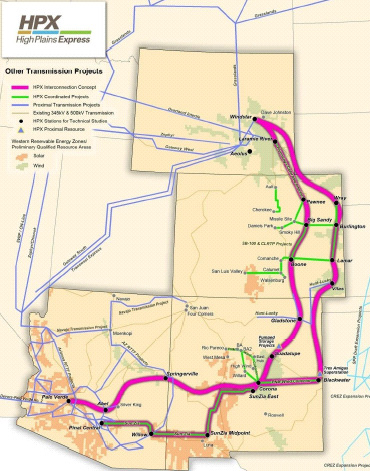
Hs should have, and I should have outed him then, because what their transmission advocacy only increases ability of utilities to move that coal generated electricity around — they are NOT advocating to shut any plants down to make room for renewables! Of course, they’re advocating the same pro-transmission positions as the Izaak Walton League’s “Wind on the Wires” which is no surprise because the $$$ comes from the same place! They’re assuming transmission is necessary and promoting federal authority and NIETC designated transmission corridors, and rather than shut down coal, saying that emissions should be “captured and sequestered” and use the same corridor for a CO2 pipeline! Obviously they did not know/admit what we all in Mesaba Project land knew about the farce of “sequestration.” (click HERE for search of Legalectric on “gasification” for info on IGCC and carbon capture) Once more with feeling — CO2 capture and storage is NOT happening, case on point is the recent release (snort!) of information about the leaking CO2 experiment with “Enhanced Oil Recovery” by piping CO2 into the ground in Weyburn, Sask. It is NOT happening, and the DOE admits that in their environmental review for these projects. And transmission “for renewables” is not, it’s all about export, the San Luis Valley line and particularly the HPX line which starts at the Dave Johnston coal plant in Wyoming, tying into Xcel’s Comanche plant, which the San Luis Valley line would connect into as well. Yes, it’s all connected… transmission, the foundation grants… maybe it’s time to concertedly expose those Energy Foundation grants for what they are?
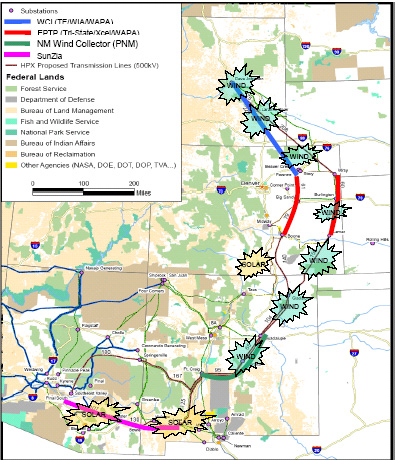
And exactly a year earlier, look what was happening in New Mexico: