The Tammens featured in Session Weekly
March 25th, 2011
It’s hard to miss the Tammens — they are EVERYWHERE!!! Saw them up in Clouqet about a year ago at an IATP Biomass love-fest, and they have been at every meeting and hearing for the Excelsior Energy Mesaba Project. Good to see they’ve been noticed!!!
Here’s the profile in Session Weekly — thanks to Darrell Gerber for pointing this out:
Soudan snowbirds
Published (3/25/2011)
By Sue Hegarty
You might not notice Bob and Pat Tammen sitting in the House hearing rooms. Bob, clothed in a crisp, pressed dress shirt and necktie, blends in with the lobbyists, deputy commissioners and expert testifiers. Pat sits next to her husband, alert to the day’s agenda.
Bob and Pat met after he returned from Vietnam in 1965.
They don’t always agree with some DFL legislators who say mining brings prosperity to a community.
When the legislative session ends, they’ll drive north again and park the camper on
Xcel’s Hiawatha Transmission Project Comments Due
March 24th, 2011

Does anyone give a rodent’s rump about Xcel’s Hiawatha Project transmission project through Phillips?

Listen up! It’s time to Comment on what we all think the scope of the Environmental Report should be for Xcel Energy’s Hiawatha Project transmission line. What should be reviewed, what system alternatives should be considered (conservation, reconductor the distribution system at issue), demand side management (demand is DOWN, DUH!), solar on every roof of Phillips to follow peak load… , whether the size of the project (the specs) conform with the need they’re claiming, whether a power factor and distribution based need claim can and should be addressed with a big honkin’ transmission line, and how ’bout some realistic magnetic field modeling, ____________ (your issue here!).
Does anyone care?
Last week was the public meeting to solicit comments on the scope of environmental review, a meeting (NOT a hearing!) held by our friends at Minnesota Office of Energy Security – MOES:
COMMENTS ON THE SCOPE OF THE ENVIRONMENTAL REPORT ARE OPEN UNTIL APRIL 6, 2011!
Send Comments to:
Bill Storm State Permit Manager Minnesota Office of Energy Security 85 7th Place East, Suite 500 St. Paul, Minnesota, 55101-2198 Fax: 651-297-7891 email: bill.storm@state.mn.us
More on Comments below… I couldn’t attend the public meeting because it was in the middle of the AWA Goodhue Wind evidentiary hearing, there was no way to do both. However, this is my old neighborhood, I spent 20 years in Prestigious East Phillips! I can’t stand the thought of this project ripping up Phillips…
To look at the dockets for this case, go to www.puc.state.mn.us and click “Search eDockets” and search for:
Hiawatha Project Routing Docket – 09-38
Hiawatha Project Certificate of Need Docket – 10-694
I’m concerned whether anyone cares, whether anyone is going to be weighing in on this, because the big intervenors in the routing case, Hennepin County, City of Minneapolis, and the Midtown Greenway Coalition have all pledged not to intervene:
Joint letter from Hennepin County, City of Minneapolis, and Midtown Greenway Coalition
Why would they say they’re not planning on intervening? Did they agree not to intervene? Why?
What does it mean if the large funded intervenors aren’t participating in the Certificate of Need docket?
Why does it matter if anyone intervenes in the Certificate of Need?
Well, it’s simple. This project isn’t needed. And in a Certificate of Need proceeding, the applicant has to prove up need. If it’s not needed, it doesn’t go forward. If you want to stop a project, force them to do it another way, the odds are a lot higher if you show up and participate in the Certificate of Need docket at the PUC. If not, well, you’re just sitting on the sidelines and stuck with whatever result happens while you’re not there. The moral to the story? SHOW UP!
During the Hiawatha Project’s PUC routing process, there were loud objections that this project was not needed, was not subject to a Certificate of Need, and should be. Rep. Karen Clark pushed through a bill requiring a Certificate of Need for this specific project:
So amid much breast-beating, this bill of Rep. Karen Clark was added to SF 3275 and became part of Ch 361. A Certificate of Need is now necessary for the Hiawatha Project.
But here’s the hilarious part — there was a $90,000 kicker to ???? some organization, to do neighborhood conservation and energy planning, $90,000, and that the project would go forward, it wasn’t hinged on the results of this “work.” The bill passes and goes on to the Gov. to be signed… SNORT… Pawlenty vetoed the $90,000 payout in the bill!
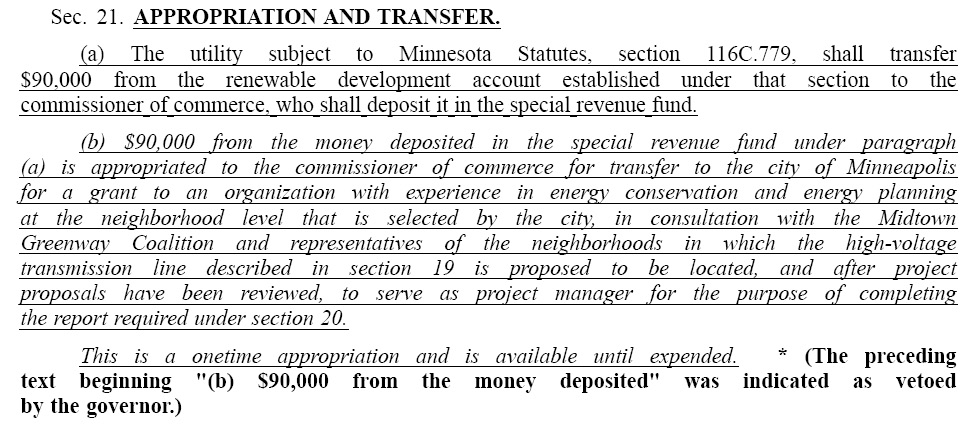
So now where are we? The money is gone… funding to a community group is pulled out from the bill. (And what community group would that be intended for… CERTS? … Xcel-funded Green Institute? What organizations have “experience in energy conservation and energy planning at the neighborhood level?”) Oh well, the project moves forward.
Next, Xcel applies for the Certificate of Need, which under this bill is not to proceed until after April 1, 2011, and now the scoping for the Environmental Report is held.
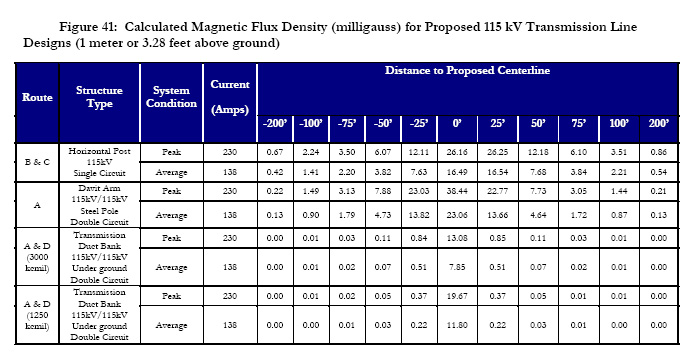
What is “scoping?” It’s when an agency collects comments and mulls it over and determines what all should be covered in environmental review. In this case, because it’s a “Certificate of Need” proceeding, system alternatives are at issue, in addition to the usual environmental suspects. And of course, a full disclosure of impacts is necessary, things like the expected range of magnetic fields. That’s a particularly prominent issue because in the routing docket, the Administrative Law Judge recommended that the Hiawatha Project be put underground due to exposure of local residents and workers to high levels of magnetic fields, higher than the threshold above which the World Health Organization would urge we exercise precaution. And of course, the reasonable levels are a lot higher than what they’re disclosing.
Before you work on your comments, take a look at what’s been posted as the “Draft” Scoping Decision:
And check out these magnetic field charts from the application – do these amp levels have any relation to the claimed need and the potential amps on the lines as spec’d?
WHAT DO YOU THINK SHOULD BE ADDRESSED IN THE ENVIRONMENTAL REPORT?
COMMENTS ON THE SCOPE OF THE ENVIRONMENTAL REPORT ARE OPEN UNTIL APRIL 6, 2011!
Send Comments to:
Bill Storm State Permit Manager Minnesota Office of Energy Security 85 7th Place East, Suite 500 St. Paul, Minnesota, 55101-2198 Fax: 651-297-7891 email: bill.storm@state.mn.us
Furnace Update
March 23rd, 2011
It’s a cold day in hell today, too cold to be painting in the new house!
Most of you can ignore this post, but for those of you looking for the owners manual for the Carrier Weathermaker 9200 Ultra High Efficiency 58MXA 060, here it is:
Nuclear saga continues in Japan
March 21st, 2011
The nuclear disaster in Japan continues, new twists unfolding each day…
Japan agency says crippled nuclear plant operator missed inspections before disaster struck – STrib
In a report released March 2, nine days before the disasters, the Nuclear and Industrial Safety Agency cited Tokyo Electric Power Co. for ignoring inspection schedules and failing to examine 33 pieces of equipment at the Fukushima Dai-ichi nuclear plant.
And as for conditions at the Fukushima nuclear site, an update from Bloomberg News:
No. 1: The temperature outside the reactor’s pressure vessel fell to 385 degrees Celsius, as of 3 a.m. from 400 degrees as of 3 a.m. yesterday, Hikaru Kuroda, an official in Tokyo Electric’s nuclear management department, said today. The reactor was damaged on March 12 by a hydrogen explosion that destroyed the building’s walls. The reactor is rated level five in terms of threat on an international scale of 1-7.
No. 3: Smoke was seen rising from the building of the reactor at about 3:55 p.m. local time. Workers were evacuated from the building, spokesman Kaoru Yoshida said. Workers connected a power cable to the No. 3 and 4 reactors. The temperature inside the reactor dropped below 200 degrees Celsius, the Fukushima plant operator said earlier today. The Japanese Self Defense Force and firefighters have doused a total of 3,742 metric tons of water on the reactor since March 17, the government agency said in a statement. A March 14 explosion damaged the unit’s fuel cover. The reactor is rated a level-five threat.
Isn’t it time for those who did the deal allowing new and increased dry cask storage at Monticello (same boiling water reactor as Fukushima’s) and Prairie Island to say NO! From the New York Times, for those of us here in Minnesota by our own GE boiling water plant in Minnesota, info on the design of that type of plant:
Live from the PUC again today!
March 17th, 2011
GO HERE and click on “Watch Webcast”
Today will be better than yesterday, for me at least.
And check out Goodhue Wind Truth’s site for info on this project.