Ft. Calhoun nuclear plant flood and fire
June 8th, 2011
Remember the flooding info and maps I’d posted a couple of days ago, noting that two nuclear plants in Nebraska were in the flood inundation area?
Well, Frieda Berryhill sent this photo of the flooding at the Ft. Calhoun nuclear plant:
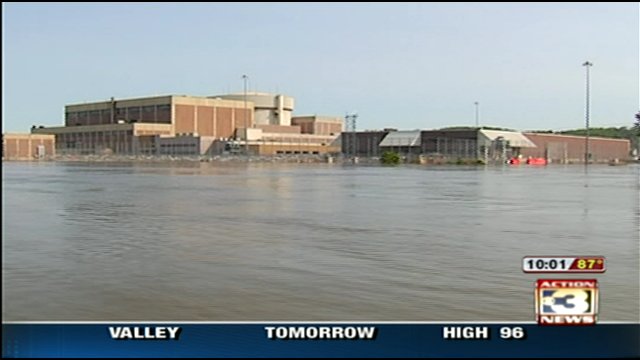
Check the video, Omaha Public Power District – OPPD didn’t want the news crew filming the flooding!!! And thankfully, they reported that point:
As if the flooding isn’t enough, they had an electrical fire, and shut down the spent fuel pond pumps to aid in fighting it. There are many articles posted on this, all the IDENTICAL AP article, and not one mention of flooding:
Here’s a local paper with some additional details:
Omaha Public Power District’s release on the flood:
OPPD Declares Notification of Unusual Event
Fukushima can’t happen here? Uh-huh… right…
June 6th, 2011
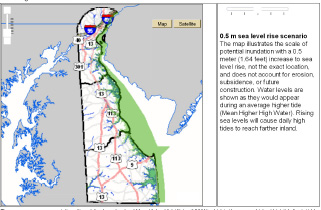
I’ve gotten a few emails questioning raising issues about our own GE nuclear reactors, like at Monticello, and they always note, “it can’t happen here.” Anyone who knows anything about nuclear knows better… and as one living in a “nuclear” community, two reactors here in Red Wing, and three in Salem, NJ, right across the river from Port Penn, I know too well the risks. Floods happen. Hurricanes happen. Salem and Hope Creek are built on a manufactured sand “island” on the Delaware River just up a tad from the Atlantic Ocean, up just enough to suck in the fresh water (and lots of fish), and close enough to be history as the sea continues to rise:
Well, folks we have a situation… the U.S. Army Corps of Engineers is releasing a lot of water from dams along the Missouri River backed up with too much rainfall, and they’ve started to evacuate parts of North Dakota, and it’ll affect South Dakota and Nebraska too.
The U.S. Army Corps of Engineers has a site: Flood Resources
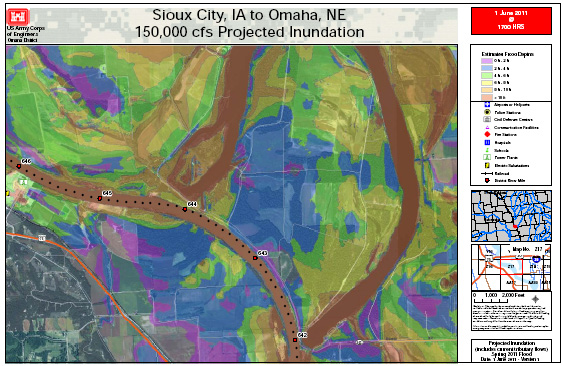
Here are the “Inundation Maps”
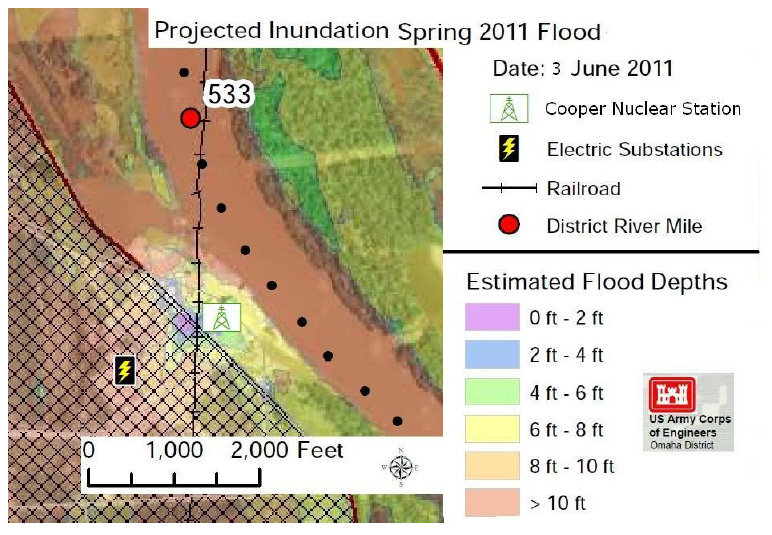
On the Sioux City, IA to Omaha, NE link, check out map Z17 and look way over in the right side for the Ft. Calhoun nuclear plant (yes, there is something in Ft. Calhoun in addition to the legendary “Ft. Calhoun Interface.”), and compare with the maps below that focus on the plants — it’s hard to miss the placement of these “critical” plants in hard to find places:
From Roger Herried today:
As a result of one of the wettest winters in over 100 years the Missouri River is threatening 6 dams that were put in place over the last 60 years to reduce annual flooding on the Missouri’s floodplain which averages between 10-20 miles across. When the area of concern was first settled by Europeans, they built their towns and farms in the fertile plain because it contained the best soil to grow food. In 1889, there was a wet year that filled the entire floodplain with a torrent that lasted for weeks. All towns and farms on the plain were washed away. The only thing left of my home town of Vermillion SD. were a few big concrete blocks of the local church. The next time they rebuilt was not on the flood plain but on the bluffs overlooking the Missouri.
Starting in the 1960’s the US Corps of Engineers constructed 6 dams on the Missouri River, the last of the six being located near Yankton SD called Gavins Point Dam. With the dams in place, everybody went back to putting farms and guess what, two nuclear power plants on the flood plain. Due to the extreme winter including major rains in May the Corp of Engineers has announced that it will be forced to release 150,000 cubic feet of water per second throughout much of June. This is five times more water than the Corp has ever had to release before, and the rainy season has not ended yet. They are suggesting that these levels will continue for much of June.
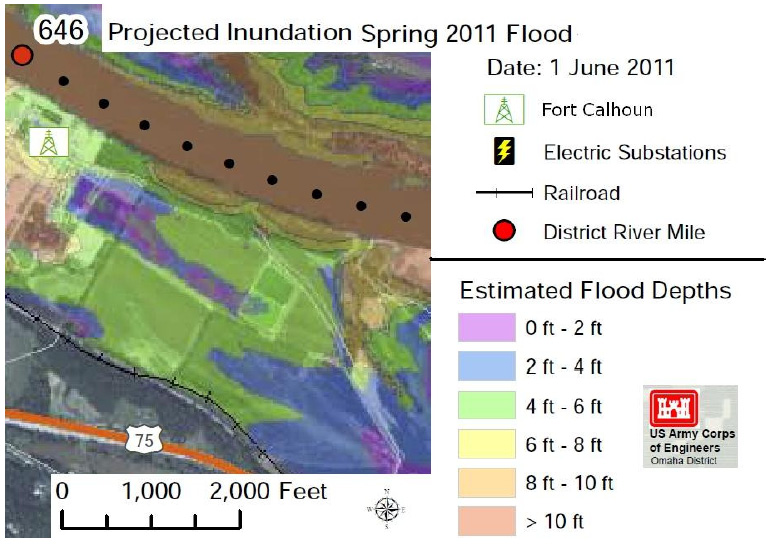
The Corps of Engineers has just released a set of projected flood maps for the area from Yankton SD throughout Nebraska showing what they think will happen in terms of controlled flood levels in the region. Based on these maps both of Nebraska’s nuclear facilities are in severe danger with the Fort Calhoun unit located 19 miles north of Omaha Nebraska and projected to be under water from 4 to over 10 feet of water (see map below). Note that in May of this year, the NRC hit Ft. Calhoun for poor flood control problems from flooding that took place last year. The facility is a 500 MegaWatt Combustion Engineering PWR reactor that is currently shut down.
The other reactor the Cooper nuclear station is located 23 miles south of Omaha and is an 830 MWe GE Mark 4 reactor and is currently at full operation. It is predicted to be under water from 4-8 feet. Behind the reactor and to the Northwest are located levees that are meant to keep at least reduce flooding by 2 feet.
Here are two maps sent by Roger Herried that identify and focus on the Ft. Calhoon and Cooper Nuclear Station nuclear generating plants:
Fracking sand mine video from Jim Tittle
May 31st, 2011
Rumor has it that there’s a fracking sand mine in the future down by Hay Creek. More on that here:
There’s a similar operation just across the river in Maiden Rock that’s grown with the natural gas surge, and here’s a video by Jim Tittle of what people who have to live with that mine think about it:
It’s not just about living next door. Stopping our Hay Creek mine is one part of the picture, that sand is the start of fracking, and stopping it is one thing we can do to slow the destruction of aquifers, land, and communities when natural gas drilling comes to town.
Gil Scott-Heron dead at a high-mileage 62
May 30th, 2011
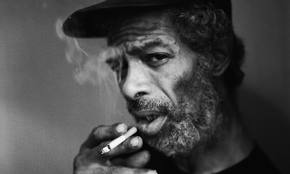
Gil Scott Heron died at 62, the end of a tortured and torturous life, he was one of the few speaking out, standing up…
On Gil Scott-Heron, prelude to a performance at the Dakota last year, and “Gil,” warns his road manager, Danielle Beckom, “is not good with schedules.”
From City Pages:
By Rick Mason Wednesday, Mar 24 2010
Often called the Godfather of Rap these days, Gil Scott-Heron in fact emerged as a fiercely eloquent voice from the urban wilderness in the early 1970s, mercilessly skewering political and social forces that had disenfranchised huge swaths of the population and were leading the world down a treacherous path. A writer first and an admirer of Langston Hughes, Scott-Heron eventually fused his own poetry with a potent dose of jazz laced with blues and R&B, railing against complacent media, an oblivious mainstream America, runaway consumerism, racism, venal politicians, and drug abuse. Pieces like “The Revolution Will Not Be Televised,” “Winter in America,” “Johannesburg,” and “Home Is Where the Hatred Is” hit like lightning bolts, both electrifying and enlightening. The rise of hip hop was clearly indebted to Scott-Heron, who has been sampled and referenced by the likes of Kanye West and Common. Silent for a decade and a half—during which he reportedly battled health, addiction, financial, and legal problems—Scott-Heron, 60, recently re-emerged with I’m New Here, a stark, riveting portrait of the artist as weathered scribe, more personally analytical than of the wayward world that once drew his searing scrutiny. In place of jazz is hard-edged post-industrial blues laced with ragged beats as he covers Robert Johnson’s “Me and the Devil,” Bobby Blue Bland’s “I’ll Take Care of You,” and Smog, in the title track’s tale of arid alienation. It’s like hearing a voice from the other side of the apocalypse, but unmistakably that of a survivor.
South Africa, U.S. tunes from way back, became the theme today for me as I listened to Gil Scott-Heron, I’d seen him decades ago… a riveting show… the Guthrie, early 80s??? He was a staple in our album collection at KFAI. In Paul Hipp’s Bachmann McCarthy Overdrive “What’s the word? TINKLENBERG!” seemed like a good riff off of Scott-Heron’s Jo’burg. In the CapX 2020 Hampton-LaCrosse docket there’s a conslutant from Biko Associates, which reminds me of that era, everytime I look at his testimony, my tape loop starts.
Here’s Gil doing Johannesburg:
And another earlier version, 1976:
… and speaking of Jo’burg, then there’s the Biko song that keeps going through my brain whenever I read William P. Smith’s testimony in the Hampton-LaCrosse case — what’s his tie?
“People must not just give in to the hardship of life. People must develop a hope. People must develop some form of security to be together to look at their problems, and people must, in this way, build up their community.”
-Stephen Bantu Biko
So on that theme, Peter Gabriel on one of the Amnesty International tours, best version I could find:
Morels in the backyard!!!
May 27th, 2011
Here in SE Minnesota, there are morels everywhere, so I hear, and I’ve been searching for 11 years now (locations are top secret of course) and nada… lookin’ for morels in all the wrong places, and here today, I’m flinging Summer poops up the hill and:

EEEEEEEEEEEEEE-HA!!! IT’S A MOREL!!! … so I take another look around, and:
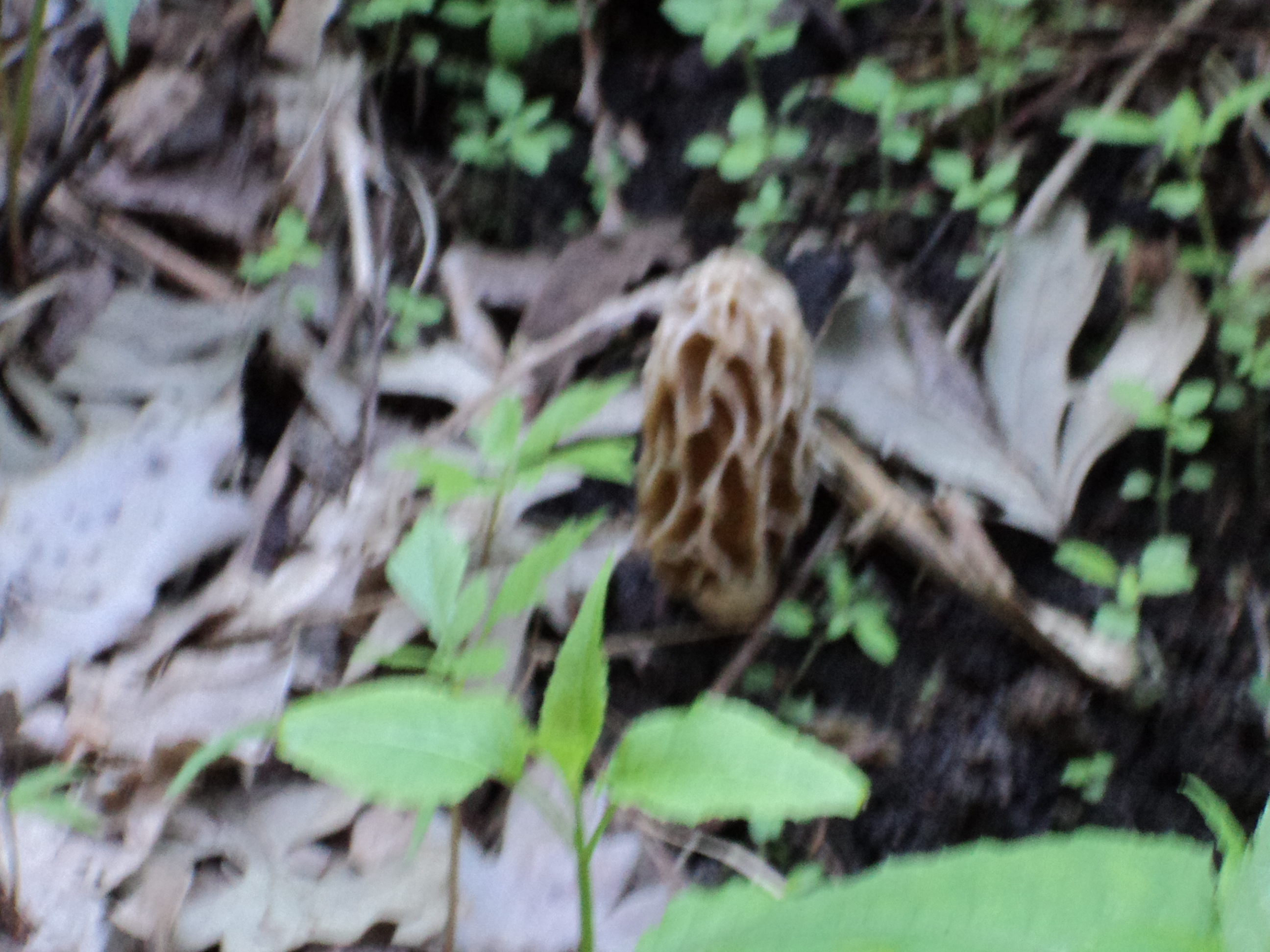
Could use a few more — and they must be there — so nevermind those Information Requests I want to get out, THIS IS A PRIORITY!!!

So the good news today is that it’s not just nuclear waste that I’ll find in my own back yard!