micheletti_1_mpr082216

For years and years, I represented mncoalgasplant.com opposing this wretched boondoggle of a pipe-dream of “clean” and “green.”

IGCC – Pipedreams of Green and Clean

The project lingers on, on life-support, and pulling the plug is long overdue.

The good news is that the Duluth News Tribune is finally paying attention, and looking into the financial irregularities.  Duluth News articles are here, and next will be some responses.

It started with an article in Duluth News Tribune, first in a series, the second below:

Published August 21, 2011, 09:40 AM


Millions in public money spent, but Iron Range power plant still just a dream


DNT investigation, part 1 of 2: When Excelsior Energy launched its ambitious, clean energy project in 2001, the company touted it as a way to bring much-needed jobs and investment to the Iron Range. But after nearly a decade and receiving more than $40 million in public money, Excelsior has little to show.

By: Peter Passi, Duluth News Tribune

When Excelsior Energy launched its ambitious, clean energy project in 2001, the company touted it as a way to bring much-needed jobs and investment to the Iron Range at a time when local residents were still stinging from the closure of LTV Steel Mining Co. The innovative, state-of-the-art coal gasification plant also would enable the nation to more effectively tap domestic coal reserves with minimal harm to the environment.

But after nearly a decade and receiving more than $40 million in public money, Excelsior has little to show. While significant work has gone into developing site plans and engineering work and garnering permits, the company has yet to move a shovelful of dirt to build its would-be 2,000-megawatt, $2.1 billion power plant.

And despite receiving virtually all of its backing from the public trough, the company’s spending records, including its officers’ paychecks, remain under wraps.

“At the end of the day, this is a project that has not hired one full-time worker on the Iron Range. Only lawyers, lobbyists and professional meeting attenders have gotten jobs,” said Rep. Tom Anzelc, D-Balsam Township, the only Iron Range legislator who has opposed the project. “And it has all been financed by the public.”

Behind the delay

Heading Excelsior are two seasoned energy professionals: Tom Micheletti, a Hibbing native and former Northern States Power executive, and his wife, Julie Jorgensen, former CEO of CogenAmerica and VP of NRG Energy Inc.

Supporting them is another Iron Range legislator, Sen. Tom Bakk, D-Cook, who argues that cleaner ways of turning abundant domestic supplies of coal into electricity are greatly needed.

Bakk blames the development’s delay on Xcel Energy’s refusal to do business with Excelsior, with the established energy company intimating that power from the new plant could be too expensive and could drive up customer rates.

“There was clear legislative intent that Xcel would purchase their power, but Xcel has been unwilling to enter an agreement,” Bakk said. “Without an out-take agreement, the project has not been bankable.”

Excelsior has made repeated efforts to persuade the Minnesota Public Utilities Commission to compel Xcel to buy its power, but has so far been unsuccessful.

Micheletti, who serves jointly with his wife as Excelsior Energy’s president and CEO, also said the project has suffered from unfortunate timing and the effects of a recession.

“Hardly anything is being built right now,” said Micheletti. “Load growth has come to a standstill, so there’s not a great deal of need for new facilities right now.”

Regulatory uncertainties facing the power industry have further complicated the plant’s outlook, Micheletti said, though he added that tougher regulation could help the project if it leads to the shutdown of older, dirtier coal-burning power plants or a shift away from nuclear energy.

Yet Micheletti said he’s stopped making predictions as to when Excelsior will build its first plant.

“It bothers me that, given the current economic situation, we’re not where we thought we’d be,” he said. “By now, 3,000 people would be working on the site if things had gone the way we thought.”

Public funding

From the start, Excelsior has relied primarily on public support, according to a 2008 audit by the Minnesota Office of the Legislative Auditor. The agency noted that excluding a small sum of private seed money, “the company initially relied mainly on Iron Range Resources loans for many basic costs it needed to operate, such as office space, desks and computers.”

In 2001, Excelsior borrowed $1.5 million from the Iron Range Resources and Rehabilitation Board. Additional loans have brought that company’s IRRRB debt to $9.5 million

In August 2010, Excelsior was to begin repayment of its IRRRB loans, but the agency extended the timeline to 2017, in light of project delays.

The company also received $10 million in state aid through the Minnesota Public Utility Commission’s Renewable Development Fund, despite objections from environmental groups about spending such funds on a plant designed to run on fossil fuel.

The U.S. Department of Energy contributed another $22 million, intended to cover half of the preliminary design costs.

The only public record of private equity in Excelsior occurred at its inception, when Micheletti and Jorgensen made a combined investment of $60,000.

Shuttered windows

Tracing where all Excelsior’s public money went and how it has been used is not easily accomplished, particularly after state lawmakers voted to restrict public access to Excelsior’s financial statements. Before 2008, reports the company is required to submit to the IRRRB as part of its loan agreement had been publicly available.

But that year, the Minnesota Legislature changed the state law, with a conference committee inserting language into an omnibus tax bill to classify financial disclosures made to the IRRRB.

Bakk, a member of that committee and also of the IRRRB’s board of directors, told the News Tribune he had no recollection of inserting the language and suggested the IRRRB itself may have requested the change.

Sheryl Kochevar, an IRRRB spokeswoman, confirmed that, justifying it to say the agency’s aid recipients should have “privacy protections that are similar to those a business would expect and receive when it is dealing with a bank.”

Kochevar said the IRRRB must approve all its loans and investments in a public meeting. After that, however, she said the agency will not disclose “nonpublic data about the business that it uses to monitor and protect its loan to or investment in the business.”

Bakk defended the IRRRB’s rationale, saying that if the agency required total transparency of the companies it assists, some might shun its aid, causing the Range to miss out on potential economic development opportunities.

But there is nothing stopping Excelsior itself from disclosing what it does with the public money it receives. Micheletti, however, refused to release that information.

“We do not and have never disclosed confidential private financial information, so that subject is off limits,” he told the News Tribune.

Charlotte Neigh, co-chair of Citizens Against the Mesaba Project, a group opposed to the plant, said the Legislature’s secrecy provision came on the heels of a complaint her group made about some of Excelsior’s uses of IRRRB funds that touched off an examination by the Office of the Legislative Auditor.

The auditors found Excelsior had indeed used some IRRRB loan funds for inappropriate purposes, including lobbying. The company subsequently was required to repay $40,161.

Anzelc contends that any entity that has received so much public assistance ought to be more forthright about how it has spent taxpayer money.

“I believe they should tell us exactly what they’ve done with all the public dollars they have secured,” he said.

Limited view

Even when Excelsior’s financial reports to the IRRRB were still public, they sometimes provided scant detail.

A 2004 letter to the IRRRB Board of Directors from Freeberg & Freeberg Certified Public Accountants acknowledged gaps in Excelsior’s reporting.

“Management has elected to omit substantially all of the disclosures and the statements of cash flows and retained earnings required by generally accepted accounting principles,” the report said.

Still, the reports provided a limited view into how the company was spending its funds. As of the end of 2006 — the last year for which financial reports are public — Excelsior had spent $9.6 million on engineering and site development, $8.2 million on permits and regulatory work, $6.9 million on commercial, financial and administrative services and $7.9 million on in-house staff and consulting expenses since the project’s inception.

Some of these expenses were in the form of unpaid bills to be settled at a later date. A significant portion of that debt was owed to the husband-and-wife team at Excelsior’s core.

State funds from the IRRRB and the Renewable Development Fund could not be used to compensate Micheletti and Jorgensen. Even though they could not collect paychecks for the first several years of Excelsior’s existence, Micheletti’s and Jorgensen’s salaries were carried on the company’s books with the understanding that payments would be made when appropriate funds became available.

According to records, in 2001, the two drew a combined $125,000 in deferred pay. In August 2002, the deferred annual salary of each was increased to $250,000, or $500,000 for the pair. In 2003, they each received another $50,000 raise, bringing their combined annual pay to $600,000, where it remained through 2006, at the last time of public disclosure.

The first indication that Excelsior actually cut paychecks for Micheletti and Jorgensen can be found in 2006, when Department of Energy funds became available for the project. As of 2005, Excelsior owed the pair $2.49 million jointly. In 2006, that debt was reduced by $600,000.

Micheletti’s and Jorgensen’s deferred annual salaries totaled $600,000 each of the previous three years. And unless the co-presidents took a cut, Excelsior actually would have had to pay them $1.2 million in 2006 to reduce their total deferred pay by $600,000 in a single year.

How much more pay Micheletti and Jorgensen have received since 2006 has not been publicly disclosed.

Micheletti refused the News Tribune’s request to disclose how much Excelsior has paid its officers, saying, “As I have indicated to you many times before, our company, like all others, does not disclose confidential information, including confidential financial information.”


Part II of the Duluth News Tribune series on Excelsior Energy:

Published August 22, 2011, 12:30 AM

Iron Range energy project seeks lifeline in more funding, new fuel source


Despite receiving more than $40 million in federal and state government money, Excelsior Energy risks running out of gas if it cannot attract additional investment from the public or private sector soon.

By: Peter Passi, Duluth News Tribune

* EARLIER: Millions in public money spent, but Iron Range power plant still just a dream

Despite receiving more than $40 million in federal and state government money, Excelsior Energy risks running out of gas if it cannot attract additional investment from the public or private sector soon.

Gone are state funds, including:

# About $9.5 million in loans it received from the Iron Range Resources and Rehabilitation Board, and

# $10 million from the Minnesota Renewable Development Fund.

Soon, Excelsior will burn through the more than $22 million in federal funding the Department of Energy earmarked to help develop its clean coal project on the Iron Range, according to financial records obtained through the Freedom of Information Act and analyzed by the News Tribune.

Those records show that as of Sept. 30, 2010, Excelsior had only about $1.9 million in unobligated DOE funds still available. The company had already spent more than 90 percent of the federal funding approved for project development.

And at what was then the company’s expenditure rate — consuming an average of $418,000 in grant funding per quarter in 2010 — Excelsior would exhaust the last of its federal aid before the end of this calendar year.

Tom Micheletti, Excelsior’s co-president and CEO, refused to discuss how much money the company has left or where it will turn next. Yet his confidence remained intact.

“We’ve got staying power to see our way through this,” he said.

Rep. Tom Anzelc, D-Balsam Township, said he expects Excelsior will turn again to the IRRRB for more support. But IRRRB Commissioner Tony Sertich said there have been no discussions about providing aid to Excelsior beyond the loans that it already has received.

“I don’t anticipate any further request from them,” he said. “We’re watching to see what happens next, just like everyone else.”

Refueling

Unable to move ahead with plans to build a $2.1 billion power plant that would run on gasified coal, Excelsior received authorization from the Minnesota Legislature this past session to proceed initially with a plant fueled by natural gas.

Sen. Tom Bakk, D-Cook, supported Excelsior’s request.

“I think that if we allow Excelsior to start as a natural gas plant, it substantially increases the chance that it (the coal plant) will be built,” he said.

Bakk noted that a natural gas-fueled plant would rely on pre-existing rather than relatively untested technology.

“There’s much less risk from an investor standpoint,” he said.

Anzelc was the only Iron Range legislator to oppose the idea of allowing Excelsior to shift gears and build a natural gas plant instead of one running on gasified coal. He sees the change of plans as a last-ditch effort to throw Excelsior a lifeline.

“The majority of the Range delegation and the governor believe that this is the only way to get any of the $9.5 million in IRRRB funds back. You need to have an actual project that has permits and is constructed. You need a real company that makes a profit,” he said.

Nevertheless, as hard as it may be to accept the loss, Anzelc contends that walking away from Excelsior is the responsible thing to do.

At present, natural gas prices are comparatively low, making it a competitive fuel for power generation, said Julie Jorgensen, Excelsior’s co-president and CEO. Still, Excelsior needs to consider the long-term price outlook for both gas and coal, and Micheletti said the company is weighing its options.

“Do we go slow on one and faster with the other or vice-versa?” he asked. “Or do we proceed with both at once?”

Micheletti estimates a couple of 600-megawatt natural gas-powered units could be built for about $900 million. That’s less than half the anticipated cost of Excelsior’s proposed gasified coal plant. Also, permits for natural gas-fired generators are typically easier to obtain than for coal-burning plants.

One roadblock is that Department of Energy money earmarked for “clean coal” technology probably could not be used to help develop a natural gas plant, Micheletti said. Regardless, he said, Excelsior is in a unique position to push a power plant along quickly.

“Right now, we have the only viable new site for an energy plant in the Midwest because of all the work we’ve done,” he said.

But Anzelc said Excelsior still lacks one essential: a customer.

“To my knowledge, no on in the power business is supportive of this project,” he said.

Search for customers

While Micheletti said he could not discuss specifics because of confidentiality concerns, he said Excelsior is in active talks with potential customers. He said the company will push ahead with a project only when markets justify the investment.

“A lot of companies went bankrupt building on spec. We’re not going to build without a customer,” he said.

Pat Mullen, Minnesota Power’s vice president of marketing and public affairs, isn’t surprised that Excelsior is looking at alternatives to its plan for a gasified coal plant.

“Their original project was way too expensive, and it didn’t get any traction,” he said. “We didn’t want it and neither did Xcel.”

Xcel and Minnesota Power objected to the project, warning that it would drive up their customers’ rates.

Excelsior sought to compel Xcel to buy power from its plant through a power purchase agreement, but the Public Utilities Commission refused.

Even the revamped natural gas plant plan could be a tough sell, however.

Minnesota Power spokeswoman Amy Rutledge said her company has been diversifying its energy portfolio to meet a state mandate that 25 percent of its power come from renewable sources by 2025. The company recently signed a deal to purchase another 250 megawatts of power from Manitoba Hydro in 2020. But new fossil fuel energy is not in Minnesota Power’s plans.

“We’ve looked at the energy needs of our customers,” Rutledge said, “and it is clear we have no need for additional power from Excelsior.”

Xcel Energy has plans to retire two coal-burning units at its Black Dog plant in Burnsville, Minn., and replace them with natural gas units. To obtain permits for that project, the company was required to seek alternative proposals to supply 435 megawatts of power by 2016 or 2017.

But the July deadline has come and gone, and Patti Nystuen, an Xcel spokeswoman, said Excelsior did not submit a proposal and Xcel anticipates no need for additional generation.

Minnesota Power’s Mullen described what he considers “a flat market” for power generation,

But he’s not counting Excelsior out.

“You have to give them credit for their tenacity,” Mullen said.

How many nuclear plants near today’s earthquakes in the US?  Dominion’s North Anna nuclear plant is right there, and was shut down:

Dominion’s North Anna Nuclear Plant Loses Power After Quake

Quake raises safety concerns as US nuclear plant shut

earthquake-nuc

Check the USGS site and you’ll be amazed how many earthquakes there are each day, but look at the U.S. for today, OH MY!

USGS EARTHQUAKE SITE HERE

earthquake-aug-23

Earthquake, a biggie, 5.9, today in Virginia, reported on the USGS site:

earthquake-details

the epicenter is near Domion’s North Anna nuclear plant, Washington Post says they’re waiting to hear from Dominion about the status …and google for more info…

Also today, looking westward, a 5.3 in Colorado:

earthquakecoaug-23And the USGS details on that:

earthquakecomagnitude-5

PJM members set new record…

August 20th, 2011

pjm-logo-photo-croppedashx

A little birdie asked a question about need for Susquehanna-Roseland recently, and got me thinking.  This PJM press release came out a while ago and I forgot to post it.  It’s a legit PJM press release with an astonishing and crucial and decidedly “against interest” admission:

THEY ARE NOT USING DEMAND RESPONSE TO REDUCE LOAD!!!

Well, that makes business sense, they’re there to sell power, why refrain from selling it if they can!  They’re also wanting to build more transmission, which they can’t do if they can’t prove need!  And what better way to prove need than having a record peak demand?  But we know what they’re doing…  How many MW do they have in demand response, DSM, interruptibles, demand reduction by any name?  How much lower would the peak demand be if they had used it as they should?

Here’s their press release:

PJM and members set new record for peak power use

And here’s that telling admission:

Demand response was not called on to reduce load.

Demand response was not called on to reduce load.

Demand response was not called on to reduce load.

Demand response was not called on to reduce load.

Demand response was not called on to reduce load.

Demand response was not called on to reduce load.

Demand response was not called on to reduce load.

Demand response was not called on to reduce load.

Demand response was not called on to reduce load.

Demand response was not called on to reduce load.

… once more with feeling…

Demand response was not called on to reduce load.

How dare they… and then to claim a “RECORD” peak demand…

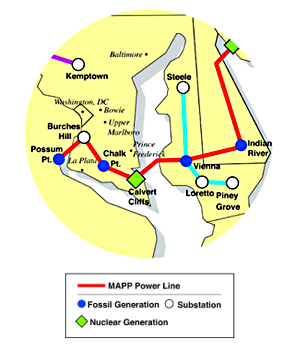
mapptransmissionoverviewSlowly but surely, Delmarva Power/PEPCO is admitting the Mid-Atlantic Power Pathway (MAPP) isn’t needed. We’ve weathered the weather, and they’re not even utilizing demand response, so where’s the need?  They’ve delayed this project, shortened it when they cut out the part through Delaware from Indian River Power Plant to the Salem nuclear plant, delayed and delayed, and now they’re REALLY delaying it, putting it off until at least 2019-2021.

Remember how the sky would fall and we’d be sweltering in the dark on a respirator without a job if this didn’t go through right away?  Well, guess again, and again, and again… the system is just fine, we can turn the lights on, we’re OK, and this line still isn’t needed and won’t be, probably ever!

MAPP PHI announces delay in project 8-19-11

From MAPP’s corporate parent, PEPCO Holdings Inc.:

As the Environmental Coordinator for the Mid-Atlantic Power Pathway (MAPP), I want to provide you with a brief update on the project.

As you may recall, MAPP is a proposed, high-voltage, electric transmission line that Pepco Holdings, Inc. (PHI) plans to build, beginning in northern Virginia, crossing the southern and eastern shores of Maryland, and ending in Delaware.

I want you to know that PHI has notified the Maryland Public Service Commission and Virginia State Corporation Commission that the company is requesting temporary delays in the Commissions’ reviews of the respective applications filed by the utility’s subsidiaries, Pepco and Delmarva Power, for state regulatory approval of MAPP. These requests were filed after PJM Interconnection’s recent analyses indicated that the MAPP in-service date should be moved from 2015 to the 2019-2021 time frame. (PJM is the operator of the regional electric power grid).

However, PJM is also currently evaluating the criteria it uses to determine the need for transmission projects. Once this process is completed, PJM will reassess the need and timeline for transmission expansion in the region.

At this time, PHI will review the work required to support MAPP based on the new in-service date, and will keep you informed on subsequent developments regarding this project.

Please be assured that PHI and PJM are dedicated to maintaining the reliability of this region’s transmission system, and will continue to analyze the need for new transmission projects that provide safe and reliable service for customers.

For additional information about MAPP, please visit the project website at www.powerpathway.com or contact me via phone at 302-283-6115 or e-mail at mark.okonowicz@pepcoholdings.com.

Also, members of our MAPP team would be happy to meet with you in person to discuss the project. Please let me know if you would like to have a meeting scheduled.

Sincerely,
Mark Okonowicz

MAPP – Environmental Coordinator

There a link on the Press Release to a PJM letter:

PJM’s MAPP Letter to PEPCO

The MAPP transmission project is needing a DOE EIS because they’re getting DOE funding for it.  What’s the status on that?  D-E-L-A-Y… delay delay delay…

DOE’s Key EIS Schedule

The MAPP EIS doesn’t seem to be happening… The DOE site says that it was to be released next month, or maybe December, but rumor has it that the DOE is waiting on info from the applicants… delay delay delay… and in the meantime, the DOE is still accepting (sounds like REQUESTING) Comments:

Community and Environmental Defense Services states that:  While the Scoping comment period ended April 4, 2011, DOE will continue accepting comments, which should be directed to:

Douglas Boren
Office of NEPA Policy and Compliance (GC–54)
U.S. Department of Energy
1000 Independence Avenue, SW.,
Washington, DC 20585
Douglas.Boren@hq.doe.gov

Fax: 202–586–7031
202–287–5346

Again, contact info if you’d like to send a “Thank You” note of appreciation  to Mark Okonowicz and PEPCO for admitting what we’ve all known all along, that this MAPP transmission line is not needed:

302-283-6115

or

mark.okonowicz@pepcoholdings.com

obama-progress

Good, I’ve got a few things to rattle his cage about… as if…

Remember when Clinton came to Carleton?  He flew into MSP and then hopped a helicopter to Stanton Airport.  Initially I figured that’s how they’d do it this time, just head east instead of west, but thinking about that “bus” bit, and the FAA no fly zones, errr, methinks it will be along 52 from MPS to Cannon Falls down to Decorah, IA.

President Barack Obama is planning to stop in Minnesota on Monday to begin a three-day bus tour to promote his economic policies. The White House announced Thursday that Air Force One will land in Minneapolis on Monday morning and then the president will host a town hall meeting in Cannon Falls at Lower Hannah’s Bend Park.
Monday, Aug. 15, 2011:

Lower Hannah’s Bend Park (just north and west of downtown)

Monday, Aug. 15, 2011 – 11:45 AM

Tickets required.  Tickets may be picked up at 1 PM on Sunday, Aug. 14, 2011, at 1 PM at the Cannon Falls City Hall.

Only two tickets/person are allowed and will be distributed on a first-come, first-served basis.
(Rumor has it only 500 tickets being distributed.)

The bus tour will also include events in Peosta, Iowa, and in western Illinois.

From the White House Press Release:

For security reasons, do not bring bags and limit personal items.  No signs or banners permitted.  All attendees will go through airport-like security.  Due to limited space at the event the White House will only be able to fulfill a limited number of requests for tickets. Tickets are not for sale or re-sale.

Peosta, Iowa???  That’s where Art Hughes died!

Art Hughes has died… March 31st, 2009