Rulemaking – Certificate of Need 7849
June 12th, 2013
How to work up excitement about the Certificate of Need rulemaking??? On its own, it’s dry, detailed, wonkish stuff, thrilling only to those of us who live and breathe need decisions and utility infrastructure siting and routing… but may there’s some pizazz in the machinations surrounding input, like lack of public representation on the Advisory Committee such that even my tremendous bulk doesn’t even it out. Does Xcel deserve THREE representatives? ITC two? “Participating Utilities” two, “Wind Coalition” one and none for Goodhue Wind Truth? Here’s the list:
Plus they’re not posting the drafts on the rulemaking site, so the public has no idea what’s being proposed:
And minutes from the first meeting:
To get to the docket, go to www.puc.state.mn.us and then “search eDockets” and search for 12-1246.
We’ll be talking about the Certificate of Need criteria next, and here’s what’s proposed:
7849.0120 CRITERIA CERTIFICATE OF NEED REQUIREMENTS.
A certificate of need must be granted to the applicant on determining that:
Subpart 1. Need Demonstration. An applicant for a certificate of need must demonstrate that the demand for electricity cannot be met more cost effectively through energy conservation and load-management measures.
Subpart 2. Renewable Resource Preferred. An applicant proposing an LEGF that uses a nonrenewable energy source must demonstrate that it has considered the use of renewable energy sources, as required under Minnesota Statutes section 216B.243, subd. 3a.
Subpart 3. Assessment of Need Criteria. In evaluating a certificate of need application, the
commission shall consider the criteria contained in Minnesota Statutes, section 216B.243, subd. 3, as well as the following:
A. whether the probable result of denial would be an adverse effect upon the future adequacy, reliability, or efficiency of energy supply to the applicant, to the applicant’s customers, or to the people of Minnesota and neighboring states, considering: the region;
(1) the accuracy of the applicant’s forecast of demand for the type of energy that would be supplied by the proposed facility;
(2) the effects of the applicant’s existing or expected conservation programs and state and federal conservation programs;
(3) the effects of promotional practices of the applicant that may have given rise to the
increase in the energy demand, particularly promotional practices which have occurred since 1974;
(4) B. the ability of current facilities and planned facilities not requiring certificates of need to meet the future demand; and
(5) the effect of the proposed facility, or a suitable modification thereof, in making efficient use of resources;
B C. whether a more reasonable and prudent alternative to the proposed facility has not been demonstrated by a preponderance of the evidence on the record, considering:;
(1) D. the appropriateness of the size, the type, and the timing of the proposed facility compared to those of reasonable alternatives;
(2) E. the cost of the proposed facility and the cost of energy to be supplied by the proposed facility compared to the costs of reasonable alternatives and the cost of energy that would be supplied by reasonable alternatives;
(3) F. the effects of the proposed facility upon the natural and socioeconomic environments compared to the effects of reasonable alternatives; and
(4) G. the expected reliability of the proposed facility compared to the expected reliability of reasonable alternatives;
C. by a preponderance of the evidence on the record, the proposed facility, or a suitable modification of the facility, will provide benefits to society in a manner compatible with protecting the natural and socioeconomic environments, including human health, considering:
(1) the relationship of the proposed facility, or a suitable modification thereof, to overall state energy needs;
(2) H. the effects of the proposed facility, or a suitable modification thereof, upon the natural and socioeconomic environments compared to the effects of not building the facility;
(3) I. the effects of the proposed facility, or a suitable modification thereof, in inducing future development; and
(4) J. the socially beneficial uses of the output of the proposed facility, or a suitable modification thereof, including its uses to protect or enhance environmental quality; and.
D. the record does not demonstrate that the design, construction, or operation of the proposed facility, or a suitable modification of the facility, will fail to comply with relevant policies, rules, and regulations of other state and federal agencies and local governments.
Dan Bender is Red Wing’s new Mayor!
June 12th, 2013

Photo: A January RW Beagle photo of Dan Bender being recognized as he left the City Council after not running last November.
Dan Bender is now Mayor. I don’t know much about him and so don’t have a clue how he’ll do as Mayor. We shall see how it goes. A couple of the candidates in this 6 candidate race were not credible or substantive. He seemed a solid option, with experience in city government, and noticeably lacking in the slick oily veneer of his predecessor — that difference shows in the photo!
We shall see…

PUC’s Stealth 7829 Rulemaking Docket
June 4th, 2013

So it turns out the Public Utilities Commission has had a rulemaking going on Minn. Rules Chapter 7829, which is the PUC’s “Utility Proceeding, Practice, and Procedure” and runs alongside the Office of Administrative Hearings rules in 1400 and 1405. I discovered this by accident when looking for the PUC’s Web Archive.
The 7829 Rules are something that I’ve been fuming about, that and the 1400 and 1405, for YEARS, like 17 years or so, and they start up a rulemaking docket and don’t give me notice? Feels real personal, particularly after all the trouble I had with the Post Office and my P.O. Box, trying to change the address, and making sure the PUC had the right address on things, getting phone calls from the keeper of the list that mail was being returned. But here they use an old address?

Plus the Comment period ended in April. I am NOT happy…
Here are the rules:
Here’s the notice and proposed changes:
… and check the service list — proof they had the wrong address for me and yes, I didn’t get notice. And I”m not on any of the other lists.
HELLO! EARTH TO MARS!
Where did they get this service list? They had a list called the PPSA list, that I was on, but wrong address, and several Telecom list and an “SPL_SL_ETCList-DOC-PUC” list and rulemaking lists, and somehow I’m not on any of them? How can that be? Shouldn’t they at least have noticed this when mail was returned?
And look at the notice, the email for comments is “christopher-moseng@state.mn.us,” but that bounces, his email is “christopher.moseng@state.mn.us” — shouldn’t that be corrected?
So, for any of you who did not get notice on this, it’s time to file some comments, file on eDockets, file 13-24. It’s important, because the only ones filing are a couple of state agencies and utility toadies.
And as Suzanne noted, use their proposed procedure to assure they are not excluded as “late” — can’t have that now, can we:

Tippecanoe now joins Tyler, too
June 1st, 2013
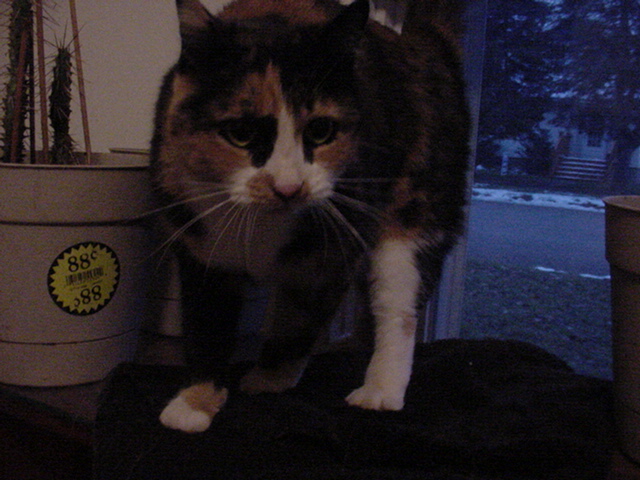
Tippecanoe died this morning. She was a very old, old cat found by Marlene Halverson way back in 1997 wandering alone a parking lot on a rainy day. Marlene brought her to the office, where she stayed a day or so, and she roamed the hallway crying so loudly for such a little beast, going around the upstairs hallway on the second floor of the Nasby Building in Northfield where we both had offices. I had Tyler then, deemed by Bob Jacobsen as “a fish,” because he didn’t allow cats in his apartments above the store, so in joining Tyler, she naturally became Tippecanoe.
A haunting song for Tippe:
I’d had to “rehome” her, Steiner too, when Krie tried to eat them (with Katze, she lived for about 6 months on top of the refrigerator, bookcases, anywhere to stay away from her, except for those few times when she’d leap from the fridge and ride Katze around the kitchen). We got them back last November, and for a while, they lived in the old house in Red Wing, and after we got back from December’s trip to Delaware, we brought them over and integrated them in, first in the basement, and rather quickly Tippe joined the rest of us upstairs, followed by Steiner. She was always small, but was pit bull muscular, and never liked to be held, just always wanted to be nearby. She had a spot on Alan’s desk where she spent her days, or the futon in the office, and she liked the window in the office where I set her up with a pillow in a couple of file boxes so she could lounge in comfort and stare out the window and lay in it when it was open. Both of the cats were skin and bones when I got them back, and Steiner gained her weight back, but Tippe didn’t, and she continued to lose weight from the 5 pounds she weighed when we took them to the vet.
Tips in the front yard:

Lately, she’s been having a more difficult time getting up the stairs, and had taken to lying on the hard but cool floors rather than on her catbeds scattered around the house. Every time we feed the dogs, she cries and cries for treats, and we gave her yogurt, sour cream, chicken, something she’d enjoy, but her cries were softer and sometimes she didn’t bother. The night before last, she didn’t eat her chicken, and I figured the end was near. She spent the last two days in the kitchen, so I put another cat box in there, and she was doing well on output, but I wondered if she’d be alive in the morning. She made it, and yesterday ate her treats, though she had trouble with the chicken, but when broken up, she ate it. Then late yesterday afternoon, I found her in the upstairs bathroom, on the cool tile, and she stayed there the rest of the day, had her chicken up there, but again, I doubted she’d make it through the night.

Early this morning, I found her on the floor, having petit mal seizures, and she was not conscious and I remembered with Krie, when her liver gave out, she started with petit mal and by the time we got to the vet, grand mal, and the same thing happened with Isabelle, roommate Peter Allen’s cat when he was in China, and those seizures were awful. I didn’t want her to go through that. Then it seemed she started to relax, her legs visibly straightening out, less tense, and fewer twitches. It was still an hour and a half before the vet opened, but they’re an hour away, so we lined a box with a towel and put her in it, just in case she started grand mal seizures, her breaths were weird, uneven and long spaces and she was clearly dying though not in distress. I went to get dressed to go to Kenyon Vet Clinic. but as I was finding my shoes, Alan said he thought she’d died. Sure enough, that was it, no big seizures, no agony, a fairly quick not-so-bad death.
Tippecanoe will take up residence in a corner of the back yard and we’ll find a plant to put there and think of her as it grows.

Buy the Farm — A Win For The Home Team!
May 29th, 2013
Today we had a rulemaking Advisory Committee meeting about Public Utilities Commission rules for Certificate of Need proceedings. More on that later, because at 10:00 a.m. the Minnesota Supreme Court decision on Buy the Farm was released (Buy the Farm, Minn. Stat. 216B.12, Subd. 4, is a statutory provision where landowners can force a utility to condemn their whole parcel, rather than just a narrow easement and let them get out from living under a transmission line), and oh what a decision. Kudos to Jerry Von Korff, who was at the rulemaking meeting, and his cohort Igor Lenzner, also Michael Rajkowski and Sarah Jewell, the attorneys who brought the appeal, plus Rod Krass/Kirk Schnitker and yours truly on Amicus. It was a win for landowners, homeowners, farmers, business owners, for everyone who has transmission condemnation/eminent domain cases pending, this one’s for YOU!
It really doesn’t get much better than this.
Bottom line on minimum compensation? Landowners are entitled to minimum compensation:
Appellants who elected to require utilities to condemn their entire properties in fee pursuant to Minn. Stat. § 216E.12 (2012) are entitled to minimum compensation under Minn. Stat. § 117.187 (2012) as owners who “must relocate” because on the date of the taking, the utilities took title to and possession of appellants’ entire properties.
… and …
Accordingly, we must determine whether appellants were required to relocate at the time their properties were taken. Because NSP initiated quick-take condemnation proceedings, the time of the takings with respect to appellants’ properties was when title to and possession of the property passed to NSP. See Moorhead Econ. Dev. Auth., 789 N.W.2d at 874 (explaining that “the date of the taking” in a quick-take condemnation proceeding is when “the transfer of title and possession” occurs, which is “well before the commissioners file their award”). It is undisputed that by the time title to and possession of appellants’ properties passed to NSP, appellants had made their elections under Minn. Stat. § 216E.12, subd. 4, which by operation of the statute, automatically converted the easements sought into fee takings. See Minn. Stat. § 216E.12, subd. 4 (explaining that at the time the property owner makes an election, “the easement interest over and adjacent to the lands designated by the owner to be acquired in fee . . . shall automatically be converted into a fee taking”). It follows that, at the time of the takings, NSP took title to and possession of appellants’ entire properties in fee. Therefore, we conclude that appellants were owners under Minn. Stat. § 117.187 who, at the time the takings occurred, “must relocate.” Accordingly, they are entitled to minimum compensation.
Bottom line on relocation benefits? Landowners are entitled to relocation benefits:
Because appellants are “displaced persons” under federal law, they are entitled to relocation assistance under Minn. Stat. §§ 117.50-.56 (2012).
… and…
Because appellants are required to relocate permanently, they do not fall within the exemption in 49 C.F.R. § 24.2(a)(9)(ii)(D). Therefore, because we conclude that appellants satisfy the definition of “displaced persons” under 42 U.S.C. § 4601(6)(A)(i)(I) and do not fall within any exemptions to that definition, we hold that appellants are entitled to relocation assistance under Minn. Stat. §§ 117.50-.56.
The decision was written by Justice Alan Page (photo from StarTribune www.startribune.com):

Yes, when he’s not wearing a football uniform, he’s the guy who is ALWAYS seen wearing one of his many classic “Jacobsen” bow ties, standing up for the public interest and the people of Minnesota. For him to be in the spot where he is, to do the work he’s doing, a long strange trip for a football player (sort of like it was for a truckdriver, eh?), with some good mentoring along the way.

This decision is something I’ve been working for, and toward, since I first got involved with the Chisago Transmission Project so long ago, and folks, that’s 17 years now…
Now and then, some event rates an “OH HAPPY DAY!” and this is the best of all, so this time from Aretha… OH HAPPY DAY!!!
From the St. Cloud Times:
The decision by the state’s highest court overturns a Court of Appeals decision and affirms the ruling by Stearns County District Court Judge Frank Kundrat that had been overturned by the Court of Appeals.
The Supreme Court ruling hinged on whether property owners who chose to require CapX to condemn their property would receive that compensation or whether those property owners chose to move from their property and therefore aren’t entitled to the compensation.
Read the rest of this entry »