Silica Sand Rulemaking off track…
April 30th, 2014
Well, that’s not quite right. This “rulemaking” has yet to get ON track, and that’s what’s bothering me.
Remember when the MPCA staff said they couldn’t imagine how a rulemaking advisory committee could or would work? From an earlier blog post, “Someone explain rulemaking to the MPCA“ here’s the MPCA resistence and an explanation:
MPCA staff’s report to the EQB stated inexplicably that they were “confused,” claiming ignorance of how rulemakign works and the impact of comments at this stage:
i. Staff requests Board direction on a question that arose at the August 2nd public meetings.
Once more with feeling, state law clearly and expressly authorizes and establishes the role of a Rulemaking Advisory Committee. The statutory purpose is to COMMENT on the proposed draft… BEFORE it’s published:
Once more with feeling… you’ve got to have a DRAFT to COMMENT ON!
Here’s the link for the state’s Silica Sand Rulemaking Advisory Panel page. And from that page:
Past meetings
April 2014
March 2014
- Meeting notes (March 2014)
- See the recorded WebEx
- Presentation: Air permitting 101 – Air regulations and permits
January 2014
The panel first met on January 29.
Look at this presentation, beginning at 10:40, where there’s an “explanation” with a slide for the group: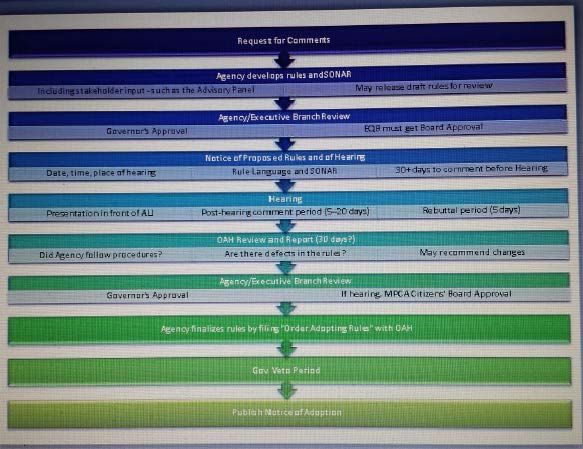
Catherine Neuschler’s explanation, at the April meeting (rough version, not quite exact) which goes around the PURPOSE of an Advisory Committee, which is to review drafts:
Your role is to inform the agencies on their silica sand rulemakings … on proposals or other key issues, things we bring to you and you want to bring to us… There’s not going to be… we do not expect any preparation for a panel report, meeting notes and recordings, provide record of what was said, not expecting a panel report. Of course all of you can make official comments as part of the rulemaking process… (no mention of draft review!!!), if you want to work together as a group to write some comments, or as a subgroup, to write some comments… To bring home what those places are where you may have the opportunity, where you will have the opportunity to weigh in (referring to chart above). Here’s a simplified version of the rulemaking process as a reminder, the process we’re in now is”Agency develops rules and SONAR” so that’s where we’re looking for stakeholder input … Various agencies, depending on how they do their process, may release drafts rules for public review, certainly if we do that, if any of the agencies do that, that will be a place you can weigh in. The next step is Agency and Executive Branch review…
WOW! Then a discussion of how this process goes forward:
The way I view then, the next step, what we’re doing internally in the PCA, is that in the summer, we’ll present, the agencies will present some conceptual overviews of rule concepts, and I am adamant, that’s going to look a lot like this, that it’s going to say something like, what’s there, what do we think we want to do, if it’s Air Emissions, OK, we think Best Management Practices, monitoring, something else, what do we think those will consist of, and present that to you for your feedback, so that you really have a sense of what do we think is important, where do we see this rule going, and can respond to that and give us that feedback. Charlie and I were talking about this a little bit in the car, sort of to give you that concept before we get into that, what do all the little details of the words have to say, because then I think you can understand where we think we’re going, give us some feedback on that, and then when we start to write the language, if it doesn’t operationalize the concepts that we talked about, you can say, that is not what you said you were going to do, we read this as something completely different.
The way I view this going foward, in the summer, we’ll present some of those conceptual overviews, various agencies will do that, then at the end of the summer, Will and I have been talking about it, we’ll use an EQB meeting, as sort of a public review of those conceptual overviews from all of the agencies and the where the public can have more input as well, and then in the fall, if the agencies would make presentations with some more defined rule proposals, and how defined they is going to vary by agencies, but probably some real concrete rule language and SONAR.
So that’s how we view it moving forward, and if something is a really big concern to you guys, obviously we can adjust. Your advice and your input is very, very valuable to us… It’s advice and input… We don’t expect a written product, we don’t expect that this is a voting process. We’ll be listening for consensus, for what we hear… that you’re all on the same page and you agree, that some people are kind of reserved about it it but you can live with it… we’re not going to be doing voting…. Our goal is that the rules that result from this process is that we’ll have rules everyone can live with. That’s really what we’ve found with this stakeholder process.
So what I’m getting out of this is that this summer, “concepts” will be brought to the committee for feedback, and that maybe, MAYBE, they might get some draft rules before the agencies present it with the SONAR for comment. Most I’ve heard is that they “hope” to have some draft language. The law was passed what, last May? These meetings started in January, and September is 9 months from January. It shouldn’t take that long. Bottom line, I think this is a “make work” thing for avoiding producing the draft rules for review.
From the MPCA site:
Upcoming meetings
Day brightening Federal decisions
April 29th, 2014
First, the Supremes — which upholds the EPA’s regulations governing air pollution emitted in one state and causing harm in another (ND v. MN anyone??).
And a little closer to home — Wisconsin’s voter ID law was tossed out, one line says pretty much all there is to say about voter fraud — FOR ALL INTENTS AND PURPOSES, IT DOESN’T EXIST:
…there is less than one questionable vote cast each major election per 330,000 eligible voters. The rate of potential voter-impersonation fraud is thus exceedingly tiny.
DOH! Here’s the case:
Krugman at his best — on Bundy
April 28th, 2014
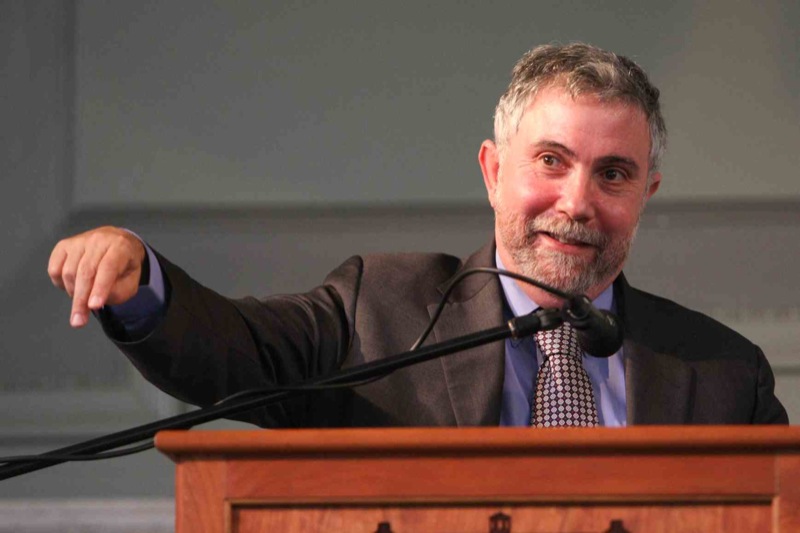
Last post on this, Paul Krugman says it all. Really…. well… probably…
In yesterday’s New York Times, Paul Krugman says very clearly what I’ve been trying to wrap my head around. Cliven Bundy is a moocher, no doubt, I’ve called him a “welfare queen” too, but the hatred Bundy spews is… is… well, read what Krugman has to say, he puts it all together.
The anti-government mindset is indeed a problem. Just Friday, I ran into it when a friend repeated the mantra, “You know what’s wrong, it’s the government, the government is too powerful,” when we were attending a hearing focused on utility power (“why do you think they call them power companies”), where it was a utility trying to take someone’s land. HUH? How is that an example of problem with “government?” The landowner in the middle of the fray clearly stated her take, “It’s the utilities, the corporations have too much power.” Yup, my take too. How does it become an issue of “too much government?” This highlights the failure of our individuals and schools to foster critical thinking compounded by the acceptance of the non-stop media regurgitation of false and twisted information. But hey, that’s just another display of corporate power.
The only thing I’d change? Where Krugman says it’s a perversion regarding “freedom of the wealthy,” I think it’s more freedom of ANYONE, and so I’d make this edit:
For at the heart of the standoff was a perversion of the concept of freedom, which for too much of the right has come to mean the freedom
of the wealthyto do whatever they want, without regard to the consequences for others.
Here are Krugman’s thoughts:
High Plains Moochers
CARS – Last night in La Crosse
April 23rd, 2014
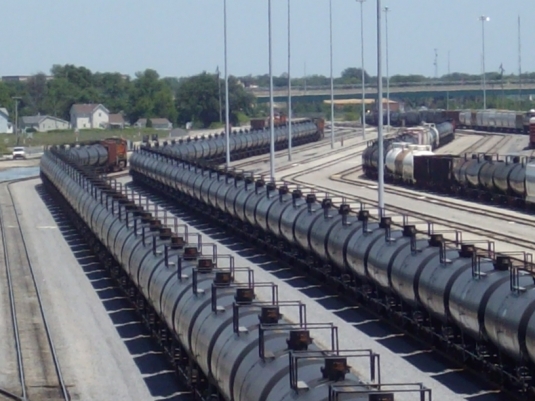
Citizens Acting for Rail Safety (CARS) held a meeting last night in La Crosse, WI, to discuss the proposal to build a second rail line in the middle of La Crosse. It was packed, over 300 people, standing room only. The comments of those attending shows the level of concern over The rail company, BNSF, claims a second line is necessary due to increased traffic. We’ve seen the increase, I’ve experienced it here in Red Wing, watching the trains rumble through the heart of town. Well, folks, it’s time for us to rumble!
Residents express concerns over new rail line
Rail expansion prompts worries about dangerous cargo, unsafe rail cars
STrib article about the unsafe rail cars:
Failure rates raising new fears over use of aging oil tankers
And more on the La Crosse proposal:
Dayton bellyflops into the frac sand fracas
April 22nd, 2014
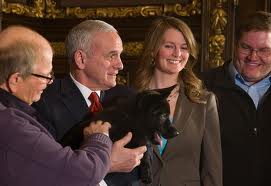
Gov. Tim Pawlenty was the “Green Chameleon,” but Gov. Mark Dayton doesn’t even pretend to be green. Today, he showed his true colors, delivering a harsh undercutting “rebuff” of a statement just prior to petitions being delivered to his office, petitions with 6,000 signatures, obtained with a lot of effort from a lot of citizens, requesting he enact a moratorium to stop new frac sand mines in Southeast Minnesota. To deliver this message in the way that he did says a lot for his regard for his constituents and their concerns. How hard would it have been to meet with those delivering the Petitions, to graciously accept them, and at least consider the request, take it under advisement?
I sure hope everyone is talking about our Governor. WOW!
6,000 signatures… how many does it take for a recall election?!?!?!?!
Here’s his statement:
++++++++++++++++++++++++++++++
As for the “Critical Areas Act” as the basis for a moratorium, well, I’m not so sure about that… There are a few steps that have to happen before it goes to the Governor. Minn. Stat. 116G.06.
Here’s where you can tell him directly what you think of his treatment of concerned Minnesotans:
Telephone: 651-201-3400
Toll Free: 800-657-3717
The report on MPR:
Dayton says no to frac sand moratorium
The report in the STrib:
Dayton says no to frac sand moratorium in southeastern Minn.
Says he lacks authority for the southeastern Minnesota ban sought by mining opponents