File FCC Complaint: WBFF Fox 45 News inciting with lies
December 23rd, 2014

Time for a complaint to the FCC, this is too serious to go unreported. Here’s the FCC Complaint page, scroll down to “TV File Complaint” and hold WBFF Baltimore accountable.
What’s at issue? WBFF Fox 45 in Baltimore both edited a protest chant and said in a voiceover that the protesters were saying “so kill the cops.” And that’s a lie. And no, it’s not an innocent one. I’ve done a few years in radio, know about editing, and the chant was repeated and repeated, and they had to work to falsely report it, both in editing of the chant, and in the voiceover. Innocent mistake? NO! WRONG! It wasn’t just once, but TWICE! Someone had to edit it and someone else did the voiceover, and I’d guess that someone else told them both how to do it and what words to use.
Here’s the original FALSE report and note they tie it in to the police assassination in New York:
Shame, shame, SHAME! File a complaint with the FCC:
The WBFF Fox 45 embedded code doesn’t work, so here’s THEIR PAGE ON THIS AND “APOLOGY”, and their link to the WBFF interview: Fox 45 interviews Tawanda Jones . There’s a comment section — be sure to tell them what you think! WBFF stresses that this was an “HONEST error” (emphasis is theirs) but as Tawanda Jones notes, how is that possible? The chant was repeated over and over and over. They did a voiceover. Tawanda Jones, I hope you’re shopping for a heavy hitting attorney to sue them and shut this down.
A compilation of the pieces of this story from TPM:
TPM: Baltimore Fox affiliate edits protest footage to sound like “Kill a Cop”
This is their roundabout admission from Facebook:
Last night on Fox45 News at Ten we aired a story regarding the increased risk in being a police officer in light of recent grand jury rulings and the shooting deaths of two police officers in New York City. We aired part of a protest covered by CSPAN that appeared to have protesters chanting “kill a cop”. We spoke to the person in the video today and she told us that is not what she was chanting. Indeed, Tawanda Jones, says she was chanting, “We won’t stop ‘til killer cops are in cell blocks”. We invited Tawanda to appear on Fox45 News at 5:00 and Fox45 News at Ten tonight for an interview so we can discuss the video and the recent violence in New York City. She has kindly accepted and we will bring you that tonight.
That’s not adequate. When they’ve reported such inflammatory lies, how can something like that ever be retracted? Something like this, particularly because the false notion that protestors are wanting to “kill cops” has to be loudly and publicly stopped, with strong action by the public and regulators, with monitoring and correcting each and every instance that protesters are branded, and a lawsuit or two by every protester falsely “quoted” and labeled. SHAME! This is false propaganda, abuse of media power at its worst.
Capitalism happens… and sometimes it doesn’t!
December 21st, 2014
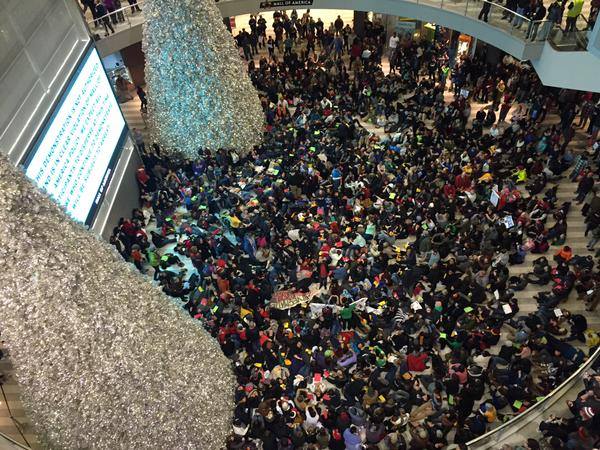
Big thanks to everyone who posted photos of yesterday’s action at the MOA. 3,000 or so Minnesotans showed up to demand accountability, professionalism, and basic civil rights — that BLACK LIVES MATTER. ALL LIVES MATTER!
And it’s in the New York Times!
Chanting ‘Black Lives Matter,’ Protesters Shut Down Part of Mall of America
In the STRIB, here’s Keith Ellison:
For Rep. Keith Ellison, recent protests speak of a lifelong struggle
The MOA issued a letter saying that protesters were not to be allowed inside, that they would be restricted to a certain part of a remote parking lot. Bloomington police, MOA and other security were there, looking like they’d just stopped off from the RNC wardrobe warehouse, full riot gear. But that didn’t stop the group from gathering in the mall. They took over the rotunda, and surrounding balconies, and shut it down for a while. YES! Because part of the problem here is that capitalism gets in the way of democracy, so it’s appropriate that one of the biggest shopping days of the year is brought to a screeching halt. A very diverse crowd including a group of Universalist pastors were on hand, a die-in here and there. Demonstrators were joined by shoppers and workers, some of whom were pushed back into a store and the gate slammed down (!). This IS what democracy looks like.
Meanwhile, “Fox News Seizes on NYC Cop Killing to Bash Obama” There’s a particularly slimy post going around equating protesting with police assassination, and police assassination with protesting, with this paragraph in it that… well… here it is:
So while you sit there, sympathizing with the criminals and becoming part of the problem by saying, “Hands up, don’t shoot” or “I can’t breathe” and preaching an ignorant and biased agenda against an individual who would willingly die for you in an instant, no matter if you like them or not; while you sit there with hate and distaste over the fact that they are “all racist” and they can hide behind the badge and without mercy, murder anyone they please-while you sit there and bask in all the hatred that has been ignited this past year, understand that they will ALWAYS be there to help you.
… oh give me a break… are people so incapable of critical thinking? Is it so hard to hold police accountable? To expect them to follow the law like the rest of us? To expect professionalism, that they follow basic policy and procedure in use of deadly force? And if we expect that, if we demand that, then hey, we’re terrorists and assassins? Right…
So on a lighter note, a historical note, is the Maul of America public property? NOT! So says the Minnesota Court of Appeals and the Minnesota Supreme Court. (Did they consider the public subsidies and pork to the Mall, to build it, to expand it, and maybe the protesters were standing on their own piece of the MOA? Naaaah, it doesn’t quite work that way. It’s like transmission lines, even though we pay for it we don’t own it. Go figure…)
Anyway, here are a couple of decisions on that issue, with the Court of Appeals and Minnesota Supreme Court bashing and tossing out the thorough and well-considered decision of Judge Nordby:
Alan says: I highly recommend reading at least the 1999 Final Order from Judge Jack S. Nordby on a demonstration at the MOA and whether it is public property:
On Bakken oil in STrib…
December 16th, 2014

Alan Stankevitz walks the walk, and while his solar system powers his home, he tracks developments in oil transport on his DOT-111 Reader site. In this STrib op ed, he exposes the truth about “regulations” ostensibly to deal with volatility of Bakken oil: “The bottom line is that the limit has been set so high by North Dakota that the mandate is toothless.”
Bakken dangers: Both the oil and the rail
Consider these numbers. Let’s dedicate ourselves to ending the smoke-and-mirrors game.
• Crude oil from the Gulf of Mexico has a RVP psi of approximately 3.
• For crude oil from the Eagle Ford shale formation in Texas, that number is approximately 8.
• For gasoline, it’s approximately 9.
• The Lac-Mégantic oil-train explosion in Quebec had a tested RVP psi just above 9.
• Bakken crude oil typically has a RVP psi between 11.5 and 11.8.
So how much oil travels through Minnesota per day on these deficient DOT-111s?
And another along the same lines, by Lisa Westberg Peters:
New Bakken volatility standards are pointless
- Article by: LISA WESTBERG PETERS
- Updated: December 15, 2014 – 6:45 PM
The explosion risk still exists, which emboldens pipeline supporters — but why must our choices be so dismal?
 (Photo: Paul Chiasson • The Canadian Press/AP file,)A large swath of Lac-Mégantic, Quebec, was destroyed and 47 people were killed in July 2013 when a train carrying Bakken crude oil derailed, sparking several explosions and forcing the evacuation of up to 1,000 people.
++++++++++++++++++++++++
I’ve seen Bakken crude oil as it comes out of the ground. It was surprising in several ways: It was almost green, quite fluid and downright fizzy with natural gases. It’s the high gas content that makes Bakken shale oil so explosive.
When the state of North Dakota established new limits on vapor pressure last week for the oil shipped out of the state, my first reaction was relief. Flammable liquids with lower vapor pressures are less volatile. We’ve seen several explosive rail accidents in recent years involving Bakken oil; an oil train derailment last year in the small Quebec town of Lac-Mégantic killed 47 people and flattened its downtown. I was pleased that regulators were addressing this problem.
But when I took a closer look at the numbers, I felt more dismay than relief. Even if oil producers exceed the regulators’ demands — and regulators say they often do — Bakken crude will still be explosive.
The appropriate comparison seems to be gasoline.
Lynn Helms, head of the North Dakota Department of Mineral Resources, said the new vapor pressure standard of 13.7 pounds per square inch (psi) would make Bakken crude no more volatile than the gasoline we put in our cars every day.
In March, an investigation by the Transportation Safety Board of Canada concluded that the Bakken oil in rail cars at Lac-Mégantic was “as volatile as gasoline,” but the vapor pressure was measured at 9 to around 9.5 psi. In other words, the Bakken crude that exploded in Lac-Mégantic was less volatile than what North Dakota regulators are demanding now, and it still exploded.
In a New York Times article last week, Clifford Krauss reported: “Once the rules are in force early next year, transported North Dakota crude oil will have a similar volatility to that of automobile gasoline, which should decrease the risk and size of any fire that might occur once a rail car is punctured in an accident, according to state regulators.” His story never mentioned the findings of the Canadian government.
Why wasn’t this New York Times reporter more skeptical of the assurances of North Dakota oil regulators, especially after the recent New York Times revelations about the leniency of regulators toward the oil industry?
The new vapor pressure standard announced last week is pointless. We will still face danger from exploding oil trains.
This disturbing fact tends to encourage pipeline supporters. Pipelines are safer, they say. In the past, oil transported by pipelines has tended not to explode and kill people; instead it spills and contaminates streams, lakes and aquifers. If you value people’s lives over clean water supply, in the short term, pipelines seem better.
But why do we have to make such lousy choices to keep our domestic energy boom rolling — to keep workers working and our dream of energy independence alive? Let’s do everything we can to encourage the other domestic energy boom, the wind and solar boom, that has already begun and that survives today despite many obstacles, including national policies that still encourage fossil fuel, yesterday’s energy source. If we were to place a price on carbon tomorrow, we would not need as many pipelines and we would be able to reduce the number of oil trains passing through our neighborhoods.
Climate experts urge us to leave much of the world’s remaining fossil fuel, including Bakken crude, in the ground. If we do as they advise, we will disrupt job markets and be forced to rethink the way we do almost everything. Why should we voluntarily face such disruption? One very good reason: We already face the prospect of pervasive disruption posed by a changing climate. It’s far preferable to take well-designed and systematic measures to control disruption than let disruption control us.
Lisa Westberg Peters is the author of “Fractured Land: The Price of Inheriting Oil” (Minnesota Historical Society Press, 2014). She lives in Minneapolis with her family.
It’s the 2014 NERC Report!
December 12th, 2014

EEEEEEEEEE-HA! The NERC Report is out:
I love the NERC Report — the annual Long Term Reliability Assessment from the North American Electric Reliability Corporation. Why? Well, it’s a nice offset to the gloom and doom of the MTEP promotional pieces because NERC features tables like this:
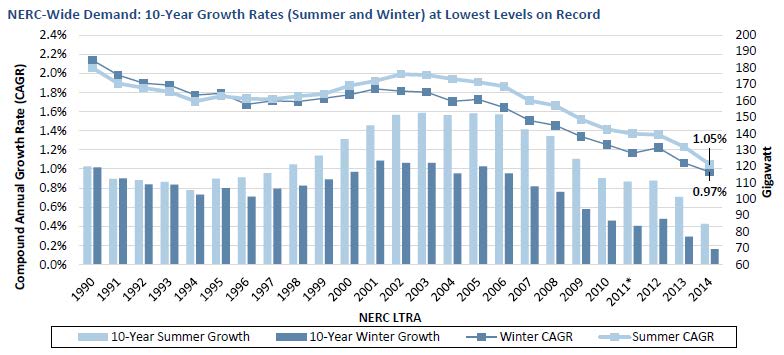
What’s not to like about “NERC_Wide Demand: 10-Year Growth Rates (Summer and Winter) at Lowest Levels on Record” as a leading table?
Better yet, they go area by area, and show, even using utility provided data, that it’s not nearly as bad as the utilities claim in their hystrionic applications and testimony. Let’s look at the bottom line in the section about MISO (click on table for larger view):
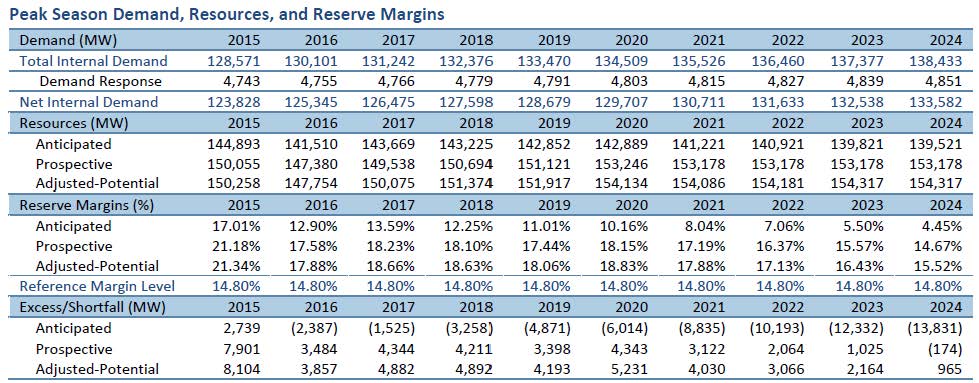
NERC Reliability Assessment, p. 38 (or p. 46 of 115 pdf). Note how this is NOT scary histrionic data here?!?! Also note, they use coincident peak for forecasting, as they should. If I hear one more “non-coincident peak” being used, I shall scream!
Again, it’s the 2014 NERC Reliability Assessment. Check this out for a more rational view.
12/19 – Power Plant Siting Act Annual Hearing
December 12th, 2014
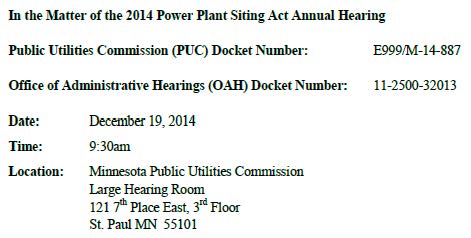
It’s that time of year… the time that we get to tell the Public Utilities Commission what does and does not work about the Power Plant Siting Act. We’ve been doing it for years, 15 or so years, and have spent over a year now in a rulemaking on the PUC’s rules, Ch. 7849 (Certificate of Need) and Ch. 7850 (Power Plant & Transmission Siting) where some of these long complained of problems will be address (with any luck). And now, again, it’s time to reinforce those comments with another round of comments:
After the hearing, now officiated by an Administrative Law Judge (new as of a few years ago), a report is issued to the PUC and then ??? It used to go to the legislature, and it used to go to the EQB… guess I have to find out what happens now.
December 19, 2014 beginning at 9:30 a.m.
Public Utilities Commission
3rd Floor Large Hearing Room
121 – 7th Place East
St. Paul, MN 55101
Each of you who have experience siting and routing of large electric energy facilities — this is the time to weigh in. Remember that this is NOT project specific, it’s not about where a project goes of whether it does, but it’s about how the process works or doesn’t, so for example, it’s the time to let them know that notice isn’t being provided, or that witnesses should be sworn on oath so that testimony will be given more weight, etc. You can do it in person, and you can do it by filing comments.
Here is the Power Plant Siting Act, which governs the siting and routing of large energy facilities:
Here are some prior dockets (to access the entire docket, individual comments, etc., go to the PUC’s “SEARCH” site and plug in the docket numbers :
2006 Report to PUC – Docket 06-1733
2007 Report to PUC – Docket 07-1579
2008 Report to PUC – Docket 08-1426
2009 Report to PUC – Docket 09-1351
2010 Report to PUC – Docket 10-222
2011 Report to PUC – Docket 11-324
2012 Report – Docket 12-360 –2012 Report Exhibits
2013 Report – Docket 13-9650143-96999-01