Rep. Osienski, Sen. McBride step up on Bakken BOOM! trains
April 8th, 2015
From Green Delaware, there’s action in Delaware in support of U.S. Senate Bill 859, the Rail Safety Act of 2015, urging something similar in the House:
Here’s the letter.
Since the reopening of the Delaware City Refinery, engineered by Gov. Black Jack Markell behind the backs of the people of Delaware, Delaware has become a leading destination for “bomb trains.” Oil comes into Delaware by train not only for refining in Delaware but for transshipment to other refineries along the Delaware River. This mocks the Delaware Coastal Zone Act’s prohibition of “new bulk transfer facilities.” Did Black Jack know that very dangerous bomb trains were part of the deal? We don’t know, but it seems unlikely he would have cared one way or the other. Delaware is also one of a few states that has shamed itself by refusing to release information on the routes and frequency of the bomb trains.
See this previous post: Bakken BOOM! Rail Safety Bill
Action:
Check the letter to see if YOUR Senator and Representative have signed on. If not, ASK THEM TO. Contact information from the League of Women Voters is here.
And thank Rep. Osienski and Sen. McBride.
Gov. Terry Braindead shows how it’s done…
April 3rd, 2015

There’s Iowa Gov. Terry Branstad showing how it’s done! He’s just axed Sheila Tipton from the Iowa Utilities Board, shortly after it made a decision that MidAmerican Energy did not like. Three days after that Feb. 6 decision, the company had a meeting with the Gov, and they openly admit that! Really? That’s OK?
As of March 2, Sheila Tipton is out… He also demoted the Chair Libby Jacobs! Guess when MidAmerican complains, Branstad hops to it!
Dissing the Iowa Utilities Board
Some people believe that; some don’t.
Gov. Branstad Accused of Allowing Energy Company Dictate Who Serves On Iowa Utilities Board
This was a $2 million annual return to ratepayers/rate reduction. Less than 1% of the capital cost of the project, on which they will be making how much? By owning it themselves they’re eliminating paying the middleman as they would with a PPA, and they’re getting the tax credits, and they’re also probably selling the energy for export. They are also the utility that just built a BIG coal plant on the western edge of the state at the “MidAmerican Energy Center” and are also the utility that is building part of the MISO MVP transmission highway across the top of Iowa, coincidentally starting connected to the 345 kV line attached to their big coal plant… applications have been filed for this project. Tipton had recused herself from this transmission project docket as she’d represented MidAmerican! Something tells me Braindead didn’t want to take chances on that transmission with any scrutiny of the project!
Here are the MISO MVP 345kV connections to the existing system to build the Energy Export Interstate System!
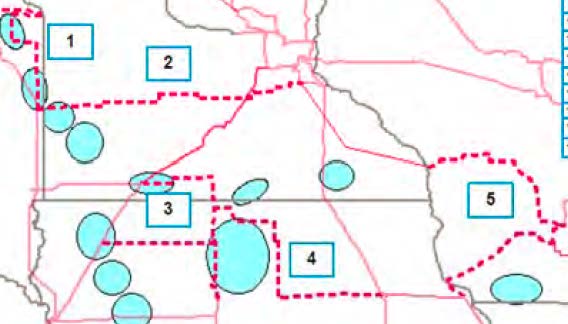
But with the new appointee…
Branstad appointee faces potential conflict in pipeline case
Must mean Braindead doesn’t mind if she recuses herself from that case, after all, she might be biased toward landowners! Better if she not be a decider on that, eh?
Crude by Rail Safety Act of 2015
March 26th, 2015
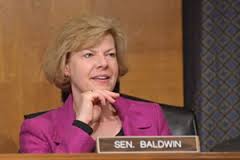
Wisconsin’s Senator Tammy Baldwin has introduced the Crude-by-Rail Safety Act of 2015. Tammy Baldwin and also Dianne Feinstein (D-CA), Patty Murray (D-WA) and Maria Cantwell (D-WA) are the authors. GOOD, ’bout time we get some federal legislation moving on this! How many more trains need to explode before we get some action?
BIG thanks to CARS (Citizens Acting for Rail Safety) for all their work on this, and for letting us all know that this bill is in the works.
Contact your Senators, ask them to support this bill, and ask them to sign on as co-authors. Let’s get this moving down the track!
Here’s the bill:
Crude-by-Rail Safety Act of 2015
And here are the basic points covered by the bill:
And Sen. Baldwin’s press release on this bill HERE.
This is such an important start to protect the safety of everyone along the many Bakken BOOM! routes throughout the U.S.
Call or email your Senators today in support of this bill!
Here’s a report from “The Bakken” on this legislation:
Bill to extend Getty/Black Oak wind contracts?
March 24th, 2015
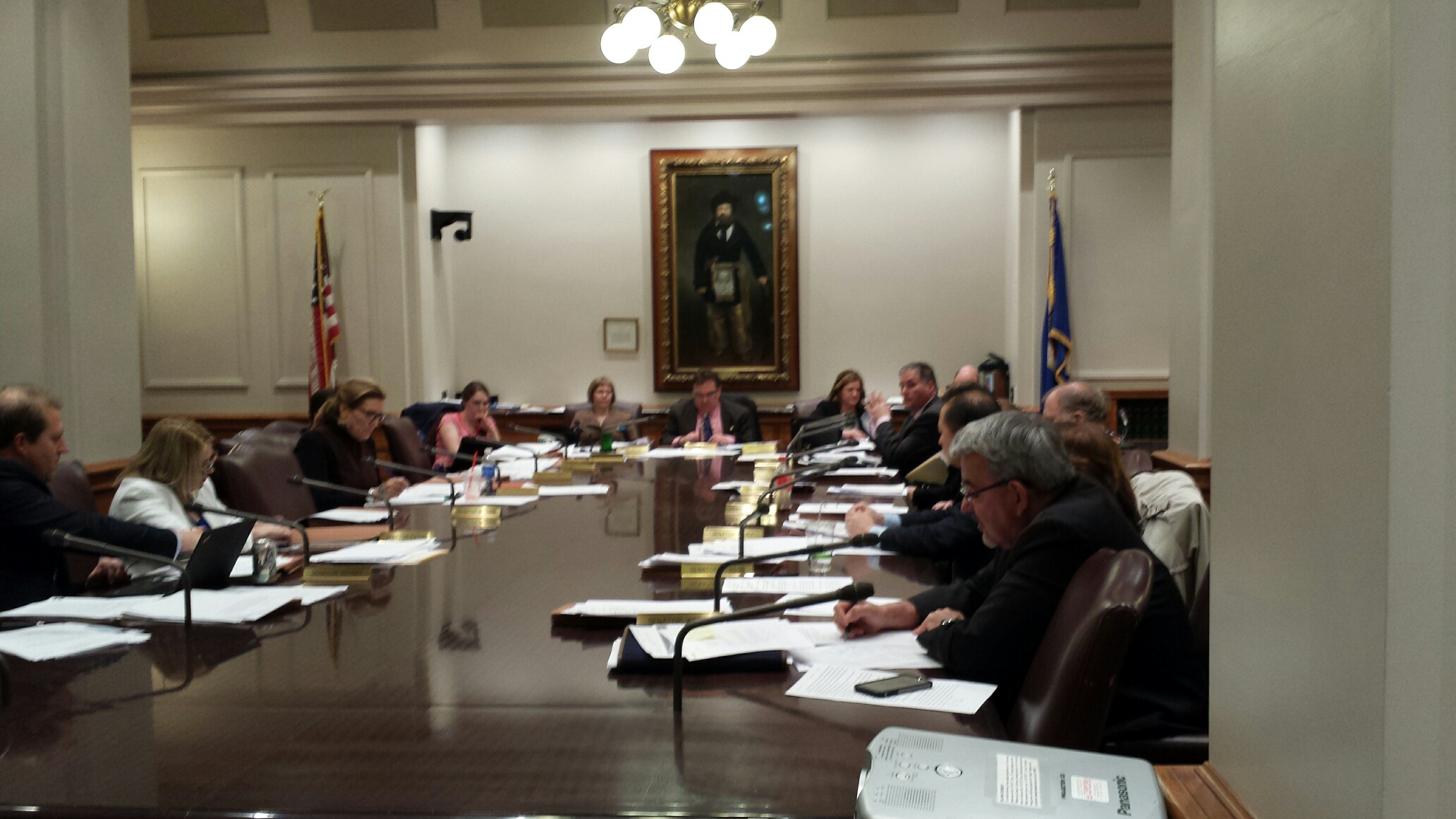
This was last Thursday evening at the Senate Environment and Energy Committee. Alan Muller and I were there for SF 1735 (the Xcel Energy e21 Initiative start)(see Great Plains Institute site) and the SF 1431 Energy Ominous Bill. Before the start on SF 1735, there was announcement of a “delete all” which means everything out and into the dumpster, and new language… and then after that, the SF 1431 Energy Ominous Bill into which the neutered SF 1735 went, and then on with the amendments to the SF 1431 Energy Ominous Bill! WHEW! What a… a… well…
There’s a lot to find offensive.
Here are the Committee meeting MINUTES.
Here’s the audio of the Committee meeting:

 (04:31:52) Part 2
Here’s the two energy bills at issue:
| S.F. 1735 | Marty | Public utilities performance-based multiyear rate plans authorization (for possible inclusion in omnibus energy bill). | |||||||
| S.F. 1431 | Marty | Omnibus Energy Bill. | |||||||
First, regarding SF 1735, WOW, what a mess. There was a delete all and what was left was pretty much nothing, and it was, immediately afterward, incorporated into the SF 1431 Energy Ominous Bill. But let’s start with SF 1735.
Here’s the A-2 delete-all Amendment S.F. 1735
Here’s the handout I’d made, but after the delete-all, we couldn’t talk about SF 1735 as introduced!
Overland_Testimony_3-19-2015 – Not handed out because we were limited to A-2
The good news is that the Office of the Attorney General had a lot to do with the gutting of the e21 Initiative S.F. 1735. And better, the AG’s Office had a rep there, James Canaday, who testified against S.F. 1735. Sen. Katie Sieben was chairing as Marty was in the hot seat introducing his bill, and she would not allow testimony about S.F. 1735 as introduced, “we’re here to talk about the A-2 Amendment.” Despite that, Canaday was able to raise four primary points of objection:
- S.F. 1735 would do away with contested case, and lines 3.9 – 3.15 would institute a “stakeholder” process (at which point, Sieben interrupted and told him not to testify about S.F. 1735).
- A.G.’s Office does not recommend we experiment with such radical changes, such as changing a 3 year to a 5 year multi-year rate case. The first multi-year rate case is being decided tomorrow, and it was a lot of work. PUC in this first multi-year case noted that if a utility cannot prove up its claim formulas, we will limit the categories that utilities can claim formulaic increases.
- This is a step toward the end of cost-based regulation and to allow projected increases based on formulas, not costs. The PUC has said it has “great doubt about formula-based rates.”
- This bill does not clarify how interim rate determination will work.
e21 Initiative and S.F. 1735 as introduced is off the agenda, at least for now. There’s a “study” in the A-2 Amendment, now added to the Energy Ominous Bill:
 Sure, whatever, study away…
Something I remain concerned about is the provision for recovery of stranded costs:
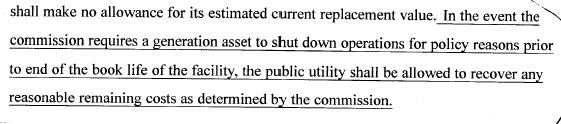 What we learned in the deregulation discussion 15-20 years ago is that what Xcel f/k/a NSP was prepping us for was for payment by ratepayers of their “stranded costs,” meaning their investment into whatever facility that was then “divested” in deregulation. Everyone was on board, nearly everyone, the “enviros” were bobbleheads in the rear window, agreeing to everything, and then…
We are now paying for the shift from “Minnesota” need to “regional” need, and we are paying for our acquiescence to the transmission build-out that facilitates the marketing of power to areas where it sells at a higher price than here in Minnesota:
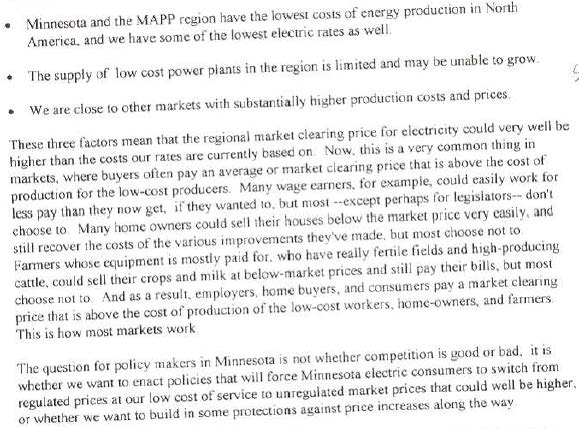
Corneli was correct in noting that the utilities didn’t have “stranded costs,” the utilities had “stranded assets,” and if deregulation were to happen, THEY’D OWE US MONEY, not the other way around! SNORT!
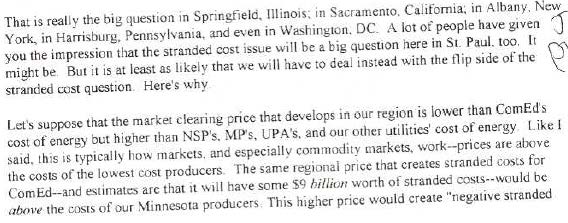
 That’s basic economics! So when you hear talk of “stranded costs” or “stranded assets” (make sure you and “they” understand and identify which is which!), or worse, “rate smoothing” as touted by e21 Initiative, “theoretical depreciation reserve” which is voo doo accounting lowering the utility’s revenue requirement, resulting in lower rates, ask, “What exactly is going on here” and “what does this mean for Minnesota ratepayers, ALL CLASSES, EACH CLASS, of Minnesota ratepayers?
The good news from last Thursday is that the e21 bill, the beginning of toadying for the e21 Initiative agenda which is HUGE, is history.
Next, the A-2 Amendment to S.F. 1735 was then added to S.F. 1431:
| S.F. 1431 | Marty | Omnibus Energy Bill. |
Here’s the result of all the wheeler-dealering:
Yes, it is indeed gross, and the process to get to this engrossment was painful to watch.
First out the gate was the A-12 amendment, by Sen. Weber, who is from far Southwest Minnesota, amending Minn. Stat. 500.30 to extend the limit on wind rights leases from 7 to 8 years, specifically for the Black Oak/Getty wind project because it won’t be completed by the time the 7 year period is up. Sen. Weber’s email: sen.bill.weber@senate.mn
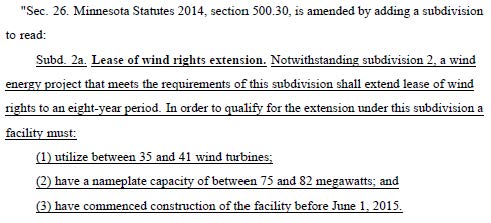
WHAT? That’s special legislation, DOH! I asked whether he’d provided notice to the affected landowners and he gave a wandering avoidant response that showed that the affected landowners had not been consulted. How disrespectful can he get? And why is he carrying this amendment, and not the local Senator for the affected area? Were the Senator and Rep informed about this? Or are they in cahoots with the project developer? What’s the story here?
Then there were a couple of rational amendments, passing and not passing, and then back to bizarre… and for this round of BIZARRE it was Sen. Osmek’s turn, first an A-6 amendment to repeal the nuclear moratorium, which went down, not added to Energy Omnibus bill. Then the most bizarre one, the A-7 Amendment (see also SF 231, HF 333) that any EPA regulations would need to go through the legislature:
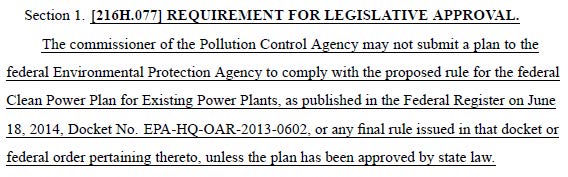 There were audible gasps around the room… and Sen. Marty delivered a very even explanation of federal and state jurisdiction, and Sen. Osmek either didn’t know, didn’t understand, or didn’t care, and pushed for a vote, and of course that went down in flames as well. Why would he do something like that which has such a clear detrimental impact on his credibility? Here’s Sen. Osmek’s email: sen.david.osmek@senate.mn
Here’s who’s on the Senate Environment and Energy Committee. Call them, email them, call and email them, and let them know what you think, very specifically and in technicolor.
Contact YOUR State Senator and all the State Senators to let them know what you think:
“Private” Zip Rail… yeah, right…
March 20th, 2015
If it’s “private” why remove a public funding prohibition?
Closed door meeting, and why?
“North American High Speed Rail Group” I don’t see a lobbyist principal registration. Joe Sperber, Chuck Michael… don’t see lobbyist registrations for them either. And who else is missing?
And if it’s private investors, why do Rep. Drazkowski, Rep. Garafolo, Rep. Norton, and Sen. Senjem think there needs to be any legislation? What’s the bill for? Why would government need to be involved? Oh… right… because they want to lift the prohibition of public money being used, yeah, that’s it… If it’s private development, why lift the ban? How could that possibly be made worthwhile for these legislators? And how is that in the public interest?!?!?!
From the video:
“Representative Pat Garafolo reached an agreement with the group…”
“Rochester lawmakers are concerned about a law prohibiting public money being used on the Zip Rail, and think a public/private partnership might be a better route.”
Say what?!?!
Here’s the video:
And in the Post Bulletin:
Long rail ahead for private rail developer
“Rail by itself isn’t always going to be economically viable, so you look at rail, you look at real estate development and then you look at the economic development that comes out of all of that,” he said.
Also from KTTC in Rochester, which identifies Joe Sperber as a wheeler-dealer on this project (what’s his interest?):