2nd CD race in The Nation… and Koch Refinery
September 4th, 2016

The Terrible Mini-Trump of Minnesota — and the Progressive Who’s Running Against Him
This is an odd article. Lewis is indeed terrible, and doesn’t even live in the district (not a requirement for Congress — that needs to be changed), and Angie Craig is a “progressive” NOT! They’re both wealthy corporate toadies, with Craig’s flavor distinctly DFL and edging a bit left, but more in the middle, and not nearly far enough to be labeled “progressive” nor to offset the extreme reactionary Republican politics of Lewis.
But what’s most odd about this is the articles’ digging into the politics of oil in Minnesota, of pipelines, and of environmental groups doing the deals that benefit the Koch Bros. It’s good to see this receive some scrutiny. From the article:
NOTE: PINE BEND/KOCH REFINERY IS LOCATED IN THE 2nd CONGRESSIONAL DISTRICT.
The article then starts in on the EPA and the Clean Water Rule, contested by Republicans, and we know well of Republican efforts to eliminate the EPA. But it also correctly reports that “our” Sen. Amy Klobuchar vote with Republicans against the Clean Water Rule, and only after pressure changed her vote the next time it came up. There’s nothing green about Sen. Amy Klobuchar!
As for the refinery, here’s how they work, buying out local governments and “environmental” groups — from the article:
The refinery became notorious in the 1990s for toxic pollution, especially of the water. Flint Hills Resources, the Koch brothers’ company that runs the refinery, paid millions of dollars in environmental fines in the 1990s and 2000s. At the same time it launched a major greenwashing effort, which continues today: help for Minnesota ducks, support for Minnesota Public Radio, funding a children’s theater festival in St. Paul. An example of the Koch spin: As part of a 2013 plan to expand the refinery, the company announced that it had signed an agreement with two environmental groups to “cut greenhouse gas emissions at the refinery by about 52,000 metric tons per year.” Cutting emissions—what could be better? Except that the “cut” is “about a fifth of the total expected increase from the project.” That means the net increase in greenhouse-gas emissions will be 260,000 metric tons—into the air south of the Twin Cities—every year.
“… pollution… especially of the water.” ??? Here’s the deal referenced above, one that anyone challenging pipelines, refineries, water pollution, and air emissions, should be aware of, a deal between “Flint Hills Refinery,” Minnesota Center for Environmental Advocacy (MCEA) and the Environmental Integrity Project (EIP) (can you believe that name?!?!) where the “environmental” orgs backed off on their air emissions permit challenge:
This deal was found online, on the EIP website, and then was removed from the page but the link remains (Here’s the link to EIP posting — download HERE NOW before it disappears). I’d posted this back in 2013:
MCEA deal with the Koch Bros?
A cool $1 million went into a fund to “reduce PM 2.5” through a diesel program, that’s the part that was made public. Is there other money passed out for this agreement? And there’s this:
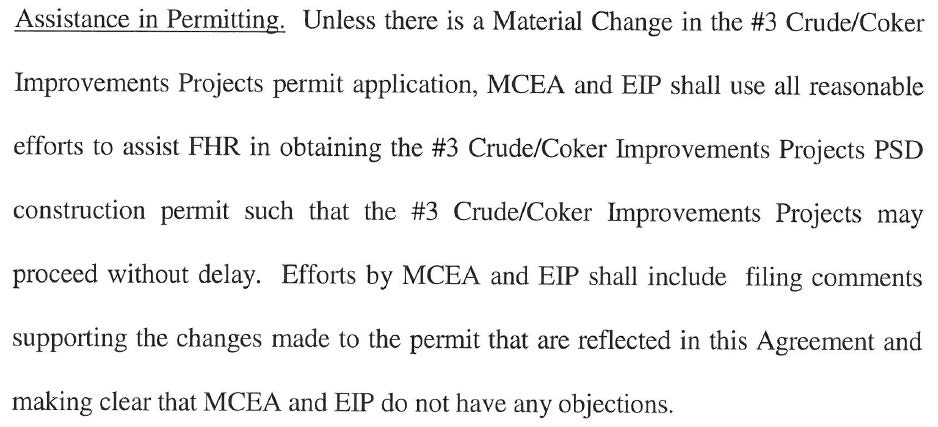 And this:
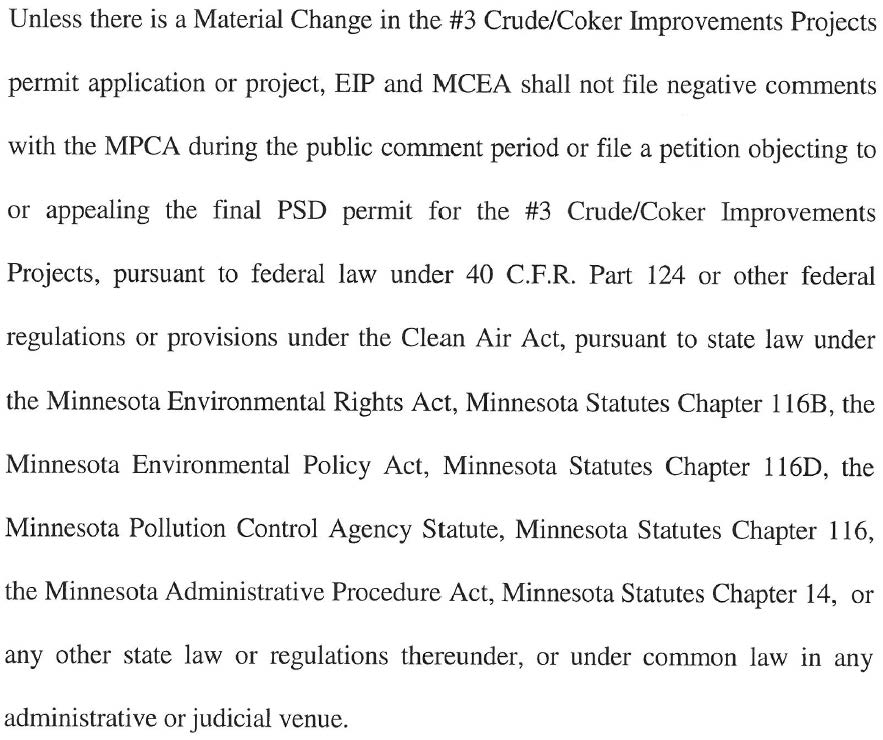 And this:
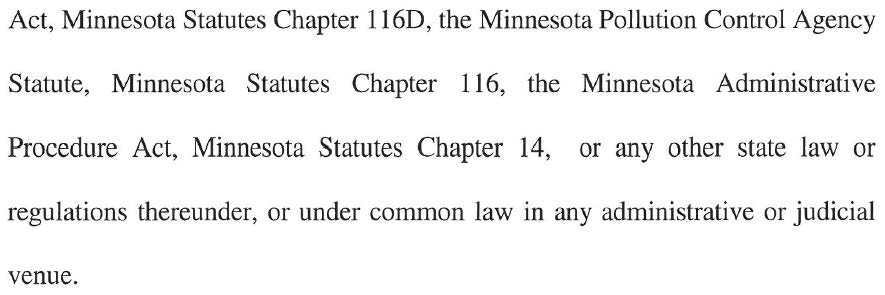 And most importantly, the Confidentiality clause!
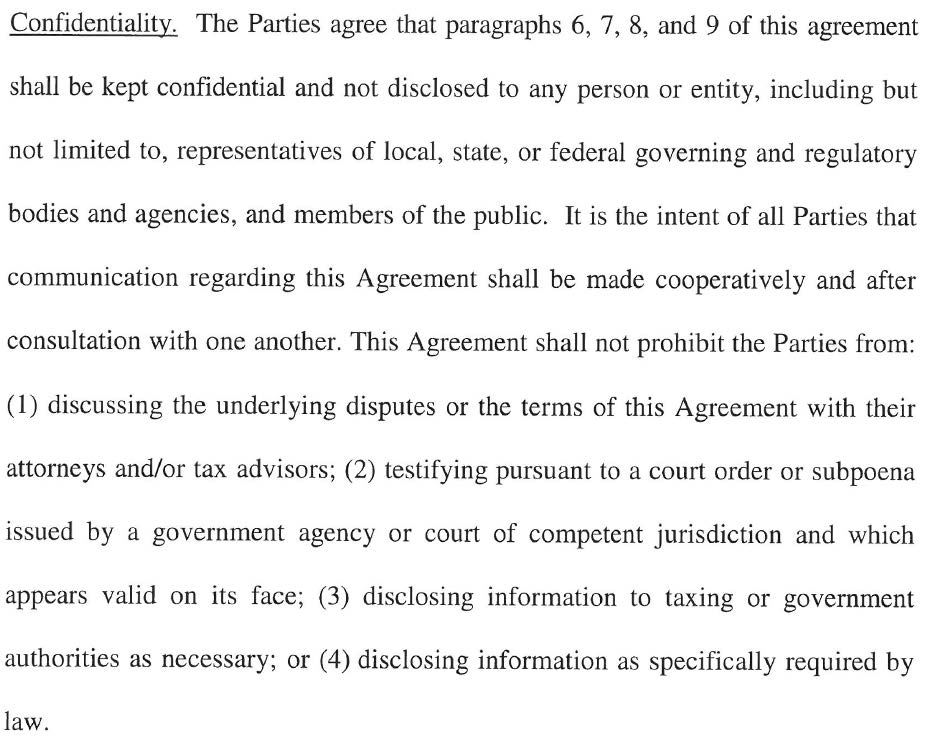 Were there other deals? This one was to be kept “confidential.” (Again, the link to EIP posting — download HERE NOW before it disappears) From my years of work and association with United Citizens Action Network (U-CAN) against the CapX 2020 transmission project, and knowledge of their isolation in fighting the MinnCan pipeline, which went from the Bakken oil fields to the Pine Bend/Koch refinery, that NO “environmental” groups intervened against that pipeline, and that only MPIRG tried to help U-CAN, it’s hard to believe that there was not a deal of some sort. The silence was deafening.
To look up the MinnCan pipeline docket, go HERE and search for dockets 05-2003 for the Route Permit and 06-02 for the Certificate of Need (Note the pipeline company is sometimes “Minnesota Pipeline Company” and “Koch Pipeline Company.”). Note the lack of an Environmental Impact Statement, the due process issues, and NO intervenors in the Certificate of Need, and none of the “environmental” orgs in Minnesota intervened in routing either… what a mess that was.
Do tell — what are the positions of Jason Lewis and Angie Craig on the air and water pollution from the refinery in CD2? Where are the Minnesota “environmental” organizations on the air and water pollution from the refinery and the Bakken BOOM! oil trains in CD2?
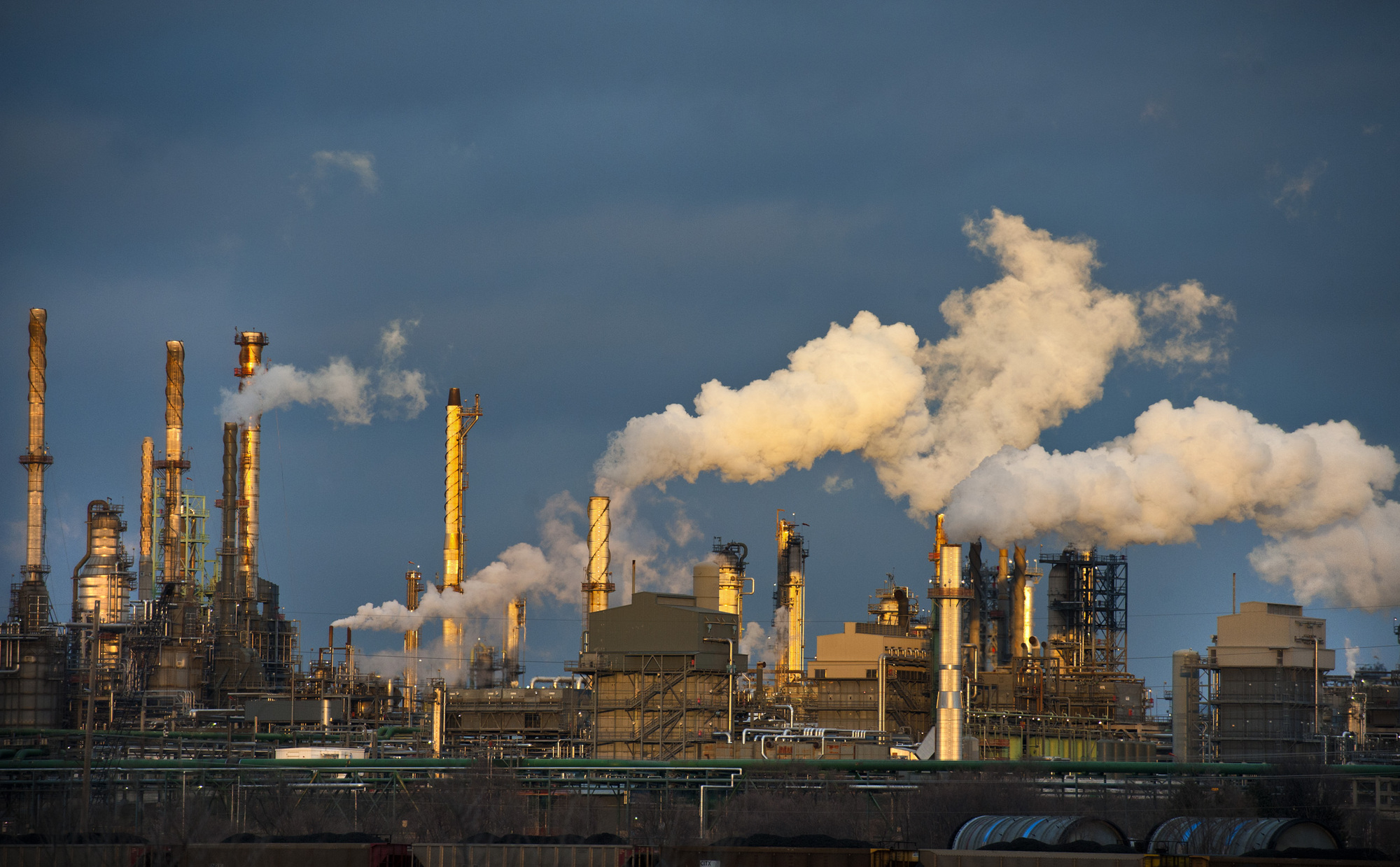 Photo fair use from the Star Tribune
Frac waste injection, seismic activity, and agency subpoenas
September 3rd, 2016
 BIG earthquake in Oklahoma today, and are we surprised? Naaaaah… Here’s the info, including location, economic impacts, etc., from USGS:
CLICK HERE: USGS Pawnee, OK Earthquake Page
In the news, and they’re making the link between gas wells and earthquakes:
Earthquake Rattles Oklahoma; One Of Strongest Recorded In State
Earthquake Shakes Swath of Country Where Wells Have Drawn Scrutiny
IMPORTANT: The Oklahoma Corporation Commission takes action!
Oklahoma Corporation Commission orders disposal wells shut down near quake epicenter
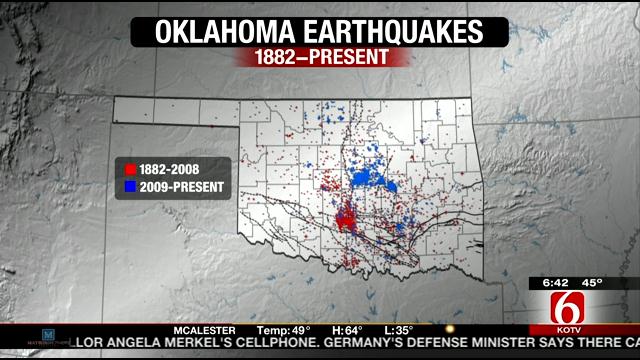
Consider why fracking and injection of frac waste is allowed… Why is a pipeline route through earthquake prone area considered? The impacts of fracking and waste injection is one thing they do NOT want to acknowledge. From KOTV in June 2014 — USGS should know better:
And when searching, look at this — can you believe:
OGS: Earthquake risk low for proposed disposal wells in Yukon
When the topic of earthquakes and other seismic activity comes up, I always recommend the “bible” of injection into the earth, because this is not a new phenomenon and we’re making this happen, putting people and our water supply at risk:
When I got this book, it was an older edition, though pricey, but with patience, it could be had for $20. For about a decade now I’ve been recommending this book, and look at the price now. Out of bounds for most of us… funny how that works. I’d guess a library could find a copy, and here it is on google books, “only” $224.00 (GRRRRRRRRRR):
Gas migration: events preceding earthquakes
Elisa Young, a cohort in Ohio, has lived in the epicenter of frack injection triggered earthquakes around Youngstown. There, after so many earthquakes, the causal connection was acknowledged, but it took too long. Here’s a Legalectric post from four years ago:
Ohio Earthquakes & Fracking
And now for a complicated sidebar. Elisa Young asked today how to get the state and federal agencies to communicate about this problem and take action. How? Damned if I know — impacts of injecting gas and liquids into the earth are well known. Yet federal and state agencies are in serious state of denial. And it’s very difficult at times to get the agencies to show up, to do their job. It’s even difficult to get their analysis, their own reports, into project permit dockets. I get really tired of this…
How to get them to weigh in? In Public Utilities Commission dockets in Minnesota, I’ve had a hard time with state agencies, initially. For example, in Excelsior Energy’s Mesaba Project docket, there was a claim that coal gasification was “clean” yet the Minnesota Pollution Agency had not, and would not, weigh in on the emissions projected for this coal gasification power plant. WHAT? We pushed and pushed, threatened to subpoena, raised this at a PUC meeting, and finally, the PUC issued an Order and wrote a letter to the PCA Commissioner requesting the MPCA lend its expertise to the Commission and show up!
And a Legalectric post about later subpoena requests on the Mesaba Project:
And subpoena and Data Practices Act requests in that same docket for financial information:
I’ve had similar issues in transmission dockets, where the DOT and DNR would file Comments on environmental scoping, and/or the Draft Environmental Impact Statement, but those Comments would only be sent to the Dept. of Commerce, and were not posted in the PUC docket, so parties and the public had no idea the concerns the agencies may have. NOT OK. During the first CapX 2020 routing docket, Brookings 08-1474, it was so egregious, I asked the DOT General Counsel who was present to make comments at the public hearing, and to submit a copy for the routing docket record (the route ultimately turned on DOT easements and that DOT would not allow the transmission line to be built over those easements). The matter was remanded by the Commission for rehearing based on their routing quandry. Shortly after, on behalf of No CapX 2020, I subpoenaed testimony and Comments.
Subpoena requests sent! (DOT & DNR)
Subpoena plot thickens (Agreement to testify)
Subpoena request for US Fish & Wildlife
Subpoena Denied(tried to get USFWS, didn’t work. USFWS Comments had been hidden in EIS Comments)
Notes from Friday
In the Goodhue Wind docket (permit granted, and then much later revoked!):
Goodhue Wind Truth – Subpoena Requests for Bjorklund and Bull
ALJ Sheehy’s Letter to Overland – Denial of Subpoena Requests
When this was attempted in the Sandpiper Pipeline docket, the ALJ denied the Subpoena request. WHAT?
And an interesting back and forth with a hearing officer about getting information into the record and whether it would take a subpoena to get it, where ultimately, the ALJ agreed that the primary documents would be entered in the record:
And here’s an aside, use of subpoena regarding Xcel’s plans for coal, served by NY’s A.G.:
New York A.G. serves Xcel with subpoena
Enbridge files to withdraw Sandpiper applications!
September 1st, 2016

YES! It took them a month from their announcement, but finally, Enbridge has filed to withdraw the Sandpiper pipeline Certificate of Need and Route applications, and has asked to suspend the contested case and EIS process in the meantime.
There is a 14 day window to “object” to this Certificate of Need withdrawal, and a 10 day window to address the Motion to suspend contested case.

Now’s the time to say “WITHDRAW, WITHDRAW WITH PREJUDICE!” Now’s the time to say “WITHDRAW ALL RELATED APPLICATIONS” because there are so many applications for transmission lines for pumping stations, i.e., the Clearbrook Transmission Line!
And then sometime after the Comment period ends, PUC staff will issue “Briefing Papers” and then the Commission will schedule a meeting to address this, with at least 10 days notice. Expect, then, at least a month before the PUC acts.
Now, about that Line 3 replacement project…
Settlement? PUC says “show your work!”
August 29th, 2016
Xcel Energy’s rate case just received another interesting twist — a request of the PUC that the parties to the “settlement agreement” show their work! I love it when that happens.
PUC staff wants detailed information about how they reached the numbers they did, how the settlement relates to each of the parties initial positions and testimony, etc., to “show your work!” The PUC staff is requesting this information so that the Commission can determine whether to accept, modify, or reject the partial settlement agreement. And note that the parties are mostly those e21Participants who signed off on Xcel’s Exe21_Initiative scam.
GOOD! Take a close look, PUC!
To review the filings in this docket, go to this PUC SEARCH DOCUMENTS PAGE and search for docket “15-826.”
Sandpiper EIS on HOLD!
August 26th, 2016

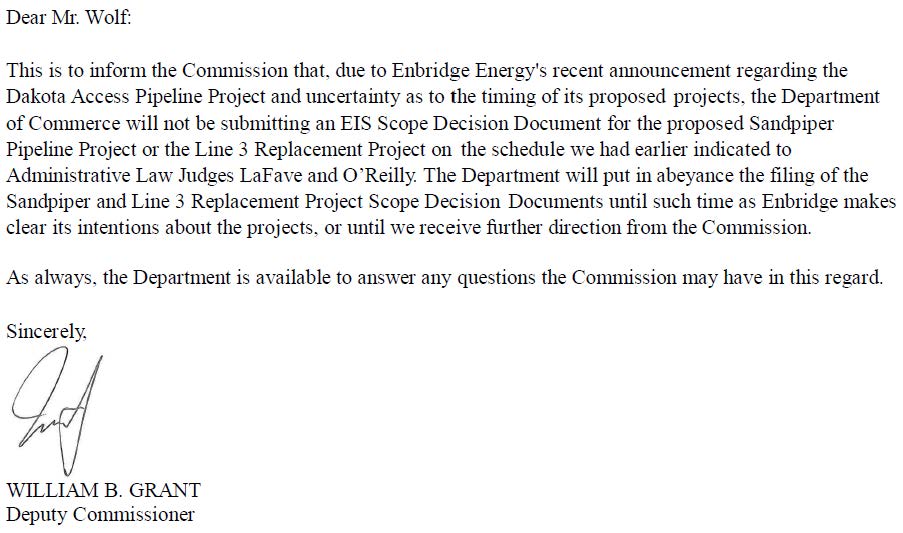
The Department of Commerce has hit the brakes on Sandpiper Pipeline and Line 3 Replacement Projects “until such time as Enbridge makes clear its intentions about the projects, or until we receive further direction from the Commission.”
Here’s the letter from Bill Grant:
20168-124424-01_Commerce_EIS Scope Decision Document on HOLD
And the guts of it:
YES!!! Now, about those transmission lines proposed for pumping stations related to these projects????