Thursday, PUC considers need & siting/routing rules
March 8th, 2017
 Thursday, tomorrow, the Minnesota Public Utilities Commission will take up the rulemaking, Minn. R. Ch. 7849 and 7850, that’s been ongoing since 2012.
Public Utilities Commission
Large Hearing Room — 3rd Floor
121 – 7th Place East
St. Paul, MN
Watch Live Webcast HERE!
The Commission will consider the draft rules, below, and decide whether to move the process forward (in itty bitty steps) and release the rules for public comment and a hearing (and we’ll need 25 requests for a hearing to get that hearing), or to send us back to the drawing board, or revise themselves, request public comment, or “take other action as the Commission deems appropriate.” See the last pages of Briefing Papers for these options in detail.
Yes, since 2012 — that’s 5 years in the making, an unreasonably long time. But wait, it gets worse — the enabling legislation is the 2005 Transmission Omnibus Bill from Hell! That’s particularly galling because the 2005 legislative changes were enacted to pave the way for CapX 2020, and all of CapX 2020 was rammed through without rulemaking covering these changes. GRRRRRRRRRRR. I like to encourage clients to carry on with the process after our immediate issue is resolved, because who knows better how the Certificate of Need and Siting/Routing process works than those who have been through it, but 5 years?!?! 12 years?!?! Some of these things I’ve been on the Commission about for over 20 years, particularly notice issues.
The existing rules:
| 7849 | CERTIFICATE OF NEED; POWER PLANT OR LINE |
| 7850 | SITE OR ROUTE PERMIT; POWER PLANT OR LINE |
And the proposed drafts that the Commission will consider:
Certificate of Need
An issue right up front is in the definitions in Certificate of Need rules, where a “transmission company” is a “utility.” Draft Minn. R. 7849.0010, Subp. 32.This is problematic because a Certificate of Need is the “need” determination necessary for use of power of eminent domain. A “transmission company” has a private purpose, not a public purpose, and should not have access to eminent domain. This change should not be made, and if it is, should only after thoughtful consideration abut the meaning of the change.
Another issue, which is in line with statutory changes, is the use of “the region” as a consideration for an determination of impact of denial of the application upon “future adequacy, reliability, or efficiency of energy supply to the applicant, to the applicant’s customers, or to the people of Minnesota and the region. Draft Minn. R. 7849.0120. This regional aspect has an impact on the Commission’s jurisdiction, and on the weight the Commission gives to MISO review and “approval” of transmission, which is very different from the review and approval performed by the Commission. Where it’s regional need, how does that mesh with the Commission’s responsibility to the residents and ratepayers of Minnesota? When “efficiency of energy supply” is at issue, how is the inherent inefficiency of transmission taken into account, particularly over the long distances contemplated by regional planning and buildout?
There’s a 10 day Comment period for the CoN Environmental Report which should be longer than 10 days, that’s a bit too tight!
Siting and Routing
There are quite a few provisions for additional notice — more notice is always good. Lack of notice was an issue in both CapX 2020 Brookings and Hampton-La Crosse dockets. Previously, the applicants were allowed to submit route alternatives very late, even a day before the public hearings, where people had no notice and no idea what the process was or how to participate. I’ve made oral and written motions to extend intervention deadlines for these people to be able to jump in, and the motions were denied. Another notice issue is that where alternatives routes/sites are added, now they may not be added after the scoping decision is issued. This means that people will get notice in a more timely manner. AND, notice upon adding alternatives for consideration MUST be given. Previously, there was no requirement, and when people would say, “Hey, we didn’t get notice,” Commerce would say, “Oh, well, there’s no requirement.” ENOUGH! These draft rules would require that they get notice. DOH! This is a no brainer, and very glad to see this in the draft.
The timing has been improved in a couple areas — look at the charts at the end of the Briefing Papers. The timing of release of the DEIS and FEIS is improved, but remains an issue, because the Draft EIS can be released up until the time of the Public Hearings, meaning just before and people won’t have time to review prior to the hearings. On the other hand, the draft rules do provide for a comment period for the Final EIS, which hadn’t happened previously. In several dockets I’ve worked on, the FEIS was not available until AFTER the public hearing and AFTER comment period had closed, and there was no way to raise adequacy issues with the FEIS. Twice, or maybe three times, I’ve made motions to keep the comment period open, but was denied.
I’d like to see a more beefed up rule, or a broader interpretation, of the Public Advisor’s role, because on the routing road shows, I’ve had to ask questions in the meeting to get the Public Advisor to explain the participation options. Public Advisors do get in the groove and let people know about Participant and Intervenor roles, volunteering for Citizen Advisory Task Force, and what they can do, but this shouldn’t have to be pulled out of the Public Advisor. What people have told me, over and over, is that the information about participation options is not volunteered, that they have to know the questions to ask, and that they feel that is not fair, that the Commission and Commerce should volunteer information to help them speak up and be heard.
Citizen Advisory Task Force has morphed into something unrecognizable over the last 20 years. These days, membership is limited to representatives of local units of government, and whether that limitation is by Commerce, or the facilitator, it has not been limited by the Commission, and it’d be useful for the Commission, in authorizing Task Forces, to specifically state that participation on a Task Force is NOT strictly limited and that members of the public are welcome to apply and participate.
There’s more, but I’m trying to keep it simple for tomorrow. There ARE some positive changes, things we’ve been raising for a long, long time. But there are some very important things missing here.
Executive Order on immigration redux
March 6th, 2017

EO13769 is revoked, and this new Executive Order takes its place. Now Washington state and Minnesota have to start all over again.
On the White House Executive Order page there are two today:
Executive Order on March 06, 2017 (might be deleted now, ?)
Executive Order on March 06, 2017
Xcel Energy’s Peak Demand – nowhere’s near 2007
February 27th, 2017
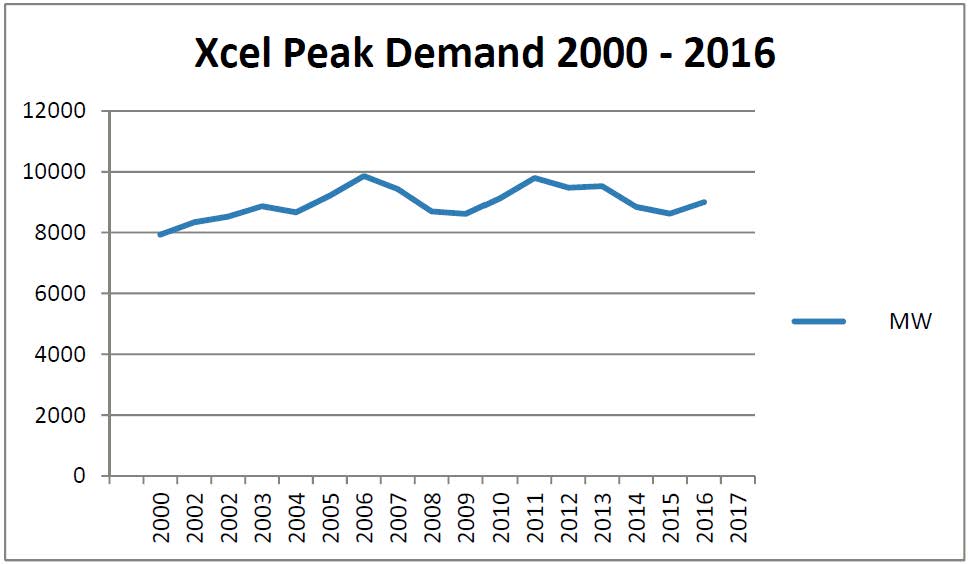
Xcel Energy has released its 2016 SEC 10-K, and here is the number I care most about, the peak demand, incorporated into the chart above:

“Peak Demand” is the number they use to attempt to justify “need” for all sorts of abhorrent and expensive infrastructure, particularly infrastructure of the transmission variety. Here are the specifics in megawatts (MW):
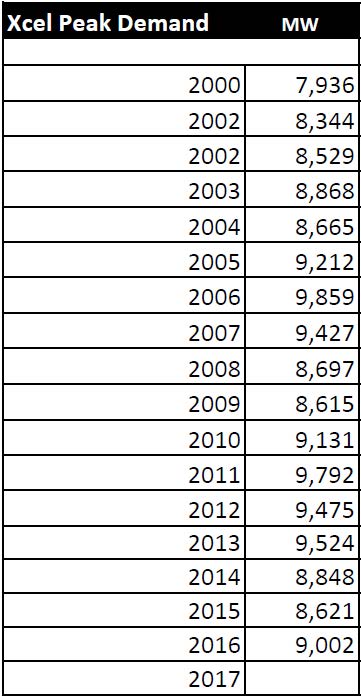
As Xcel Energy’s Ben Fowkes says, this is the “new normal.” From the Seeking Alpha transcript of the XEL Earnings Call, January 31, 2013.
Hence, they’re looking for other ways to make money, which they found in transmission, specifically CapX 2020 transmission, which was justified with this chart from MN Dept. of Commerce’s Steve Rakow, in his bar napkin depiction of the ups and down of peak demand:
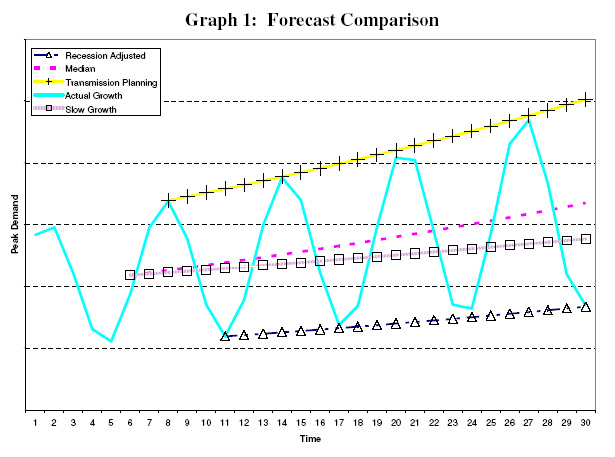
Compare this drunken-dream drawing with the actual peak demand above — doesn’t look at all similar, does it. Nevertheless, we’ve been stuck with over $2 billion in transmission infrastructure build-out which we’re just starting to pay for, and just starting to see show up in rate cases. People are just now starting to get a feel for the economic impact, as if the environmental and quality-of-life impact isn’t bad enough…


Meanwhile, after going through years and years over CapX 2020, followed by the MISO MVP 17 project portfolio, now under construction, MISO wants to spring another bunch of projects on us. Their “Transmission Overlay.” Yeah, right…
Here’s the list, in a spreadsheet:
This is the MN, WI, SD, ND and some IA wish list weeded out from that spreadsheet (click for a larger version):
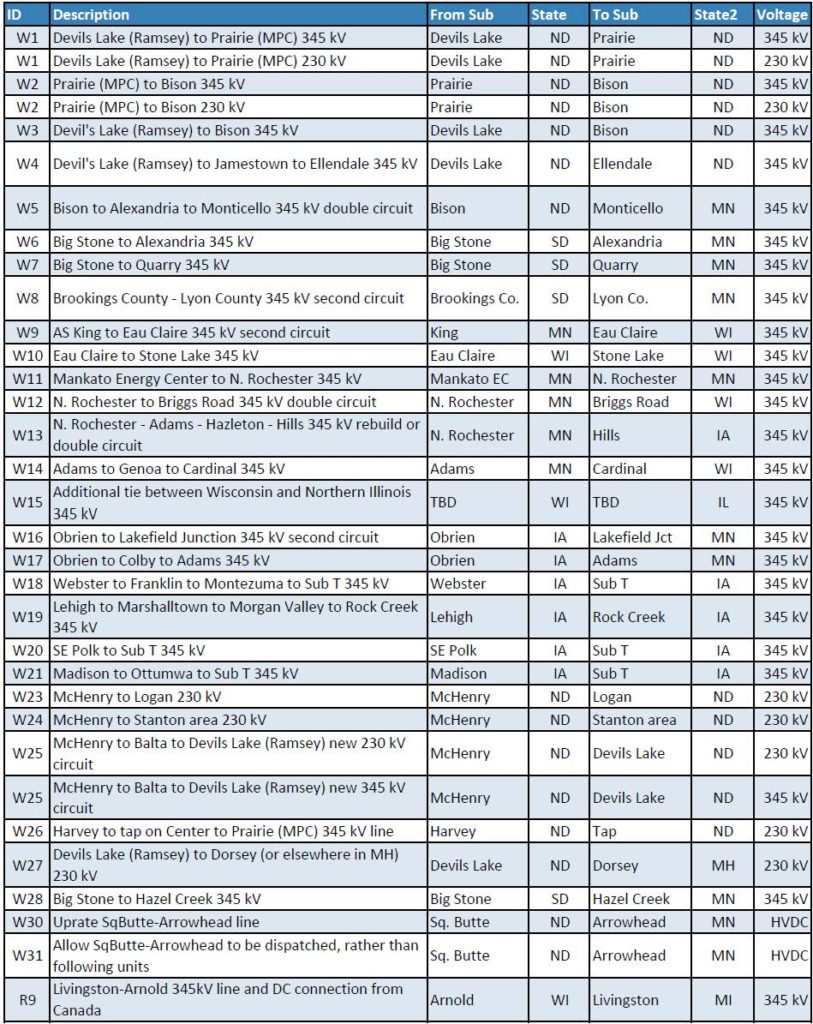
They want to add all of this, nevermind that Xcel is whining in its e21_Initiative that only 55% of the grid is not utilized:
(N) Identify and develop opportunities to reduce customer costs by improving overall grid efficiency. In Minnesota, the total electric system utilization is approximately 55 percent (average demand divided by peak demand), thus providing an opportunity to reduce system costs by better utilizing existing system assets (e.g., generation, wires, etc.). (e21_Initiative_Phase_I_Report, p. 11).
And they want to build more? MORE?!?!
And they want to ram it through even though it’s not needed, just like CapX 2020 transmission? As if Obama’s RRTT wasn’t enough, pushing CapX 2020 Hampton-La Crosse transmission line:
Obama “fast tracks” CapX Hampton-LaCrosse?!?!?!
… check out tRump’s Executive Order 13766:
Expediting Environmental Reviews and Approvals for High Priority Infrastructure Projects
GRRRRRRRRRRRR! As if there’s not enough work to do these days… but you know, the work never ends for us “paid protesters.” And a woman’s work is never done either.
Manzanar – Information on Japanese American Internment
February 27th, 2017

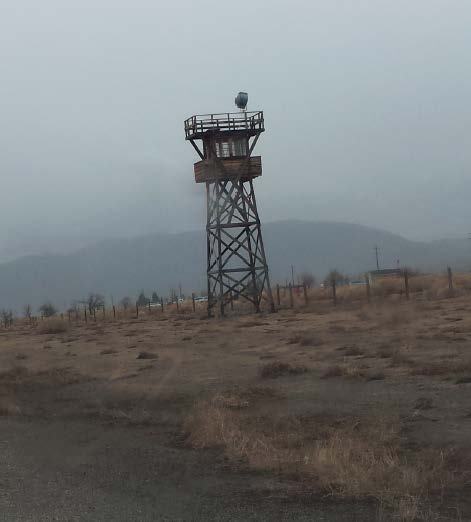
Internment of Japanese Americans was all too real, and it’s a shameful part of American history that we all should know more about. Yeah, I’ve been posting a lot about this, the intentional and orchestrated buildup of hate and racism leading to Executive Order 9066. I knew about it before I went, but actually being there, it hit home in a profound way that isn’t captured by words, particularly when we’re seeing a similar intentional and orchestrated buildup of hate and racism today.
Manzanar National Historical Site
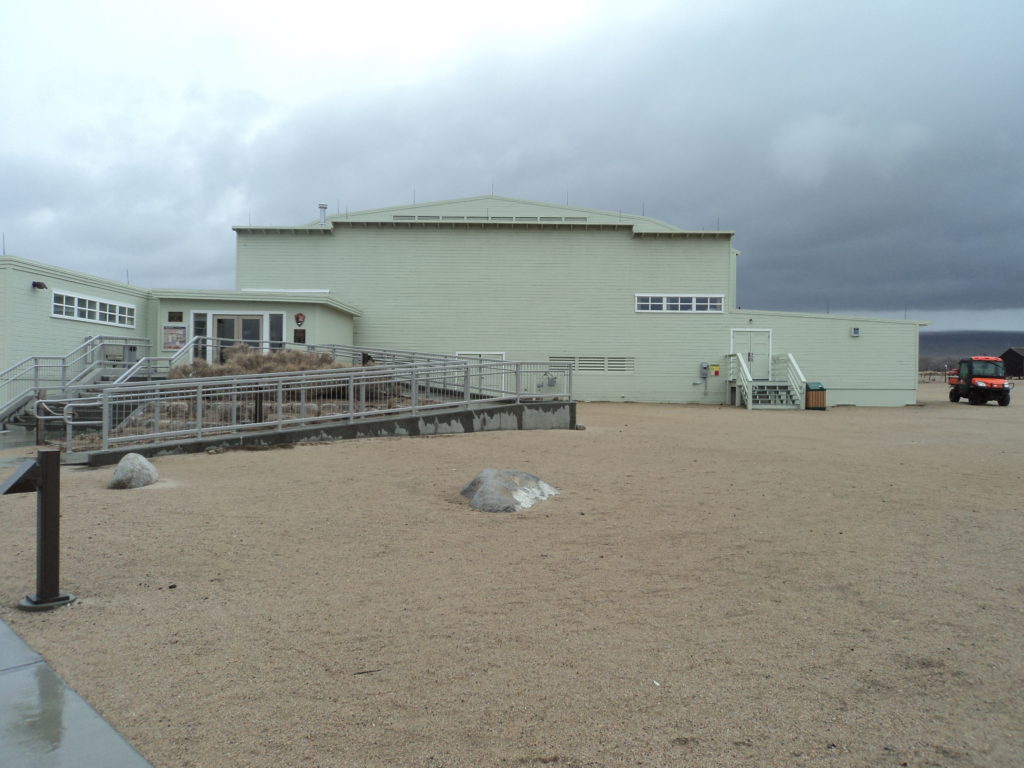
This is the original large hall build by prisoners. It became the focal point of the camp, a gathering spot, even a theater and dance hall — attempts to have some semblance of “normal” life, though captive.
How to research family specifics? Here’s a page from the National Park Service on how to research families held in internment camps across the US:
The arguments for internment were not rational, and evidence presented to Pres. Roosevelt in reports he requested to assess threat to US of Japanese Americans found uniformly that there was no threat. Those reports of “no threat” were turned around with this statement below, turned around, much like today where the recent terroristic events were NOT from the 7 countries of tRump’s Muslim Ban:
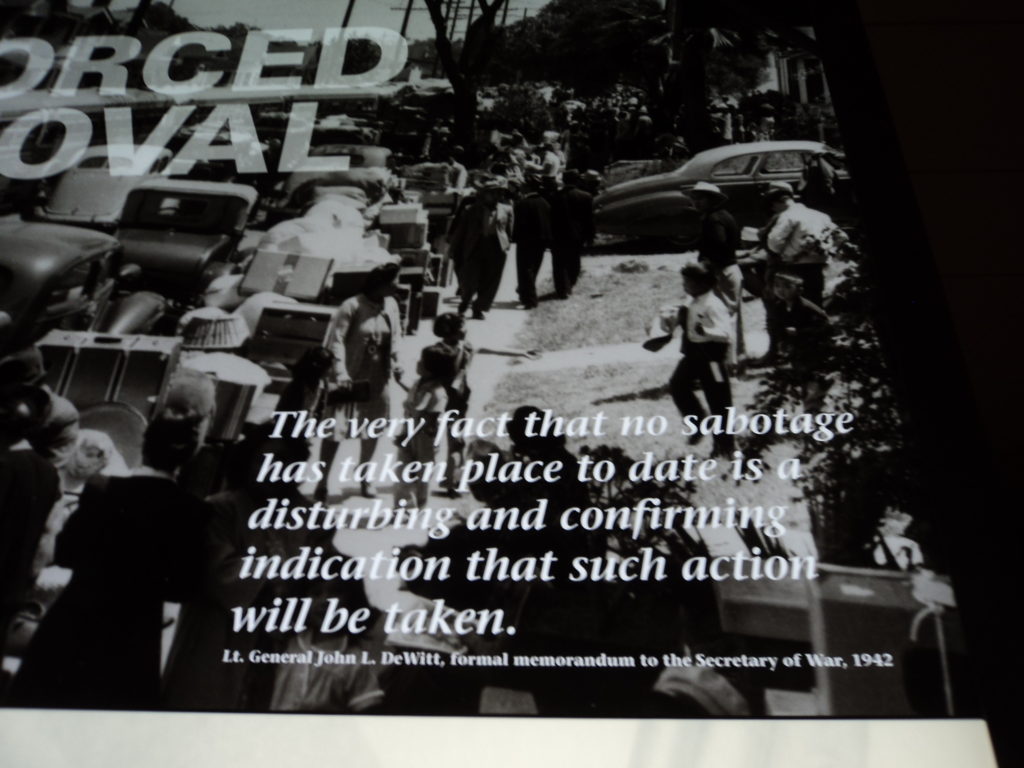
Really… “The very fact that no sabotage has taken place to date is a disturbing and confirming indication that such action will be taken.” WHAT?!?!?!
On a large wall, from the high ceiling to the floor, there’s a long, long list of families interred, a graphic image of the broad impact, looking up to the top is dizzying:

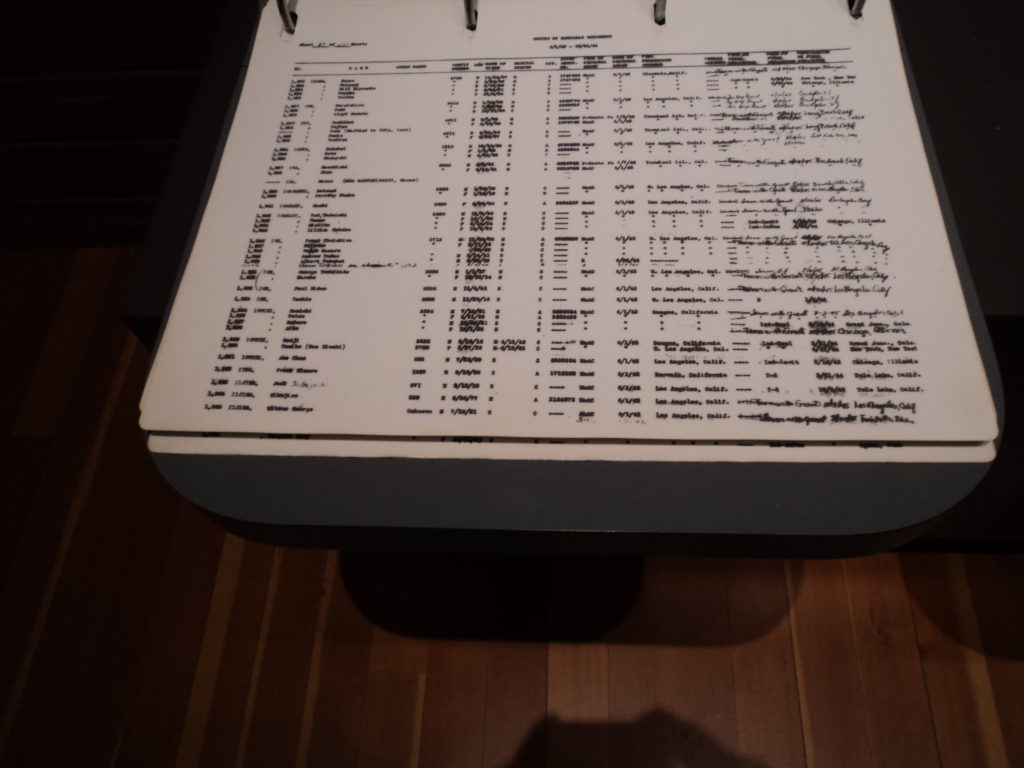
And notebooks listing the families, information about them, and where they went when they left:
There’s a oral history project ongoing, and the National Park Service is collecting this history through interviews, sharing documents, family items, to convey the experience of internment and preserve it to help us learn about our country. Here’s a booklet with information on participating in this project:
It took over 40 years for the U.S. to admit this grievous wrong, apologize and offer modest reparations. An NPR report:
From Wrong To Right: A U.S. Apology For Japanese Internment
Now, rather than do this all over again, rather than be wrong, wrong, wrong, let’s just get it right from the start and rescind the Muslim ban (Executive Order 13769).
Tuesday, Resolution of Inquiry at House Judiciary Committee
February 27th, 2017

Contact each member of the House Judiciary Committee and ask them to pass House Resolution 111! What?!?! Why?!?!?! Because this is really important!!!
On Tuesday, the House Judiciary Committee takes up House Resolution 111, which requests from the Office of the Attorney General any and all documents related to tRump’s “financial practices” — the requests are specified in great detail, check it out:
Tell each member of the Judiciary Committee to vote YES on House Resolution 111. Call the Republicans at top of list:
- Here is the Downloadable Judiciary Committee Member List.
- Here is a Directory of Representatives where you can get their contact info.
Their contact page may restrict it to constituents, but remember that when they’re on a committee, they’re representing US, not just their constituents. Maybe it will take phone calls, well worth your effort.
The Resolution is a step to hold tRump accountable, to disclose information about any criminal or counterintelligence investiation, any investment by foreign governments in tRump, tRump’s interests in businesses, profits from foreign governments use of his hotels or business holdings, Foreign Emoluments Clause, and about conflicts of interest.
This has been called the first step towards impeachment. I regard it as the first, and very necessary, step toward accountability. Turn up the heat. Call today, tonight, just do it!