Bent Tree Noise report confirms permit violations!
February 7th, 2018
 “January Pretzel” — a Bent Tree bent turbine blade 1/20/2018
Taken by the Hagens in the Bent Tree wind project
DOH! The Bent Tree Phase II noise report is out and it confirms that the project is violating the siting permit.
Bottom line:

Here’s the Phase I report:
Bent Tree_Noise Monitoring and Noise Monitoring Report_20179-135856-01
So now what are they going to do?
Tomorrow, the Big Blue wind project is at the PUC which is violating their permit too, and the PUC decision options are to revoke permit, suspend permit, or continue operations with compliance filings.
The process here is flawed (to put it mildly). There is noise modeling required in wind project permitting, but clearly that isn’t sufficient to site them in a way that won’t steamroll the neighbors to the project. The setbacks in MN aren’t adequately protective. Deal with it, Public Utilities Commission!
Subpoenas ‘R Us! Association of Freeborn Co. Landowners
February 1st, 2018
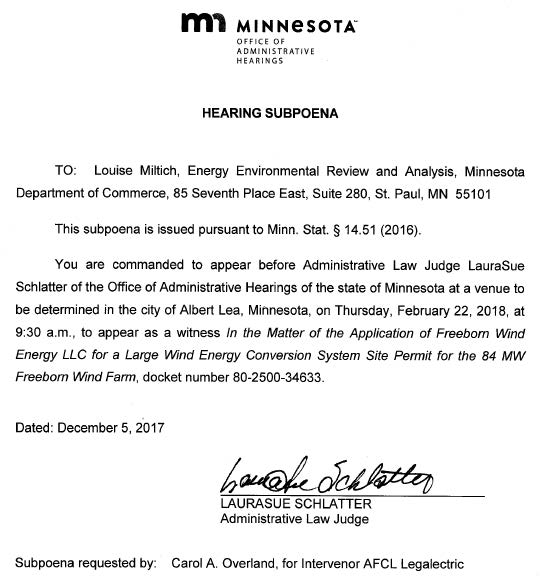
Well, Association of Freeborn County Landowners got Subpoenas, served them, and for some reason, the Dept. of Commerce and Dept. of Health really don’t want to bring their reports into the Freeborn Wind docket:
Here are the reports that really matter:
Dept of Health – Public Health Impacts of Wind Turbines
Dept of Health – Comment Pages 59-61 from Siting_InitialFiling_Appendix A_Agency Correspondence
One way or another, these reports WILL get in the record. Why? Well, look at the recommendations in the Dept. of Health comment:
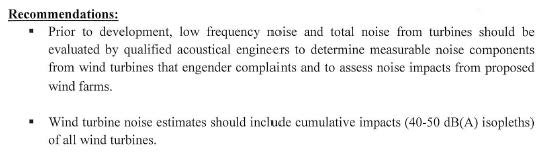
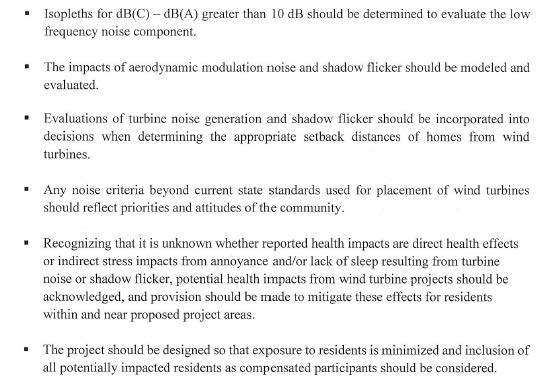
Pretty specific? And the more general recommendations fro the “Public Health Impacts of Wind Turbines” report:
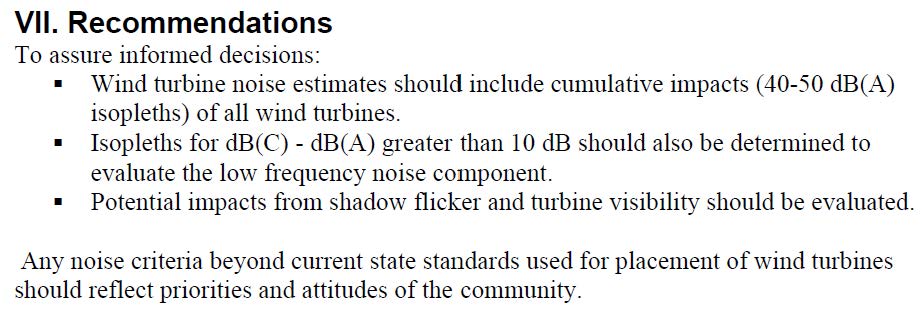
The Dept. of Health report is part of Invenergy’s Roberts’ testimony, but it’s not entered in the record yet. The Dept. of Health 5/2/2017 Comment was part of the Applicant’s Appendix A (pps. 59-61) and again, it’s not part of the record yet. So just making sure it all gets in there one way or another.
Do tell — has the Applicant followed these recommendations of the Minnesota Department of Health in siting their project? Has the Dept. of Commerce followed these recommendations in reviewing the project? Has the Public Utilities Commission followed these recommendations in considering permitting the project?
And what about Commerce? We have documentation that in the Bent Tree project, which had wind noise modeling performed as a part of the application and permitting process, noise modeling which said, “no problem,” and yet (click for larger version):
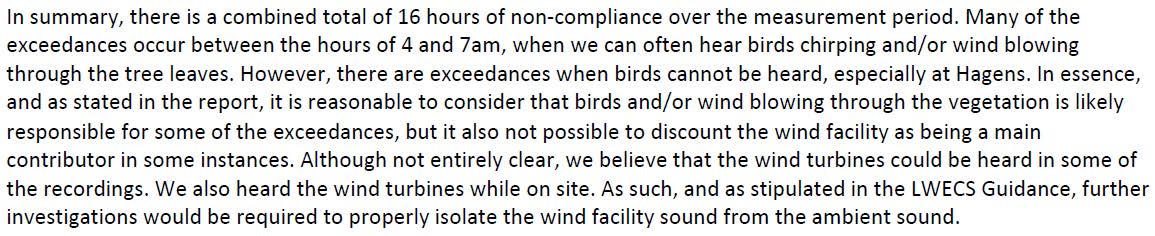
And the full Bent Tree Noise Monitoring and Noise Report ordered by the Public Utilities Commission.
Commerce filed a Motion to Quash:
And we reached an agreement:
Oh, but wait… they’re really not wanting that Bent Tree info to get in the record! So once more with feeling:
OK, whatever…
And then there’s the Minnesota Department of Health (MDH), and they also jumped on the bandwagon, clearly the Asst. Commissioner who signed the Dept of Health – Comment wasn’t the author and didn’t know much about it (!), so:
Letter and Stipulation for the Release of the Assistant Commissioner
Which leaves the DNR. Got a call from DNR Counsel Sherry Enzler, who clearly didn’t get that Commerce Motion to Quash had no bearing on DNR Subpoena, and that wed reached an agreement and Commerce had withdrawn their Motion, oh my… but anyway, we agreed that we’d set a time certain the last day of the hearing for the DNR staff. No problem… though we’ll need an Order from the judge confirming that.
So on we go…
Oh, but wait, the Applicants, Invenergy, also got their $0.02 in, and filed a Motion:
… OK, again, whatever, gotta get response in on this one…
And may the ALJ decide!!!
The Administrative Law Judge in this case, and the Public Utilities Commission, the ultimate decider, need to recognize that the permitting system is fatally flawed. Prevention, precaution, prudence…
Red Wing City Council Workshop
January 27th, 2018
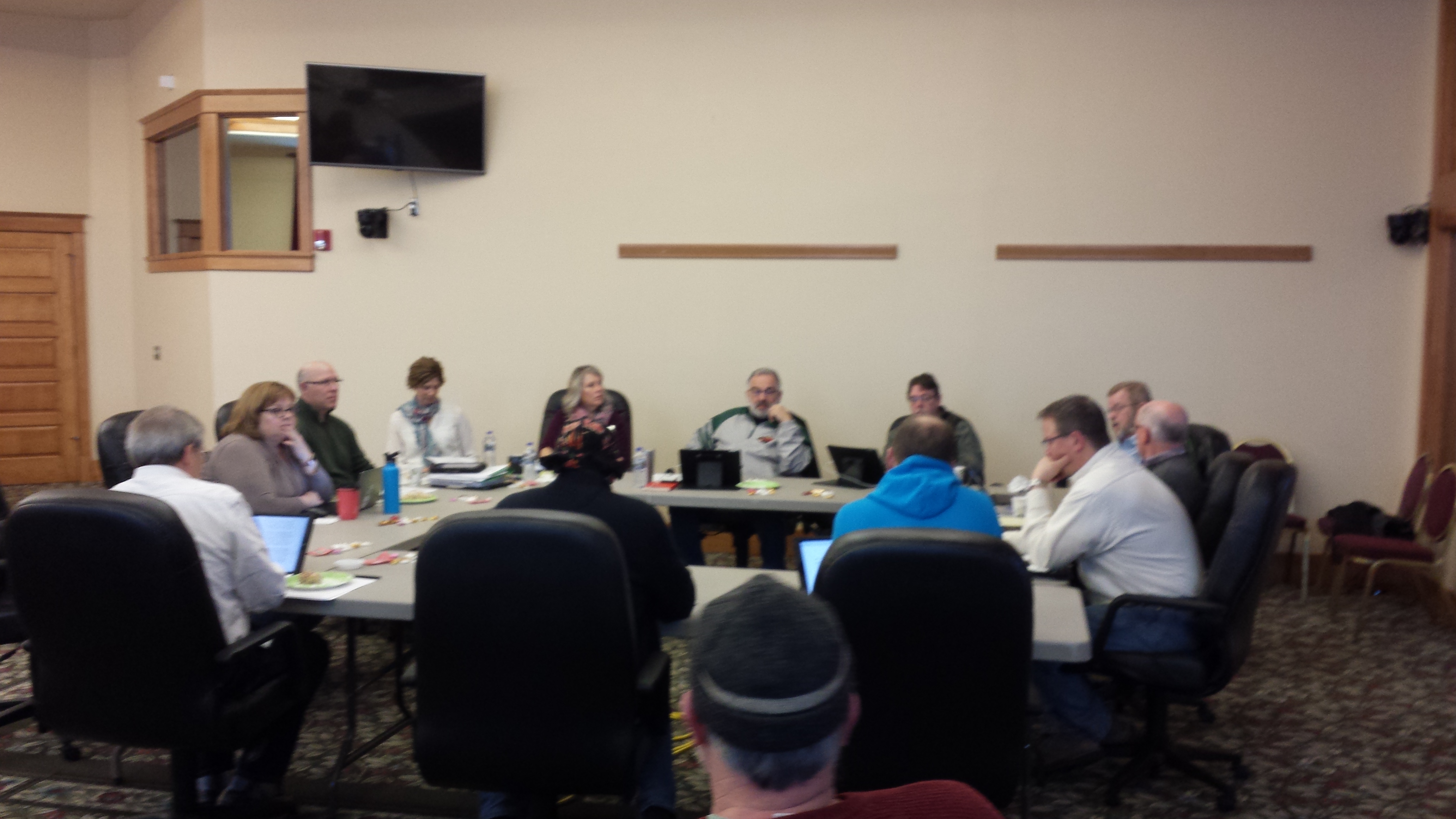
Today the Red Wing City Council started its Day 2 of the Council Workshop, and it was worth going to, but too early o’clock. Getting the last Icelandic Almond Roll was some consolation!
Here is what was part of yesterday’s discussion… really…

What’s that? It’s a shield, under the bench, one for each of the City Council members and staff , to pull out in case of terrorist attack.
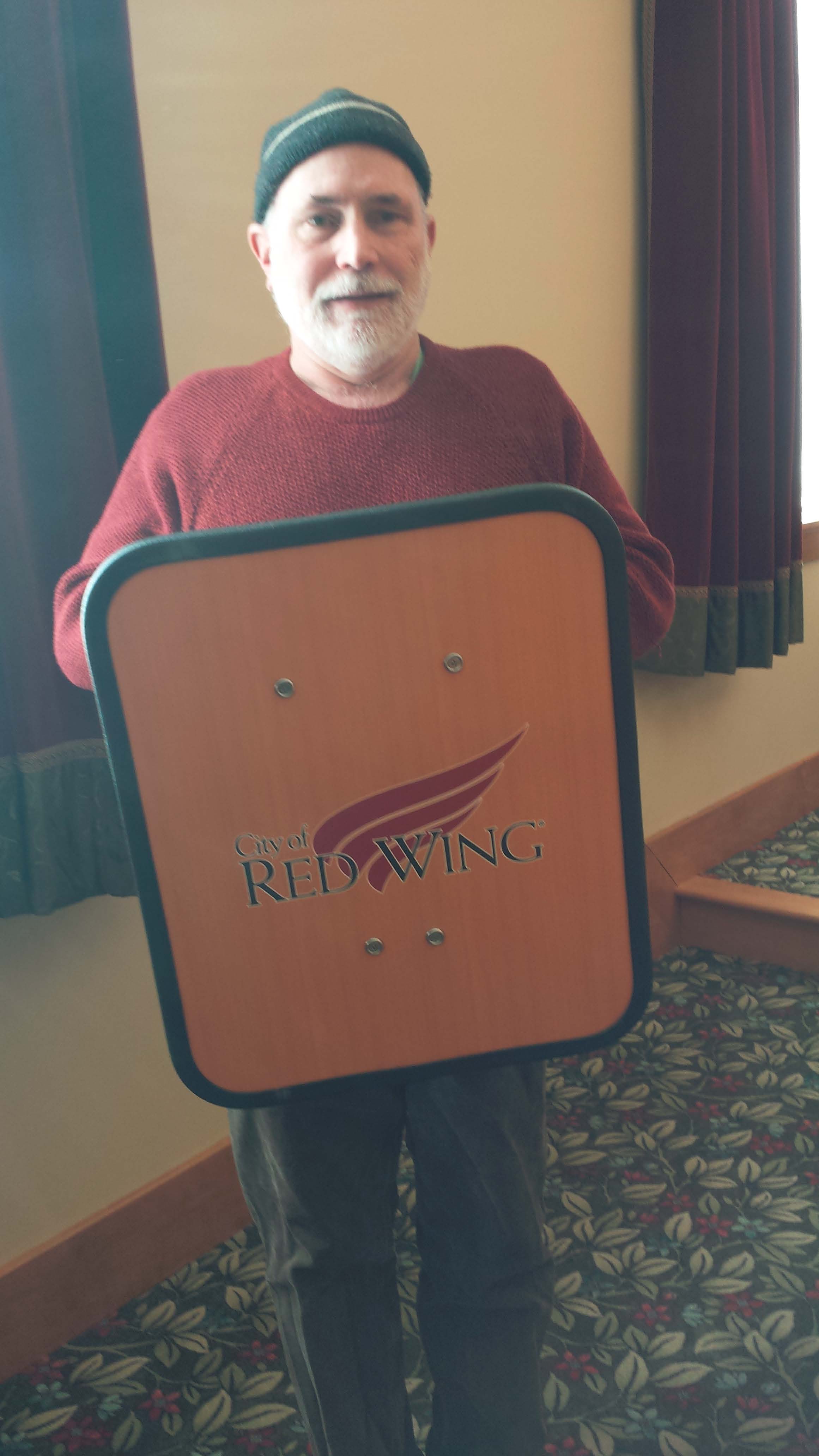
Oh well, they already did it, and this was mostly a report on what had been done. Rumor has it that these were about $8,000 each, or $50K+ total… Oh my…
Onward… today first was a discussion of painting on Barn Bluff. I rather enjoy the painting cropping up on the outcrop. But I also hear that this bluff is a sacred Dakota area. I’ve seen the flag on the bluff, it hasn’t been there all that long, and to me, that flag there is inconsistent with respect for Dakota tradition. Flagpole and flag here in upper right hand corner of this borrowed photo:
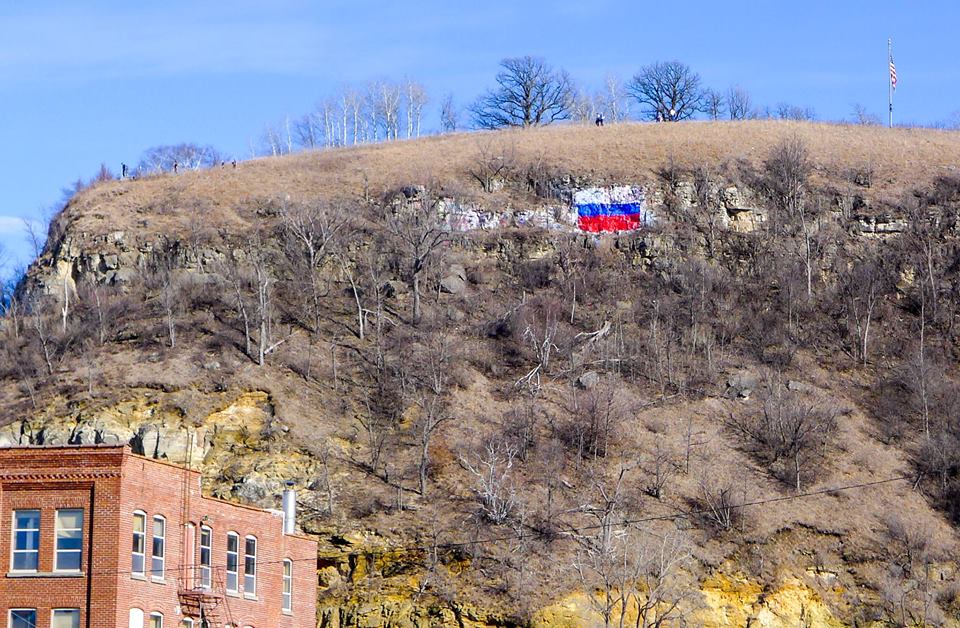
Today, from the discussion, I learn that the flag was sited right in the midst of a burial area! WHAT?!?! And this is not the first time siting is an issue, probably this happens a lot here, but I do know it was also an issue with the siting of the Red Wing lay down yard, where that Lot and building and storage area was right within the Water Tank Mounds area and that was not fully disclosed during that permitting, nor was the timing of agency involvement and review correctly disclosed during the Ash Mine permitting proceeding. Looks to me like the City has a pattern of inadequate investigation of and respect for Dakota sacred and burial areas. Falling through the holes, being pushed through, how do we fix this, assure it doesn’t keep happening, and make amends?
And then on to the “Public Hearing Process Discussion.” Oh my… Here’s the background from the workshop packet:
Overland’s $0.02: The discussion of civic engagement and “Public Hearing Process Discussion” morphed into a “no public comments on agenda items where there has been a Public Hearing at Planning Commission” as a council policy and taking it off the Council President. NO, not OK. The “No public comments” is bad policy. I note that 2-3 council members felt it was important for the public to be able to address, face to face, the decision makers. YES, it is. And when that is not allowed, it is the job of those council members to stand up for the public!
Today’s discussion, from the packet, was framed in binary, either Option A, where board/commission brings recommendation to Council, “No public input would occur at the Council meeting.” Option B, Boards and commissions have a lesser role in government decisions. Public input often happens at both the board/commission meetings and the City Council meetings.
Note the framing — problematic, as Option A would as policy eliminate public comment at CC meetings on agenda items. NOT OK! Option B frames it as allowing public comment at meetings means “boards and commission have a lesser role in government decision.” NOT OK! The notion that allowing public comment means undermining the Planning Commission is absurd. If there’s crucial determinative “new information,” then it should go back to the Planning Commission with a clear directive, and mindful that the Planning Commission is an “Advisory” Planning Commission, they are NOT the decision makers.
The framing of the options was off, and impact of this framing was to guide toward making it Council policy not to allow comment. NOT OK! Was that intended or not? Who knows… The framing was NOT OK for two reasons, first, public comment should as policy be allowed and encouraged. Second, the decision not to allow public comment has been a decision of the Council President, and he’s accountable for that. NOT OK! I do think that bullet was dodged, and instead a more reasonable Option C, that public comment WILL be allowed, and if Council has issues about what’s proposed, it will go back to Board/Commission. It took a lot of objecting and targeted statements to pull this into encouraging public participation, and not further limiting it as a matter of policy. We shall see…
Plains & Eastern Clean Line Dead?
January 24th, 2018
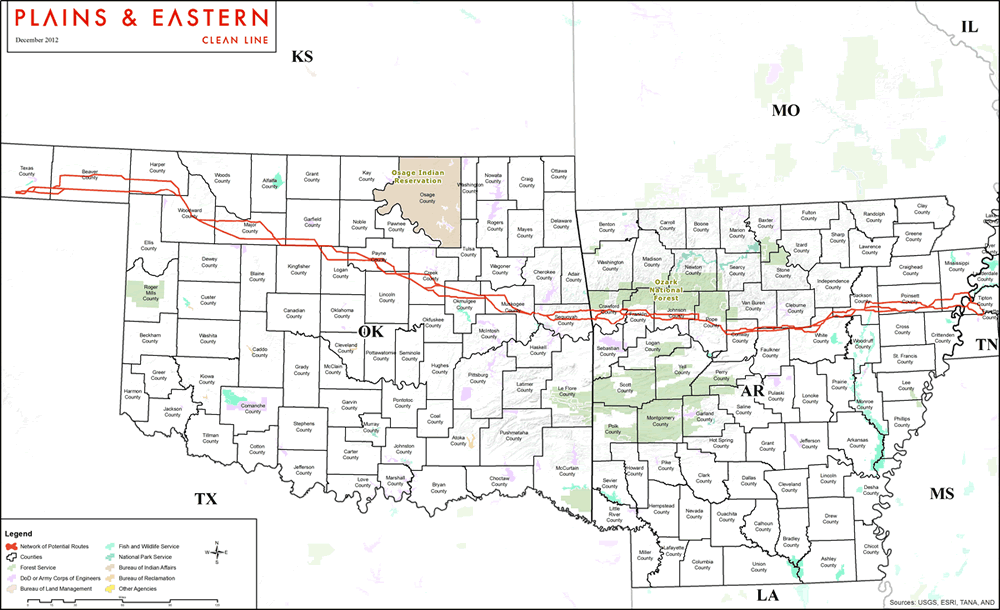
From Alison Milsaps and Dave Ulery, Block Plains and Eastern Clean Line:
To recap the events of recent weeks: Plains & Eastern, Clean Line’s regulatory crown jewel and the only of its projects to be fully (if questionably) permitted, is DEAD in Arkansas. Hallelujah. Don’t take our word for it, though. Let’s look at a little evidence:
Hubris: Clean Line’s Michael Skelly and the End of the Plains and Eastern Project…
You know, I love it when this happens.
Under the agreement, Clean Line Energy retains project assets east of Oklahoma, and NextEra Energy Resources owns only the project assets in Oklahoma.
Clean Line Energy added that the transaction will continue the project’s forward momentum and install a new sponsor to a transmission solution to the burgeoning wind sector in Oklahoma and the Southwest Power Pool.
A Clean Line Energy spokesperson on Dec. 22 told TransmissionHub of the deal, “We cannot disclose financial information.”
Clean Line Energy Partners, a Houston-based developer of five major transmission lines for wind-generated electricity, has dropped its interconnection agreement with TVA for one of its most promising projects after the federal utility declined to buy what Clean Line officials said would be cheaper and cleaner power for TVA…
… But after years of study, TVA said the Clean Line project didn’t make economic sense for the nation’s biggest government-owned utility, since TVA already has enough power-generating capacity and is on path to get more than half of its power from carbon-free sources. TVA President Bill Johnson said the intermittent nature of wind power would require TVA to build other backup power generators, including natural gas plants, that would offset the promised savings from the wind-generated power sources alone.
“We’re looking at a power demand in the future that is flat, or declining slightly, so we don’t anticipate needing major additions to power generation for a decade or more,” Johnson said.
“We all are wondering at this point” what is going on, said Julie Morton, of Van Buren. “We are disconnected on the western end now. The TVA was going to take 3,500 of the 4,000 megawatts it was going to generate, but now it is disconnected on that end.
“We are stuck in the middle, unplugged at both ends, and the only way out for us is if Clean Line completely implodes, which I think is happening, and the Department of Energy withdraws from the project.”
and now…
Using powers contained in the Energy Policy Act of 2005, the department moved the project forward over the objections of Arkansas leaders.
Among other things, the law would enable the use of eminent domain to obtain property from unwilling sellers.
But the participation agreement allows the department to back out of the deal if “the Commencement Date has not occurred by December 31, 2018.”
In the letter, delegation members urged Perry to “pause the Project to either study or terminate its participation before the deadline.”
Since it was unveiled, the power line project has generated controversy.
Arkansas lawmakers ask DOE to block Clean Line transmission project
Don’t know what more we could possibly need to show that this project is O. V. E. R. I do wonder if the appellate case was dismissed so there would be no precedent, and then, immediately after it was dismissed, all this happens. Then, if they or someone else wants to try a Section 1222 project, the door remains open????
End of Temporary Protection Status?
January 12th, 2018
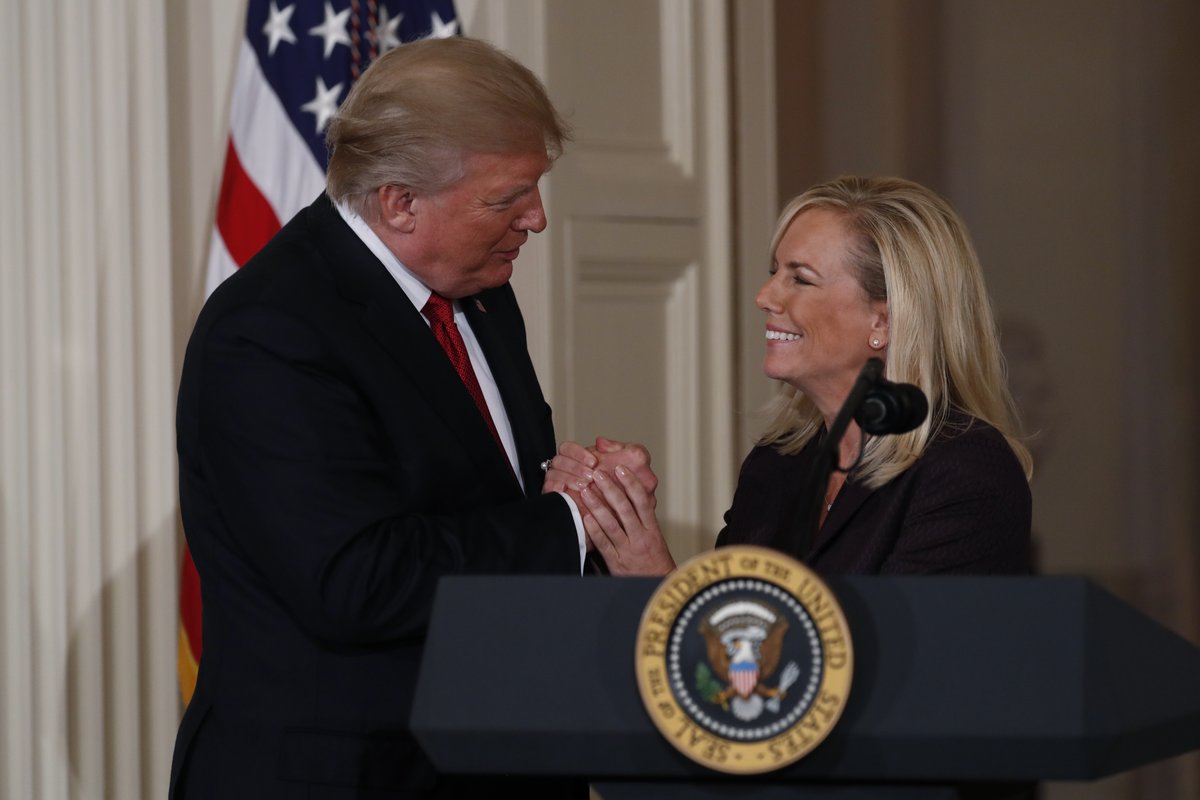
Yes, this administration is planning to end “Temporary Protected Status” for many legally admitted/present refugees. Here’s the U.S. Citizenship and Immigration Services’ Temporary Protected Status page. They’ve been here legally for how long, and now, the rug will be pulled out from under them.
Countries covered include:
And here’s the real news of Secretary of Homeland Security Kirstjen M. Nielsen doing tRump’s bidding — note it’s coming from Homeland Security, this one regarding El Salvador:
For Immediate Release
Office of the Press Secretary
Contact: 202-282-8010
Nielsen Carefully Considered Conditions on the Ground
WASHINGTON— Today, the Secretary of Homeland Security announced her determination that termination of the Temporary Protected Status (TPS) designation for El Salvador was required pursuant to the Immigration and Nationality Act. To allow for an orderly transition, she has determined to delay the termination for 18 months. The designation will terminate on Sept. 9, 2019.
The decision to terminate TPS for El Salvador was made after a review of the disaster-related conditions upon which the country’s original designation was based and an assessment of whether those originating conditions continue to exist as required by statute. Based on careful consideration of available information, including recommendations received as part of an inter-agency consultation process, the Secretary determined that the original conditions caused by the 2001 earthquakes no longer exist. Thus, under the applicable statute, the current TPS designation must be terminated.
The Department of Homeland Security has conducted extensive outreach to Salvadoran communities throughout the country. This includes, but is not limited to, community forums on TPS, panel discussions with Salvadoran community organizers, stakeholder teleconferences, regular meetings with TPS beneficiaries, news releases to the Salvadoran community, meetings with Salvadoran government officials, meetings at local churches, and listening sessions. The Secretary met recently with the El Salvadorian Foreign Minister and Ambassador to the United States, and spoke with President Sánchez Cerén.
Following the 2001 earthquake, El Salvador received a significant amount of international aid to assist in its recovery efforts, including millions of dollars dedicated to emergency and long-term assistance. Many reconstruction projects have now been completed. Schools and hospitals damaged by the earthquakes have been reconstructed and repaired, homes have been rebuilt, and money has been provided for water and sanitation and to repair earthquake damaged roads and other infrastructure. The substantial disruption of living conditions caused by the earthquake no longer exist.
Additionally, in recent years, the U.S. government has been repatriating individuals back to El Salvador – more than 39,000 in the last two years – demonstrating that the temporary inability of El Salvador to adequately return their nationals after the earthquake has been addressed.
To allow for an orderly transition, the effective date of the termination of TPS for El Salvador will be delayed 18 months to provide time for individuals with TPS to arrange for their departure or to seek an alternative lawful immigration status in the United States, if eligible. Salvadorans in the United States who benefited from TPS may still receive other protections under our immigration system for which they are eligible.
The 18 months will also provide time for El Salvador to prepare for the return and reintegration of its citizens. During this timeframe, DHS will work with the Department of State and the Government of El Salvador to help educate relevant stakeholders and facilitate an orderly transition. In addition to materials posted online, DHS components will participate in outreach activities such as teleconferences, town halls and roundtables to ensure that affected populations have a full and accurate understanding of their rights and obligations.
Only Congress can legislate a permanent solution addressing the lack of an enduring lawful immigration status of those currently protected by TPS who have lived and worked in the United States for many years. The 18-month delayed termination will allow Congress time to craft a potential legislative solution.
Salvadorans with TPS will be required to re-register for TPS and apply for Employment Authorization Documents in order to legally work in the United States until the termination of El Salvador’s TPS designation becomes effective Sept. 9, 2019. Further details about this termination for TPS, including the re-registration period, will appear in a Federal Register notice. Salvadoran TPS beneficiaries should not submit re-registration applications until the re-registration period is announced through the Federal Register notice.
# # #
Each has its own notice, but some are set to expire and no notice — here’s what’s on the site:
- Acting Secretary Elaine Duke Announcement On Temporary Protected Status For Haiti.
- Acting Secretary Elaine Duke Announcement on Temporary Protected Status for Nicaragua and Honduras.
- Termination of the Designation of Nicaragua for Temporary Protected Status.
- Temporary Protected Status for Sudan to Terminate in November 2018 (an Arabic translation is also available (PDF, 191 KB).