Xcel demand down, down, down
September 28th, 2014

I’ve been saying this for so many years, that electric demand is down, down, down, and instead, Xcel Energy (and all the others) have been saying it’s going UP, UP, UP (even though Mikey Bull said years ago that they wouldn’t need power for a while), and they’re applying for and getting Certificates of Need for all these permits for utility infrastructure that are obviously designed to market and sell the surplus, and the Public Utilities pretends to be oblivious (I say “pretends” because I cannot believe they’re that unaware and uninformed.).
This is a must read:
Here’s the short version from Xcel:
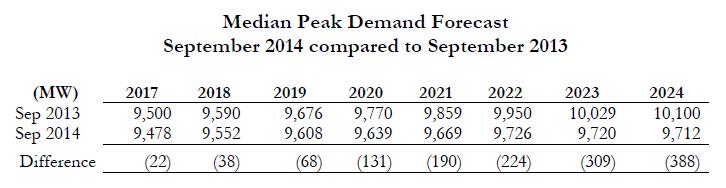
2024 is expected to be about what it was back in 2007, the industry peak year. DOH! But note this — there’s a “small capacity surplus in 2016.” DOH!

And given the surplus which we’ve known has been present and looming larger, that’s why they then ask for withdrawal of the Certificate of Need for the Prairie Island uprate because it isn’t needed (and really, that was just what, 80 MW or so? Or 80 MW x 2 reactors, 160 MW?). If they don’t need that small uprate, why on earth would they need so much more?

But what do I know…
Hollydale Transmission Line was clearly not needed, and they withdrew that application…
CapX 2020 transmission was based on a 2.49% annual increase in demand, and for Hampton-La Crosse in part supposedly based on Rochester and La Crosse demand numbers, yeah right, we know better, but that was their party line. Again, DOH, it didn’t add up to needing a big honkin’ 345 kV transmission line stretching from the coal plants in the Dakotas to Madison and further east, but who cares, let’s just build it…
ITC MN/IA 345 kV line — the state said the 161 kV should be sufficient to address transmission deficiencies in the area, but noooooo, DOH, that wouldn’t address the “need” for bulk power transfer (the real desire for the line).
Here’s a bigger picture of the bottom line (I’m accepting this as a more accurate depiction, not necessarily the TRUTH, but close enough for electricity), keeping in mind that these are PROJECTIONS, and that they’re adding a “Coincident Peak adjustment” which should be included in the “peak” calculations):

Notice the only slight reduction in coal capacity, just 19 MW, nuclear stays the same, a 320 MW decrease in gas, a 128 MW reduction in Wind, Hydro, Biomass, which I hope includes garbage burners and the Benson turkey shit plant , slight increase in solar of 18 MW, and Load Management also a slight increase of only 80 MW. This is Xcel Energy with its business as usual plan, which has to go. We can do it different, and now is the time.
Will someone explain why we paid so much to uprate Monticello, and paid to rebuild Sherco 3?
From the archives:
500+ give LS Power a piece of their mind
October 20th, 2009
2012 NERC Long Term Reliability Assessment
May 7th, 2013
PJM Demand is DOWN!
November 15th, 2012
Transmission? It’s NOT needed!!!
October 18th, 2012
Xcel shelves projects, admitting demand is down
December 3rd, 2011
BLM rules for solar and wind projects
December 30th, 2011
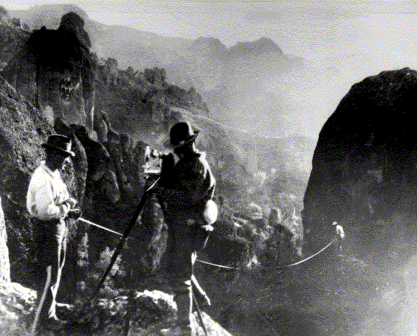
The Bureau of Land Management has issued Advance Notice of Rulemaking for solar and wind projects on federal land.
Here’s the Notice:
Send Comments by February 27, 2012:
ADDRESSES: You may submit comments by any of the following methods:
Mail: Director (630) Bureau of Land Management U.S. Department of the Interior Room 2134LM 1849 C St. NW.
Washington, DC 20240 Attention:
1004–AE24 Personal or messenger delivery: U.S. Department of the Interior Bureau of Land Management 20 M Street SE., Room 2134LM, Attention: Regulatory Affairs Washington, DC 20003
Federal eRulemaking Portal: http://www.regulations.gov Follow the instructions at this Web site.
Here’s an article from Bloomberg about it:
U.S. Proposed wind, Solar Leasing Rule on Federally Owned Land
By Benjamin Haas – Dec 29, 2011 3:14 PM CT
The U.S. Interior Department is seeking comment on how it should issue right-of-way leases for competing solar and wind projects on government land.
The department wants to establish a competitive bidding process that would bring “fair market value for the use of public land,” it said in a statement today. The government is considering bidding procedures within zones designated for wind and solar projects, including how companies would qualify and what financial arrangements would apply. A 60-day comment period ends Feb. 27.
These zones may be beneficial to birds, the American Bird Conservancy said in a statement today. “American Bird Conservancy is developing a map of the areas where wind energy would be most risky to birds,” said Kelly Fuller, the organization’s wind-campaign coordinator.
The Department’s Bureau of Land Management oversees 245 million acres (992,000 sq. kilometers) across the U.S, according to the report. It plans to have 10,000 megawatts of wind, solar and geothermal projects approved by 2015.
To contact the reporter on this story: Benjamin Haas in New York at bhaas7@bloomberg.net
To contact the editor responsible for this story: Susan Warren at susanwarren@bloomberg.net