Energy is an essential part of American life and a staple of the world economy. The Trump Administration is committed to energy policies that lower costs for hardworking Americans and maximize the use of American resources, freeing us from dependence on foreign oil.
For too long, we’ve been held back by burdensome regulations on our energy industry. President Trump is committed to eliminating harmful and unnecessary policies such as the Climate Action Plan and the Waters of the U.S. rule. Lifting these restrictions will greatly help American workers, increasing wages by more than $30 billion over the next 7 years.
Sound energy policy begins with the recognition that we have vast untapped domestic energy reserves right here in America. The Trump Administration will embrace the shale oil and gas revolution to bring jobs and prosperity to millions of Americans. (does he have no understanding of energy market?) We must take advantage of the estimated $50 trillion in untapped shale, oil, and natural gas reserves, especially those on federal lands that the American people own. (does he not know the havoc in ND during Bakken BOOM!, the many Bakken BOOM! train explosions, pollution, and deaths? And he’d allow corporations to take OUR land?) We will use the revenues from energy production (a production tax increase?) to rebuild our roads, schools, bridges and public infrastructure. Less expensive energy will be a big boost to American agriculture, as well.
The Trump Administration is also committed to clean coal technology, and to reviving America’s coal industry, which has been hurting for too long. (again market forces, coal is not least cost, and new coal is way beyond anything market would support. “Clean” coal? Don’t even think about it, it doesn’t exist!)
In addition to being good for our economy, boosting domestic energy production is in America’s national security interest. President Trump is committed to achieving energy independence from the OPEC cartel and any nations hostile to our interests. At the same time, we will work with our Gulf allies to develop a positive energy relationship as part of our anti-terrorism strategy.
Lastly, our need for energy must go hand-in-hand with responsible stewardship of the environment. Protecting clean air and clean water, conserving our natural habitats, and preserving our natural reserves and resources will remain a high priority. President Trump will refocus the EPA on its essential mission of protecting our air and water. (everything I’ve seen and heard from Trump and EPA pick points towards dismantling and defunding EPA. What does this mean?)
A brighter future depends on energy policies that stimulate our economy, ensure our security, and protect our health. Under the Trump Administration’s energy policies, that future can become a reality.
tRump’s Memoranda & Executive Orders
January 24th, 2017

There’s been a flurry of activity, and finally they posted the actual documents so we can see what’s going on, or what won’t be going on. This was part of my “One a Day” plan to send off a missive to the White House every day, something of substance. When the Contact page was blank on Monday morning, I started calling, ALL DAY LONG, and got through around 7 p.m., when a human answered, and hung up. I called back, got that same human, who wouldn’t tell me who I should talk to about the Executive Orders (presumed that’s what they were as that’s what was said) and said the Comment office person was gone so I had to leave it online, and she got pissy when I said that the Comment page was blank, and hung up again. OK, whatever…
Civics Lesson from USA Today, Presidential memoranda vs. executive orders. What’s the difference?
Here are the Memoranda thus far from the White House page (these are not required to be published in the Federal Register, so ???, but they are now on the White House Memoranda page:
Presidential Memorandum on January 24, 2017Presidential Memorandum on January 24, 2017Presidential Memorandum on January 24, 2017Presidential Memorandum on January 24, 2017Presidential Memorandum on January 23, 2017Presidential Memorandum on January 23, 2017Presidential Memorandum on January 23, 2017Presidential Memorandum on January 20, 2017
And here are the Executive Orders, from the White House Executive Order page:
Executive Order on January 24, 2017Executive Order on January 20, 2017
Now maybe they’ll have the routine down and keep up with what they’re doing. Drives me crazy to be loating around in the dark — it’s hard enough to know or guess what these might mean in practice, but without an actual document to look at, it’s just blather. Well, it’s just blather anyway, but here it is. Read it and get busy!
Tuesday’s Executive Orders from tRump
January 24th, 2017
Of course there’s nothing on tRump’s Executive Orders page.
Trump clears way for Dakota Access, Keystone pipelines
And via email to the EPA:
Trump bans EPA from giving updates to reporters, bars new contracts, grants
“New EPA administration has asked that all contract and grant awards be temporarily suspended, effective immediately,” read the e-mail, which was shared with the Washington Post. “Until we receive further clarification, which we hope to have soon, please construe this to include task orders and work assignments.”
An America First Energy Plan?
January 23rd, 2017

Contact Page for Trump’s White House
Comments: 202-456-1111
Switchboard: 202-456-1414
The Trump regime has published this “Energy Plan.” WHAT? Mitt Romney’s “Energy Plan” wasn’t much, and was grossly misguided, but it at least had SOME substance:
Romney’s Energy Plan – much ado about nothing
This is something a 5th grader could put together, nothing but blathering and slapped together code words. It shows no thought or understanding of energy in the U.S. today. I mean really, “clean coal” is so dead. During the Bush administration, they put billions in, between tax credits, grants, subsidies at state and federal levels — here’s a DOE announcement from 2006:
Energy Secretary and Secretary of the Treasury Announce the Award of $1 Billion in Tax Credits to Promote Clean Coal Power Generation and Gasification Technologies
The Bush Administration made coal gasification (IGCC) a priority, and even all that lobbying, subsidization, and wishful thinking couldn’t make it happen. Minnesota’s Excelsior Energy’s Mesaba Project is one example of that abject failure (see also www.camp-site.info). Delaware’s NRG coal gasification plant is another (note another NRG coal gasification plant proposed for NY went south too).
Meanwhile, existing coal is not economical, that’s why the older plants are being shut down, not anything to do with “Clean Power Plan,” and instead, that there’s a surplus of electricity and coal plants’ production costs a lot more than other available electric generation. The market says no! How does Trump think he can trump the market? And even if he could, how is that in our interest?
Here’s a map of MISO market — note all the blue on these maps — I love using these as wallpaper, a constant reminder:
Here’s the PJM market map:
And the joint MISO/PJM market map:
Coal cannot compete in the market, even with its outright and embedded regulatory subsidies, even the existing plants. There’s a glut of electricity, has been for a decade now. As Xcel’s Ben Fowkes says, recorded in the Seeking Alpha transcript of the XEL Earnings Call, January 31, 2013.
So…. drumroll…. Here it is, cut and pasted from the White House site in its entirety (emphasis added in red)(and parenthetical comments):
How clueless can Trump be? Well, we’re seeing… and it’s unbelievable… UNBELIEVABLE!
2016 PPSA Annual Hearing
December 23rd, 2016
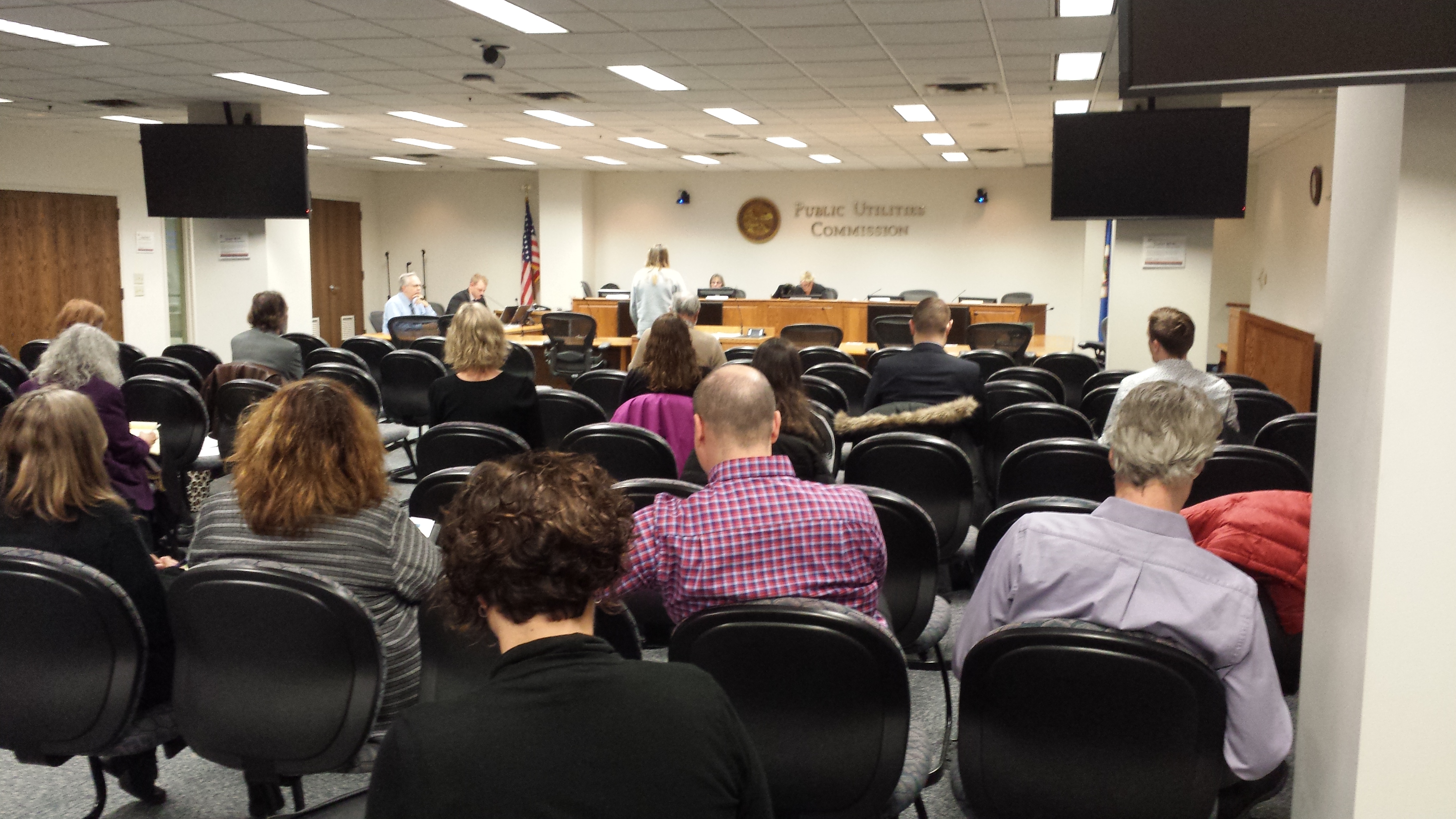
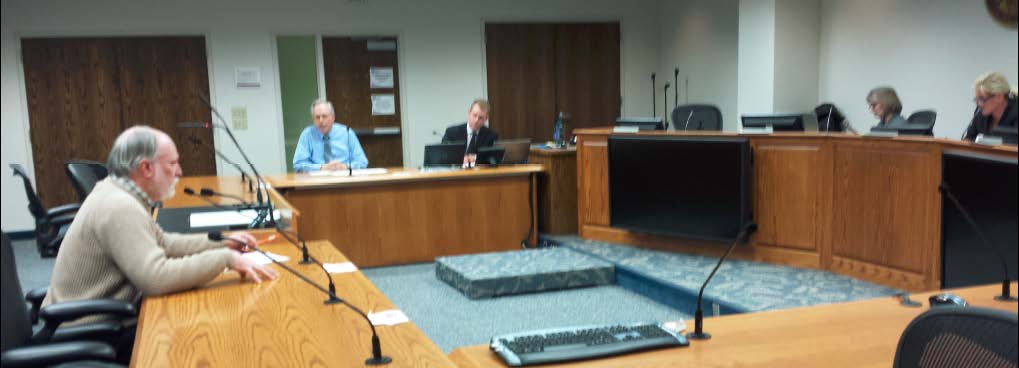
Tuesday was the Annual Hearing for the Power Plant Siting Act. I’ve been fighting off this sickness that Alan’s had for a week now, and not quite feeling right, more like life inside a pillow, everything’s rather dampened. But I slogged out into the world, and raised a few of the recurring points, issues with the Power Plant Siting Act, particularly public participation issues common not just to the Power Plant Siting Act (Minn. Stat. Ch. 216E ), but also to wind siting dockets under Minn. St. Ch. 216F, and pipeline routing dockets under Minn. St. Ch. 216G.
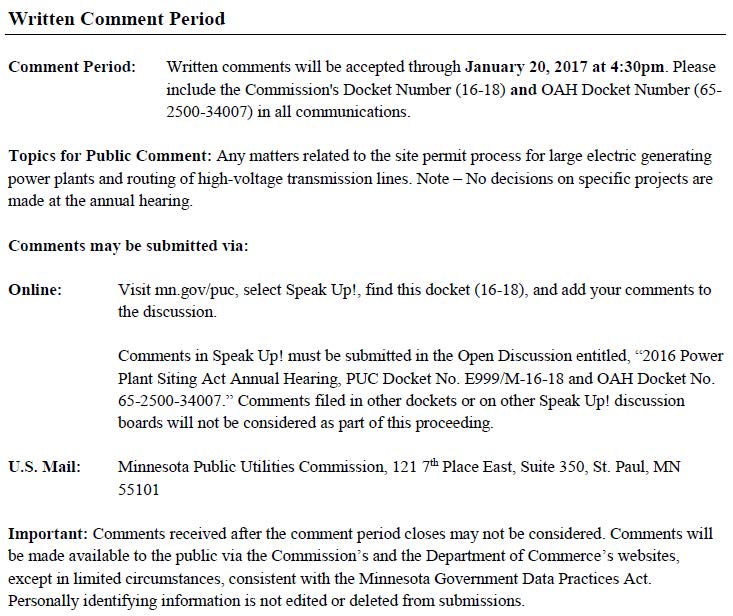
Here’s how to submit comments, deadline January 20, 2017:
Until this year, the Power Plant Siting Act Annual Hearing has included a review, rundown, listing, of all the projects approved by the Commission, including wind and pipelines, and this was anticipated at this hearing per the notice:
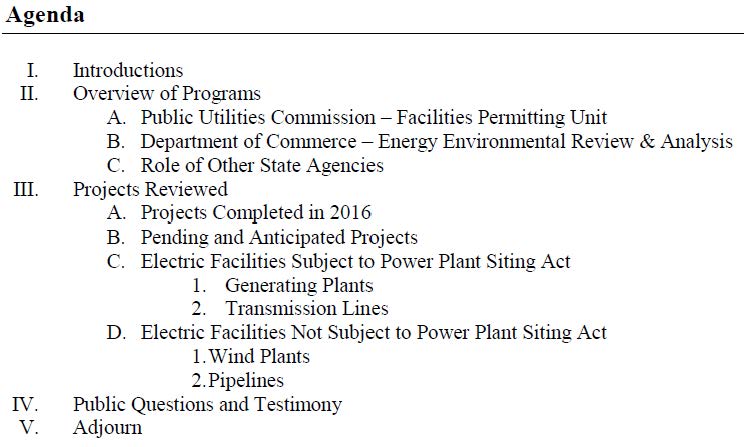
The full Notice:
HOWEVER… that report, “Projects Reviewed” section D, “Electric Facilities Not Subject to Power Plant Siting Act, did not occur. I’d guess in large part it was due to the many issues raised by those intervening and participating, or attempting to participate, in wind siting dockets who have appeared at PPSA Annual Hearings over the years. And I’m sure they did not want input from those participating and intervening in pipeline dockets, we’ve seen how Enbridge cancelled their “public informational meetings” up north after having to face the public and their legitimate issues the day before in Bemidji. Alan Mitchell, formerly EQB PPSA staff, and now working for Enbridge, was there, so this was on Enbridge’s radar, but of course, that Alan didn’t have any comments for the record (I do wish I remembered more about the pipeline rules rewrite that he worked on during his time at the EQB, I think somewhere around 2002-2004?).
The ALJ is to write a summary of the Comments, both at the meeting, and those filed afterwards, and then? What happens? Experience says “not much.” PUC staff responded to the “What happens” question saying that things that don’t require statutory changes or rulemaking, that those are things they want to impliment, to change, to improve, and to the extend that we can, we implement. So he said. When the report comes from the ALJ, they review it, they’ll have the transcript from this meeting, and will go over it.
There was a pretty crowded room, better attendance than for the last couple of years, with two new members of the public speaking up. John Munter, who has been very active in opposition to the Sandpiper and now the Line 3 “replacement” pipeline issues, spoke about the difficulties of participating in the dockets, the difficult to untangle web of “need” and “route” dockets, and of the many pipeline projects ongoing. Tina Carey spoke of the issues she and her neighborhood encountered during construction of the massive “largest in Minnesota” solar project that went up across the street, and that the complaint process was insufficient and ineffective, and the neighborhood’s complaints were disregarded. Cynthia Warzecha, of the DNR, gave a solid synopsis of DNR activities in PPSA dockets, and I’ll note that the DNR and DOT have really gotten into the groove of reviewing projects and providing material and substantive comments for consideration, in the EIS and in the route or siting docket (and also in environmental review in Certificate of Need dockets). Kristen Eide-Tollefson spoke as an individual with a 20 year history as a participant in routing and siting dockets, and noted for the record this legislative prelude to the transfer of environmental review from the EQB to the Dept. of Commerce:
2005 Session — Chapter 97, Article 3, lays out the purpose for transfer from EQB to PUC and DOC, of responsibilities for Siting, Routing and Environmental Review.Environmental Review. Sec. 17. To ensure greater public participation in energy infrastructure approval proceedings and to better integrate and align state energy and environmental policy goals with economic decisions involving large energy infrastructure, all responsibilities, as defined in Minnesota Statutes, section 15.039, subdivision 1, held by the Environmental Quality Board relating to power plant siting and routing under Minnesota Statutes, sections 116C.51 to 116C.69; wind energy conversion systems under Minnesota Statutes, sections 116C.691 to 116C.697; pipelines under Minnesota Statutes, chapter 116I; and rules associated with those sections are transferred to the Public Utilities Commission under Minnesota Statutes, section 15.039, except that the responsibilities of the Environmental Quality Board under Minnesota Statutes, section 116C.83, subdivision 6, and Minnesota Rules, parts 4400.1700, 4400.2750, and 4410.7010 to 4410.7070, are transferred to the commissioner of the Department of Commerce. The power plant siting staff of the Environmental Quality Board are transferred to the Department of Commerce. The department’s budget shall be adjusted to reflect the transfer.
2006 Report to PUC – Docket 06-1733
2007 Report to PUC – Docket 07-1579
2008 Report to PUC – Docket 08-1426
2009 Report to PUC – Docket 09-1351
2010 Report to PUC – Docket 10-222
2011 Report to PUC – Docket 11-324
2012 Report to PUC – Docket 12-360
2013 Report to PUC – Docket 13-965
2014 Summary Comments– Docket 14-887
2015 Summary Report – Docket 15-785
Drumpf’s “Questionnaire” to Dept. of Energy
December 9th, 2016

Trump’s energy agenda, vague as it is, has been essentially to promote “clean coal,” nuclear and to deny climate change and dismantle federal climate change and “renewable” energy programs, of course with no move to eliminate subsidies for coal and nuclear. The “transition team” sent a big laundry list of questions to the Department of Energy, and it’s pretty broad. It’s also something that would be both telling and intimidating to receive. Looking at this, there’s no doubt where they’re headed.
Here’s the document — read it and see what you think… and note how many of these questions are “Can you provide…” which are easily answered with just a “Yes” or “No” and that’s the end of it!
But wait… there’s another version (similar, but different order, etc.):
I think Trump needs somebody to write his questions for him, somebody new that is. He obviously didn’t come up with this, but his staff person who did, well, if they worked for me, “YOU’RE FIRED!”