Monticello’s not the only one!
January 18th, 2007

There’s more — there are other plants like Monticello, they could have the same problem of 35,000 pound pieces of the plant breaking loose and falling…
Where is that potassium iodide?
Monticello accident prompts alert to other nuclear plants
Four plants, in New York, New Jersey, Vermont and Massachusetts, are similar in age and design to the one idled in Minnesota.
By Tom Meersman, Star Tribune
Last update: January 17, 2007 â?? 9:24 PMFederal officials have alerted the owners of four nuclear power plants about a potential safety problem that caused an automatic shutdown last week at Xcel Energy’s Monticello nuclear plant in Minnesota.
“Typically when there’s a problem at one plant, we look to see if any aspects have the potential of applying to other plants,” said Jan Strasma, spokesman for the Nuclear Regulatory Commission. “It’s a precautionary or prudent notification.”
At the time of the Jan. 10 incident, Monticello had been operating for a record 637 consecutive days, 161 days longer than ever before, according to Xcel officials. Typically nuclear plants shut down for refueling every 18 to 20 months, and are out of service for four to five weeks, during which utilities also schedule major maintenance and inspections.
The Monticello plant remained closed Wednesday, one week after a 35,000-pound control box broke loose from its support beams and fell about a foot onto a large pipe carrying radioactive steam. The pipe did not rupture or leak.
Strasma said his agency has notified managers of four Northeast plants similar to Monticello in age, design, and layout about the incident in Minnesota. The plants are Vermont Yankee, Oyster Creek in New Jersey, Nine Mile Point in New York and Pilgrim in Massachusetts, he said.
The Monticello plant, about 45 miles northwest of the Twin Cities, began operating in 1970.
Two months ago Xcel received federal permission to extend the plant’s license for 20 years after its current license expires in 2010. State regulators have also given the utility permission to expand radioactive-waste storage in casks outside the plant, but the Minnesota Legislature has the option to review that decision.
Suspicion has focused on the control box’s welds, which may have been weakened by vibrations.
Charles Bomberger, Xcel’s general manager for nuclear asset management, said the steam pipe struck by the falling box didn’t rupture. He said steam pipes are designed, anchored and tensioned to withstand much more severe shocks and stresses, including earthquakes.
Even if the pipe had leaked, only a small amount of steam would have been released and isolated within the plant, Bomberger said.
“I don’t want to sugarcoat it; this was a significant problem,” Bomberger said. “It’s got the full attention of Xcel.” The utility will fully evaluate the cause of the problem, repair it, check for other possible damage and report everything to federal authorities, he said.
“We anticipate a relatively short-term outage that will be measured in days, not weeks,” he said. “I think we have our arms around what caused it.”
George Crocker, a nuclear safety advocate in Lake Elmo, said the incident should be a warning for several reasons.
“Market forces that push nuclear plants to the limit, coupled with aging issues, coupled with the lack of understanding about how these components and materials perform over time as they’re subjected thermally and radiologically — all of these factors are increasing the likelihood that a really unforgiving event will occur,” said Crocker, executive director of the North American Water Office.
The group is a nonprofit organization that has raised concerns about nuclear problems for more than two decades and also works on renewable-energy policy.
Bomberger rejected the notion that Monticello has been pushed to the limit, or that it’s risky. Nuclear plants have multiple backup systems to provide layers of safety, he said. Maintenance occurs on many parts and systems even while the plant is at full power production, he said enabling Monticello to run for longer periods between shutdowns.
Bomberger said that setting records for consecutive days of operation shows that Monticello is being operated more efficiently, and that equipment failure and other problems are more likely when a plant is stopped and started than when it’s running at a constant rate.
“I firmly do not believe that just because we have a long continuous run that we are running the equipment harder and that’s it’s going to wear out faster,” he said.
Tom Meersman â?¢ 612 673-7388 â?¢ meersman@startribune.com
©2007 Star Tribune. All rights reserved.
Oh, yeah, I feel safe now…
June 27th, 2006
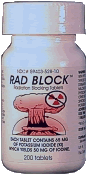
You can get it here if you don’t want to wait…
WTF??? In the STrib:
Nuclear antidote chemical will be distributed
It will go to people living near the state’s two nuclear power plants and would provide some protection in an accident.
Tom Meersman, Star Tribune
Every person within 10 miles of Minnesota’s two nuclear power plants will receive vouchers for two free doses of potassium iodide, which would offer some protection in the event of a nuclear accident, state officials said Tuesday.
The state has received the first round of potassium iodide supplies from the U.S. Nuclear Regulatory Commission and will distribute them later this year, the Department of Public Safety announced.
The supplies will go to businesses, schools and individuals who live and work near the Monticello and Prairie Island plants, each about 50 miles from the Twin Cities.
“People shouldn’t worry, because nothing has changed as far as the security and safety of the plants,” said Doug Neville, spokesman for the department’s division of homeland security. “Nothing has changed as far as our plans to be sure we’re ready in the unlikely event of something happening.”
The state has been discussing the measure with federal officials for two years, Neville said.
Twenty other states already have the supplies.
Although the state expects that about 85,000 people will live within the two plants’ 10-mile emergency planning zones by 2010, it will receive about 320,000 doses in tablets and 50,000 liquid doses, which are easier for children to take. The extra supplies will allow a tribal casino and city hotels and restaurants to give them to patrons if needed.
Potassium iodide helps protect the human thyroid gland, particularly vulnerable to certain types of radiation, by not letting it absorb dangerous radioactive iodine that might be released in a nuclear accident.
“This isn’t like a magic radiation pill,” Neville said. “The preferred method of protecting the public … is evacuation.” Potassium iodide is just another layer of protection, he said, in case people cannot be evacuated quickly because of weather, traffic or other problems.
Some welcome plan
The Prairie Island tribal community, whose nearest homes are 600 yards from the plant, had been considering getting potassium iodide on its own and welcomed the announcement, said spokesman Jake Reint.
Stan Slessor, Red Wing schools superintendent, said all city schools, with 3,200 students and staff members, are within 10 miles of the nuclear plant. He said the district’s chief nurse has been discussing use of potassium iodide supplies with state, utility and local emergency planners for months.
“It’s fairly early in the process,” said Slessor. “We’re working on our plan” for storing and using the potassium iodide and will consult with parents about it.
Within 10 miles of the Monticello plant are all or part of the Monticello, Maple Lake, Big Lake, Buffalo and Becker school districts.
Rick Wolfsteller, Monticello’s city administrator, had not heard about the potassium iodide supplies until told by a reporter. Although Wright County handles much of the emergency planning in the area, he said he was surprised that his office had not been informed.
“This might make people kind of wonder why this is being done now, since the plant has been here since 1970,” he said. “It will make people more alarmed than necessary unless there’s a good information campaign about why they’re doing it and what’s the benefit.”
Tom Meersman â?¢ 612 673-7388
Trojan nuclear plant — one down, more to go
May 26th, 2006

From CNN’s “Nuclear power plant tower imploded”
“Trojan closed in 1993 for financial and safety reasons…”
We’ve got the sense to implode the Trojan nuclear plant — how long before the rest follow?
Here are some videos from the p-nut gallery — seems the bluffs were lined for the show.
Here’s the local TV station’s bird’s eye report
Because of its size and unusually strong build, Loizeaux said the tower is of keen interest to the nuclear power industry.
“Everybody is watching,” Loizeaux said. “Because at some point in time, their’s will have to come down.”
.
12 v 100 – Somebody’s lying about the radioactive release!
May 10th, 2006
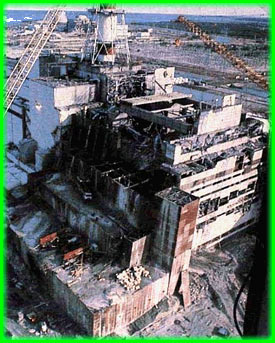
Prairie Island radioactive release was just one week after the 20th anniversary of the Chernobyl disaster (above).
The NRC report of the 5/3 release says “approximately 100 workers” and NOT 12.
Here’s the NRC report on the radiation release at Prairie Island:
Morning Report for May 5, 2006
Headquarters Daily Report
* REGION IIIAirborne Radioactivity Released Into Containment Building During Outage Work
Licensee/Facility:NUCLEAR MANAGEMENT CO.
Prairie Island 1
WELCH, Minnesota
Dockets: 05000282
[1] W-2-LPMR Number: 3-2006-0006
Date: 05/03/2006Resident Inspector Notified
Discussion:
The licensee inadvertently released airborne radioactive contaminants into the Containment Building in preparation or planned work in the Unit-1 steam generators during its refueling outage. Steam generators were not properly vented during removal of the generator man-ways in preparation for nozzle dam installation. Consequently, gaseous contaminants within the steam generators were exhausted directly into the Containment Building atmosphere. The Containment Building was evacuated until radiological conditions were restored approximately 12-hours later through the containment building atmosphere cleanup system. There was no radiological release to the environment. Approximately 100 workers present in the Containment Building were externally contaminated and had small intakes of radioactive material composed principally of radioiodines. Preliminary results show that radiation doses from the intakes were less than one percent of applicable regulatory limits. Workers were decontaminated to remove external contamination prior to being released from the plant.
Regional Action: Two Region III Radiation Specialists will review the circumstances and the radiological consequences of the incident during an onsite inspection the week of May 8, 2006.
Accession Numbers:
Accession No ML061250255
Accession Date 05/02/06Contacts:
Name SLAWINSKI, WAYNE J
Office Abbrev R3
Phone No (630) 829-9820
E-Mail WJS2@nrc.gov
=========================================================================================
I found notice of this radioactive release first in the Red Wing Republican Eagle. But that report said 12 workers. Then I saw the STrib’s story, which said 100, and was buried in “Science & Technology.” And then the StPPP report which said 100. Now it’s 110 in the Red Wing paper. Anne Jacobson, the Editor, was the reporter on this. She was a reporter back in “Nuclear Waste Daze” and unlike her Editor predecessor, I found her credible and trustworthy. I seriously doubt she’d report over 100 affected workers as “12.” So where did this number come from? The incident occurred LAST WEEK, so I would think that Xcel would know how many workers were affected, to what degree, and what was done a week ago! Where did that 12 number come from?
Here’s how it’s explained in the Red Wing paper:
About 110 workers at the Prairie Island nuclear plant were exposed to low levels of radiation last week, Nuclear Management Co. said Tuesday. A dozen of those received slightly higher exposure than the others — about the equivalent of a dental X-ray.
But after that, this story follows, and it’s hard to do other than snort. I ask you, is this reassuring? (bold emphasis added)
Public would be informed if risk of radiation existed, inspector says
Jen Cullen Red Wing Republican Eagle
Published Wednesday, May 10, 2006
If there was an event at Prairie Island nuclear plant the public needed to know about, they’d be informed.
And probably from a number of sources, said Duane Karjala, one of the plant’s resident Nuclear Regulatory Commission inspectors.
“I live in Red Wing so I’m protecting my own family, my own home,” he said. “One of NRC’s guiding principals is openness. We want to make sure we protect the health and safety of the public and make sure the information is available to them.”
There are four emergency levels at the plant (from lowest to highest): unusual event, alert, site emergency and general emergency.
Last week’s radiation exposure fell below the lowest of those emergency levels, Karjala said.
Any incident that falls within those levels would lead to a prompt notification of state and local officials.
The plant has various reporting periods depending on the severity of incidents or emergency situations. For example, Karjala said a “very severe” incident would have to be reported to proper officials within one hour.
A public information center would also be set up and the press would be briefed whenever possible, he added.
So what exactly is considered an unusual event at the nuclear plant? (unusual event = lowest category)
Karjala gave a few examples: The failure of a piece of safety equipment. Release of radiation â?? above regulated amounts â?? outside the plant.
A general emergency would be declared if there was damage to the plant’s reactor core, among other things.
Karjala understands how last week’s incident can put people on edge. But he urges the public to let plant workers and inspectors like himself do their jobs.
“We’re watching everything that’s going on and can recognize the incidents that are serious,” he said. “The word radiation naturally raises fear in people if they don’t understand the word.”
More information about the NRC can be found at www.nrc.org. Karjala also said he or Prairie Island’s other resident inspector, John Adams, can answer questions about safety from the public.
Both inspectors can be reached at (651) 388-8209.
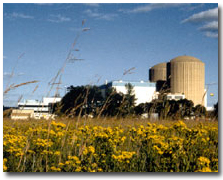
Aaaaah, yes, life in a company town. Not long after I moved here, I listened to the local radio station, and NSP was holding an event in one of the parks here, and they billed it as “a nuke house event for the whole family.” Really! They had a 10 or more foot Reddy Kilowatt, damn, I want one of those… and would you believe Tom Micheletti is CEO of Reddy Kilowatt corporation?
Anyway, a little Beagle told me that there was a radiation release at Prairie Island:
Nuclear plant workers exposed to radioactive gas
Anne Jacobson
Red Wing Republican Eagle
Published Tuesday, May 09, 2006
About a dozen workers at the Prairie Island nuclear plant were exposed to low levels of radiation last week, Nuclear Management Co. said Tuesday.
Some radioactive gas leaked into a containment building May 5 while workers were opening a steam generator in Unit 1. The procedure is part of normal maintenance during a refueling outage.
The plant evacuated about a hundred people as a safety precaution, Site Vice President Tom Palmisano said. About 12 people were exposed to low-level radiation equivalent to a dental X-ray. The workers, who were wearing protective suits, were cleaned up and sent home.
“We monitor for this. We know it can occur, so we spotted it very quickly. We had the workers exit the building,” he said. “Nobody was contaminated.”
The plant began a scheduled refueling and maintenance outage of Unit 1 on April 28.
The unit’s steam generators, which operate under about 2,000 pounds of pressure, were allowed to cool and depressurize. Some radioactive gas emits whenever a generator opens, he explained. Normally the gas is routed to a filtering and cleaning system, but the ventilator wasn’t working effectively or was slightly misaligned so a small amount of gas built up in the containment building.
No radioactivity was released the outdoors, said Jan Strasma, spokesman for the Nuclear Regulatory Commission.
After checking the hundred workers, Nuclear Management had the building’s air purified. Within 12 hours maintenance crews were back at work.
“We’re very conservative. We take the protection of our workers very seriously,” Palmisano said.
Exposure was between 10 to 15 millirems. The Nuclear Regulatory Commission limits a worker’s exposure to is 5,000 millirems of radiation in a year. Prairie Island’s internal limit is 2,000.
“What made this undesirable is that this was 10 millirems we were not expecting to get,” Palmisano said.
Nuclear Management Co. operates the plant for Xcel Energy and refuels each reactor about every 18 months. This outage will take several weeks and includes replacing the reactor’s vessel head, which represents a $25 million investment in the plant.
Prairie Island Unit 2â??s vessel head was replaced last year. Unit 2 continues operate during the Unit 1 outage and will be refueled this fall.
And in the STrib:
100 Prairie Island workers exposed to low radiation
100 repair workers inhaled radioactive gas for a short time last week at the Prairie Island nuclear plant in Red Wing. Repair workers breathed radioactive gas for a short time last week at the Prairie Island nuclear plant in Red Wing.
Tom Meersman, Star Tribune
Last update: May 09, 2006 â?? 9:40 PM
About 100 workers at the Prairie Island nuclear plant in Red Wing, Minn., were accidentally exposed to low levels of radiation last week, federal officials confirmed Tuesday. The Nuclear Regulatory Commission said the incident occurred on May 5, about a week after the plant had been shut down for scheduled maintenance and refueling.
There was no release of radioactivity to the outdoors, said Jan Strasma, spokesman for the commission, and the workers received about as much radiation as is contained in a single X-ray. “The exposure was small and did not have any health and safety consequences, ” Strasma said.
The workers left the area immediately, he said, and they were decontaminated before being allowed to go home.
Vince Guertin, business manager for the International Brotherhood of Electrical Workers Local 949, said that he had no comment on the incident because he had not seen any report about it. The local represents many workers at the plant.
Arline Datu, spokeswoman for Nuclear Management Company, which operates Xcel Energy’s nuclear plants, said the workers were exposed after they entered the innermost portion of the nuclear plant called the containment area. It is sealed while a nuclear plant is operating, but is opened when the plant is inactive so that workers can access the reactor and other equipment for inspection, repair and refueling.
Datu said that radioactive iodine gas was inadvertently released onto the workers and inhaled when they opened “manways” into the steam generators. The radioactive iodine was in the air, she said, because of a tiny leak in one of the reactor’s many radioactive fuel assemblies.
Exposure to high levels of radioactive iodine, called iodine-131, can cause thyroid cancer and related problems.
Strasma said that the radioactive gas, even at very low levels, should have been removed by a carbon-based air filtration system before the workers entered the containment area, but for some reason that did not happen. “Our inspectors will be looking at this further,” he said.
Strasma said that Prairie Island has no history of similar problems, but that it’s not unusual to have relatively minor contamination during maintenance at nuclear plants. However, he said that Prairie Island was different in one respect: “The fact that 100 workers were exposed was a high number,” Strasma said.
Datu said that the radioactive iodine gas was cleared from the plant within 12 hours, and that the maintenance and other repair work has resumed. Utilities do not disclose how long repairs may take for competitive reasons, she said.
p.s. A little Beagle also told me that that the reactor is down from April 28 – June 1, 2006.