More BS – Big Stone II that is
December 7th, 2006

The Big Stone II hearings have begun at the PUC, ostensibly for transmission for the project, but the need for the plant remains at issue.  For the PUC docket on Big Stone, go to www.puc.state.mn.us and then to “Search DOckets” and then plug in 05-619.
You can tell that the people in Alexandra have been getting word out about the Big Stone plant, and you can tell what way the wind is blowing at the Echo Press in Alexandria — Mark Rolfes, the BS project manager, gets the Commentary, a defensive Commentary, while the regular guy gets a little ink in the LTE, but as we all know, the size of the commentary is directly proportional to the weakness of their argument!
Big Stone II will limit mercury emissions, double generating capacity
12/06/2006By Mark Rolfes, Big Stone II project manager, Fergus Falls, MN
The public debate about mercury contamination too often is based on hyperbole rather than reason.
Those who are critical of plans to expand the Big Stone power station’s generating capacity suggest that mercury contamination will disappear from our lakes, streams, and fish if only we agree to not use coal to produce electricity. What they offer is an overly simplistic answer to a complex environmental problem.
Mercury is a naturally occurring element that is released into the environment through human activity and natural processes. About 55 percent of the mercury worldwide is produced from runoff and natural leaching, forest fires, and volcanic activity.
While it is true that some mercury is released from coal-fired power plants, the amount is relatively small, largely insoluble, and not easily converted into the methyl mercury that contaminates our waters and collects in the fatty tissues of fish.
Moreover, there has been significant reduction in the mercury emissions in the United States during the last 30 years. Since 1970, industrial use of mercury has decreased by 80 percent. Because of improved pollution-control technologies, mercury emissions from power plants declined 38 percent between 1995 and 1999.
In 2005, the U.S. Environmental Protection Agency established a new standard that requires a 20 percent reduction in electric utility mercury emissions within the next four years. By 2018, mercury emissions from power plants must be reduced by 70 percent.
Our project will more than double the generating capacity of the Big Stone power station near Milbank, S.D., without increasing the amount of mercury discharged into the atmosphere. By installing highly effective emission control equipment on the new 630-megawatt generator and the existing generator, we will be able to limit the mercury in our emissions to no more than 189 pounds per year. That is equal to the record we achieved in 2004 with the existing 450-megawatt generator.
By any measure, the seven utilities involved in the Big Stone II project â?? Otter Tail Power Company, Central Minnesota Municipal Power Agency, Great River Energy, Heartland Consumers Power District, Missouri River Energy Services, Montana-Dakota Utilities Co., and the Southern Minnesota Municipal Power Agency â?? are concerned about environmental protection. Limiting our mercury emissions to the 2004 level while more than doubling our generating capacity is a significant accomplishment.
We and other regional utilities are participating in expensive research to reduce power plant emissions. Utilities are investing millions of dollars in research and demonstration projects to develop emission-control technologies that will capture mercury before it leaves the power plant.
We will use highly effective technology not only to supply our customers with reasonably priced electricity but also to minimize environmental degradation.Â
Here’s the view from the regular guy:
Big Stone II: An environmental mistake
12/06/2006To the editor:
I think that members of Runestone Electric Association should be concerned that the power supplier for their and many other rural electric cooperatives (REC), Great River Energy (GRE), would be a major owner of a planned coal-fired electric generating plant, Big Stone II, which would be built in South Dakota. I think that building such a plant at this time would not only be an environmental mistake but could also be a catastrophic financial blunder.
This plant, like all coal-fired plants, would be a large contributor of green house gases (CO2), which most scientists agree are causing global warming. The cost of this plant has already increased from $1.2 billion to $1.6 billion and a route for the associated transmission lines has not been approved, but the involved utilities seem to be proceeding full speed ahead.
If, as many knowledgeable people predict that CO2 limits and penalties are enacted, the costs, which would be added onto a plant like Big Stone II, would be substantial. Some say as much as 30 to 40 percent.
The involved utilities say they will deal with these issues as they appear. What this translates to is that you and I will end up paying for their mistakes. Our rates about doubled after the last large coal-fired plant, Coal Creek, came online.
There are alternatives to this electric generating plant. Our power supplier GRE is involved in wind energy and has natural gas-fired peak time generators to back them up when the wind is not blowing.
I encourage everyone to get involved in this issue. Ottertail Power and power suppliers to most municipal utilities are also involved in this project, so it affects many people in this area.
Glenn Bennett
Lowry, MN
(Editor’s note: Watch for an in-depth story about the Big Stone II project and the controversy surrounding it in Friday’s Echo Press.)
… and if you think YOU had a bad day…
December 6th, 2006
… here’s some reality therapy. Tom just sent this, so if you don’t believe it, call solarson…
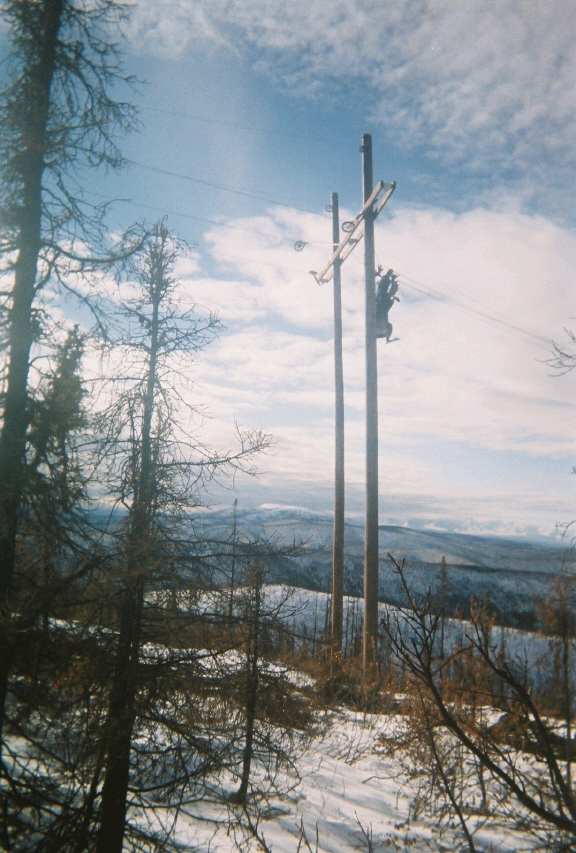
Wow, just when you think youÂ?ve seen it all. This might be the winner this year.
“Isn’t that just amazing. They were laying new power cables. They were strung on the ground for miles. The moose are rutting right now and very agitated. He was thrashing around and got his antlers stuck. When the men (miles away) pull the lines up with their big equipment, he went too. They couldn’t get the lines right and went searching for the problem. He was still alive when they lowered him, but he had to be shot later because he was in distress. He was a huge 60 inch bull.”

Excelsior Opens Coleraine Office
December 6th, 2006
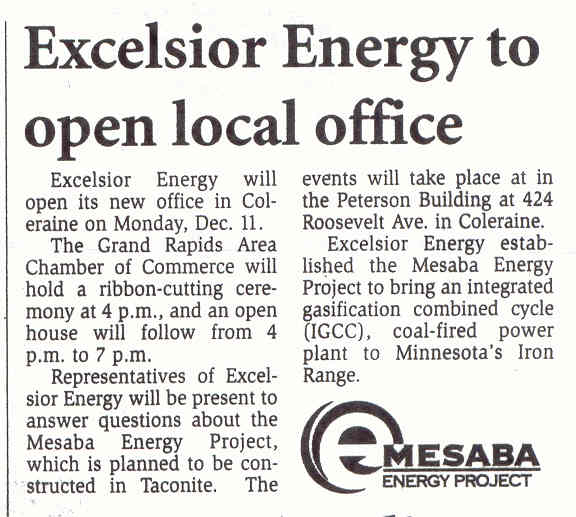
Mark your calendars – next Monday, December 11. Somebody PLEASE go and send me photos to post.
It’s in Coleraine’s Peterson Funeral Home building on Roosevelt, so at least they won’t have far to carry the Project to bury it!
More about the DOE tax credit and PRB
December 6th, 2006
Harry Jaeger, of Gas Turbine World, has been sending comments now and then on IGCC related twists of policy, fact and proposals and he does his best to keep me honest on the facts of IGCC, in addition to making sure my blood pressure is elevated now and then… I greatly appreciate the prodding that makes me carefully hone my approach and arguments. He sent the heads up on this PRB tax credit issue:
Here’s the initial post on this from Gasification and IGCC Forum:
How did using low sulfur coal become a disadvantage?
And this one, noting the flaw of logic when BSII promoters argue it vindicates SD’s permiting Big Stone:
Tax Credit Glitch Gives Wrong Signals and Fuels IGCC vs. PC Debate
And yes, WHAT TWO PROJECTS ARE NOT NAMED???
Here’s the DOE TAX CREDIT FACT SHEET (so they say…)
Impact of no IGCC tax credit for PRB
December 6th, 2006

The DOE’s tax credit scheme for IGCC (coal gasification) is slowing down the IGCC rush. Color me confused, because even if it’s a suprise to me, it seems it should not be a suprise on the part of project proposers… what am I missing here, wouldn’t they know about the tax credit coal standards? What is the impact on the Mesaba coal gasification project? Had Excelsior wanted this tax credit? Well, duh, I doubt a tax credit exists that they wouldn’t want! Is there an impact on the ability of this Mesaba project to use PRB coal? Given that Mesaba is, in part, a DOE demonstration project to show that PRB coal can be used, demonstrate fuel flexibility, what is the impact on the viability of the project? Inquiring minds want to know…
Here’s another project hit by the tax credit, or lack thereof:
South Dakota coal-gas plant on hold after not getting a tax credit
Cleaner coal technology hit a speed bump Tuesday in South Dakota, as a major power supplier announced it did not receive a key federal tax credit.
By Ben Shouse – bshouse@argusleader.com
Cleaner coal technology hit a speed bump Tuesday in South Dakota, as a major power supplier announced it did not receive a key federal tax credit.
Basin Electric Power Cooperative had proposed a plant near Huron or Mobridge to use integrated gasification combined cycle, or IGCC.
The technology converts coal to a gas before burning, which greatly reduces air pollution and could some day allow the capture of carbon dioxide, the gas most responsible for global warming.
But the project might not be economical without a federal tax credit, said spokesman Daryl Hill in Bismarck, N.D.
“That doesn’t mean we’re abandoning work on that, but you’re right, it does slow that timetable of working with IGCC,” Hill said.
Basin sells electricity to rural cooperatives in South Dakota and eight other states. Hill said Basin will decide on a site and a technology in 2007.
A major obstacle to building an IGCC plant in South Dakota is the type of coal it would use. The best source is the Powder River Basin in Wyoming.
The 2005 energy bill, which created the coal tax credit, required plants to reduce sulfur dioxide emissions by 99 percent. But Powder River coal is already low in sulfur. Energy Secretary Samuel Bodman acknowledged that when he announced the credit recipients Thursday and said he is working to resolve it.
Seven power companies are planning to build a separate coal plant near Milbank, to be called Big Stone II. Ward Uggerud, vice president of Otter Tail Power Co., said the failure of Basin’s tax credit application vindicates the decision to use conventional coal.
“What this underscores is that IGCC is not necessarily there yet for people to proceed with on a commercial application,” he said.
Reach Ben Shouse at 331-2318.
And in todays New York Times, a note of reason about the IGCC rush — “it may not be the appropriate generation choice for every situation.” Will someone tell those “environmental” groups that are pushing IGCC this simple truth? Will this point get through to the RE-AMP folks funded to promote IGCC who are conspiring today in Chaska?
To the Editor:
â??Taming King Coalâ? (editorial, Nov. 25), about addressing emissions of carbon dioxide from coal-based electric power generation, appropriately underscores the importance of assuring that we have the technology to do it. But your predilection toward just one promising technology, integrated gasification combined cycle, or I.G.C.C., is problematic.
I.G.C.C. holds tremendous promise and is one technology that utilities will use to address carbon dioxide. But it isnâ??t the only one, and it may not be the best choice in every case.
While I.G.C.C. can produce electricity more efficiently than traditional coal plants, there are only four I.G.C.C. plants in operation worldwide (two in the United States), and the technology so far performs well only with certain types of coal.
Alternative pulverized coal technologies like â??ultra supercriticalâ? and â??supercriticalâ? are also more efficient than traditional coal plants and can make use of all coal varieties.
With respect to greenhouse gas emissions, both I.G.C.C. and pulverized coal plants will someday be able to accommodate some form of carbon-capture technology.
I.G.C.C. holds potential for easier integration of these technologies, but may not be the appropriate generation choice for every situation.
Thomas R. Kuhn
Pres., Edison Electric Institute
Washington