Charlotte Neigh in BusinessNorth
December 26th, 2006
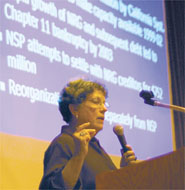
Stolen “Fair Use” from the GRHR – Charlotte Neigh speaking at the CAMP presentation at ICC two weeks ago
Here’s Charlotte’s letter in BusinessNorth. Sometimes I wonder if those writing these articles were at the same meeting. Here’s the ORIGINAL BUSINESSNORTH ARTICLE, at least at “$2 billion” they almost got the price right, and here’re the corrections:
Charlotte Neigh, Co-chair Citizens Against the Mesaba Project (CAMP)
12/24/2006 1:18:04 PM
To the Editor:
I’m glad that you covered the public hearing regarding Excelsior Energy’s attempt to force Xcel Energy to purchase the output of Mesaba I – the coal-gasification, 600 MW power plant proposed to be built in Itasca County. However, some corrections and additions are required.
There were at least 200 people present for the 5:00 p.m. session at Taconite; contrary to what was stated in the report, there were even more people present for the 1:00 p.m. session, reflecting the high level of concern among local residents.
The article referred to mncoalgasplant.com as a “Web site”. It is that, but its role in this proceeding is as an intervening party, submitting evidence and argument to be considered by
the judges and the PUC.No one is arguing that the Itasca County site is “pristine”, however its trees and more than 300 acres of wetlands are closer to being pristine than to being the brownfield site abandoned by LTV near Hoyt Lakes that was cited by Excelsior in 2003 when it received special privileges from the legislature.
The 2006 bonding bill provided $11 million (not $55 million as reported) for Itasca County infrastructure to be used for either Mesaba Energy or Minnesota Steel or both. $55 million is the amount that Mesaba was seeking from the legislature for its infrastructure needs.
If Tom Micheletti actually said that his project won’t die if the PUC doesn’t approve the power purchase agreement with Xcel, that is big news and deserves to be explored. Until now Excelsior’s stated position has been that if this PPA is not approved, not one shovelful of earth will be turned. If the PUC rejects the proposed PPA as either too expensive or not in the public interest, what other entity would be interested in
purchasing the power from Excelsior?
Charlotte Neigh, Co-Chair
CAMP (Citizens Against the Mesaba Project)
James Brown checks out
December 25th, 2006

Here’s Brown circa 1968 keeping it cool
And all my James Brown is vinyl in the back closet, there’s Fred Wesley & the JB’s out in the car, close, but…
Happy Holidogs!
December 25th, 2006
Still having computer issues, so it’s as good a time as any for a time out!
CAMP Fundraiser
December 22nd, 2006
(argh, can’t find the logo)
A missive just in from Citizens Against the Mesaba Project (CAMP) Action Group:
THANK YOU!! We had an excellent showing at the Public Hearings in Taconite at both 1p.m. and 5p.m. Each of the sessions were well over 200 in attendance! To those who attended, and/or presented and submitted comments, we appreciate what you did!
Remember to mark your calendars:
CAMP Coffeehouse
Brewed Awakenings
Grand Rapids
Come in the morning or afternoon and get information about the Mesaba Energy Project and participate in a silent auction fundraiser!
Here’s a preview of some of the items donated thus far: a portable GPS system, artwork, and a sourdough waffle breakfast for four featuring a 100yr-old alaskan sourdough starter, lingonberry sauce, birch syrup, venison,salmon,and more (is your mouth watering yet?)
Come in the evening to hear Sam Miltich and friends play amazing gypsy jazz from 7:30-9:30!
If you’d still like to help with CAMP Coffeehouse either at the info. booth or with a donation item, please reply soon. Contact camp@northlc.com
See you at the coffeehouse!
#4 BusinessNorth – Mesaba Energy proposal gets mixed reviews
December 22nd, 2006
BusinessNorth Exclusives
Mesaba Energy proposal gets mixed reviews
12/22/2006
by Beth Bily
TACONITEâ?? Public comment on a power purchase agreement for the Mesaba Energy Project in Taconite Wednesday evening was civil. But it was obvious that proponents for and opponents against building the $2 billion power plant in Itasca County have passions that run deeply.
The Dec. 20 public hearing held by the Minnesota Public Utilities Commission was one of six it scheduled around the state this week (two in St. Paul Monday and two in Hoyt Lakes on Tuesday). The purpose was to gather public comment on whether the regulatory agency should require Minneapolis-based Xcel Energy to buy the power produced from the proposed coal gasification plant. As proposed, the projectâ??s first phase would be built with 600 megawatts of generating capacity.
The gasification technology would first turn the coal into a synthetic gas before it is burned to produce electricity. Tom Micheletti, co-chief executive of Excelsior Energy, the Mesaba projectâ??s parent company, said gasification will reduce mercury emissions by at least 90 percent compared to conventional coal-fired plants, and remove a very high percentage of sulfur prior to the synthetic gas burning process. If it moves forward, the project is expected to bring about 100 permanent jobs and 1,000 construction jobs during a three-year construction phase. A purchase power agreement, or dedicated buyer of the electricity produced, however, is needed if the project is to proceed.
About 200 people turned out for the Wednesday evening hearing, following the afternoon session that drew another 100. The majority of the public comment was against the project. The technology can â??sequesterâ? or capture carbon dioxide (CO2), the biggest contributor to global warming among the so-called â??greenhouseâ? gases.
But opponents noted Excelsior Energy has no immediate plan to contain CO2, and cited concerns about other emissions, as well. They also expressed skepticism about the potential economic benefits from the project versus the price of construction, estimated at $2 billion. Several also noted the 2003 state law providing significant project incentives was enacted with the assumption a plant would be located on the East Range near Hoyt Lakes at the former LTV Steel Mining site.
Although mercury was a topic of discussion, much of the environmental concerns centered on carbon dioxide emissions and Excelsiorâ??s openness of late to capture CO2 emissions and send them by pipeline to underground storage points in North Dakota. The costs of such disposal are not estimated in the project proposal, said Ross Hammond, representing mncoalgasplant.com, a Web site long critical of the project.
Many other critics have surfaced in recent months, testament to increasingly organized opposition led by CAMP (Citizens Against the Mesaba Project), formed in Itasca County earlier this year.
Though not discussed much at the hearings in Taconite, there has been significant criticism of the 2003 state law favoring the siting of a coal-gasification project on the Iron Range. Among its provisions: the right of eminent domain for new transmission lines to provide service to Xcel, and an exemption from a certificate of need normally required for new power generation plants.
Project advocates also turned out to tout the economic benefits for an area with above average poverty â?? about 10 percent countywide â?? and a dire need for economic development.
Mike Andrews, a local resident and business development specialist for Itasca Economic Development Corp., countered criticism that the shift in preferred location from Hoyt Lakes in August 2005 to just north of Taconite represents a move from a brownfield to Greenfield site.
â??The land around this (Taconite) site is mostly owned by mining companies, this is not a pristine wilderness,â? said Andrews. â??Times have changed, weâ??re now in bad timesâ?¦we need a better quality of life.â?
The Mesaba Energy project has received major support from local and federal governments, as well as the state. With help from U.S. Sen. Norm Coleman, Excelsior Energy secured $800 million in federal loan guarantees and a $36 million â??clean coalâ? grant in the last federal energy bill. The Itasca County Board, Itasca Economic Development Corp. and the Range Association of Municipalities and Schools all have publicly endorsed the project.
Meanwhile, it also would benefit from $55 million in state infrastructure bonds approved by the 2006 Minnesota Legislature for this project, and the planned Minnesota Steel plant nearby.
But Excelsior Energy also faces opposition from some of the stateâ??s biggest business heavy hitters. Xcel Energy, the Minnesota State Chamber of Commerce and Minnesota Power are criticizing the project, citing potential costs to ratepayers. The city council in Cohasset, home of Minnesota Powerâ??s Clay Boswell plant, has remained neutral.
In the end, the Minnesota PUC hearings this week were focused on the power purchase agreement that Xcel itself supported as the 2003 state legislation was enacted, not the entire gambit of issues that surround the project. That decision likely will come down to how the PUC interprets the 2003 law.
Micheletti said the legislation clearly requires Xcel to negotiate a power purchase agreement.
The statute stipulates that a commission designate a â??clean energy technology,â? defined as â??a technology utilizing coal as a primary fuel in a highly efficient combined-cycle configuration with significantly reduced sulfur dioxide, nitrogen oxide, particulate and mercury emissions from those of traditional technologies.â? Further, it declares â??the utility that owns a nuclear generating facility shall supply two percent of the electric energy provided to retail customers from clean energy technology.â?
Xcel owns all three nuclear generators located in Minnesota, according to the U.S Department of Energy.
â??The outcome is gong to be favorable, all youâ??ve got to do is read the (2003) statute,â? said Micheletti, adding he believes any fifth grader would interpret the law in his favor.
But, other provisions in the law offer considerable room for interpretation.
It grants the Public Utilities Commission authority to waive the power purchase requirement if â??the commission finds doing so contrary to the public interest.â?
Other restrictive wording requiring the finding that the â??clean energy technology is or is likely to be a least-cost resourceâ? also could give Xcel an out on a power purchase agreement.
At the Taconite hearing, Xcel representative Chris Clark said the Mesaba Energy Project â??doesnâ??t satisfy the requirements from the legislationâ? as a least-cost resource.
Clark also said a power purchase agreement would require Xcel customers to pay an additional $1.5 billion in higher rates. According to the St. Pioneer Press, Xcel estimated those costs at the Monday hearings in St. Paul as equivalent to an 8 to 12 percent rate increase.
Micheletti said his project wonâ??t die if the PUC fails to approve a power purchase agreement with Xcel. In that case, he said he would pursue a second power purchase agreement.
An administrative law judge will combine the public comment gathered this week as well as written testimony on the power purchase agreement and make a recommendation to the Minnesota Public Utilities Commission in February 2007. The PUC will make a determination from there.
Meanwhile the draft Environmental Impact Statement for the Mesaba Energy project is scheduled for release in February.
If the project clears the power purchase agreement in addition to a number of other regulatory hurdles, current timelines have construction of the first phase of the project starting in the first quarter of 2008, and electricity production commencing in 2011.
Plans also call for a second plant in operation by 2013.
Beth Bily is a freelance writer based in southern Itasca County.