We’re going to swelter in the dark…
March 5th, 2007
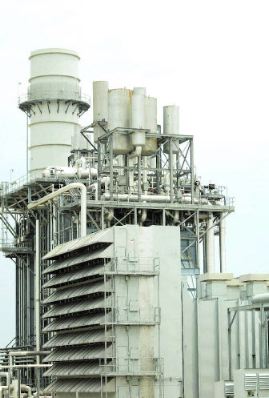
There they go again, pulling that fear tactic, the “we’re gonna swelter (this is Texas after all) in the dark on a respirator without a job” because if they don’t build coal plants, we’re gonna have blackouts in August 2009. That’s a whole lot different than the NERC review of Texas generation and transmission reliability in the NERC 2006 Long-Term Reliability Assessment. Hey, duh, where do you think I learned about those mothballed gas plants???
Read the article from the Ft. Worth Star-Telegram below and count their examples of histrionic hype:
Deal to scrap new TXU plants leaves future supply uncertain
Mar 3 – McClatchy-Tribune Business News Formerly Knight Ridder/Tribune Business News – Dan Piller Fort Worth Star-Telegram, Texas
Those who worry about an upcoming shortage of electricity in Texas point to the week of August 9, 2009.
That’s when projections from the energy consortium that operates the state’s power grid show a shortfall of almost 1,000 megawatts in North Texas for what is likely to be a time of peak air-conditioning usage.
What the industry portrays as the Great Texas Blackout can’t be predicted with certainty. But numbers from the Electric Reliability Council of Texas provide a troubling preview.
Its outlook has become even more relevant in the past week, as TXU Corp. scuttled plans for eight of 11 coal-fired power plants in a high-profile compromise with environmentalists as part of a $45 billion buyout bid.
Come August 2009, ERCOT predicts, electricity demand in the state’s northern zone, which includes Dallas-Fort Worth, will total 25,827 megawatts. Dallas-based TXU and other generators will be able to produce 24,403 megawatts, according to industry estimates. One megawatt can power about 800 homes.
The sole hope for new generating capacity now is a 518-megawatt plant that TXU will build on its generating site at Sandow, northeast of Austin. If two other coal plants are approved, they would come online right at crunch time or shortly after, according to TXU and ERCOT.
TXU and ERCOT focused attention on the projections of a looming power shortage as TXU sought fast-track approval for the 11 coal-fired plants that would have increased its power production by almost 50 percent, helping meet increasing demand throughout the region for years to come.
But now that TXU has scaled back its plans, what do the projections look like?
Pretty dire, according to the industry. But there are cushions that the industry hasn’t discussed much.
Trudy Harper, president of Tenaska Power Services Co., which generates 3,200 megawatts in Texas and schedules electricity for TXU’s competitors, said many businesses have gone to interruptible power, which could be saved during peak loads, as well as other conservation measures that could forestall the day of reckoning.
Also, TXU could produce about 2,000 megawatts at older, mothballed plants that can be pulled back into service to bridge the shortage, gaining perhaps two or three years.
Calpine and NRG have generator plants in the works, including natural gas plants, that are expected to be online in three to five years.
Pat Wood, former chairman of the Texas Public Utility Commission and the Federal Energy Regulatory Commission, thinks returning the older plants to service would be enough to save the day.“The problem is those older plants are very expensive to operate, so that makes the electricity more expensive at a time when Texas is going to want to cut electricity costs,” Wood said.
He said more plant builders will step forward, particularly now that TXU has taken much of its plans off the table.
“You’ll see a mix of coal, natural gas and nuclear come on,” Wood said.
Harper agrees, saying: “There’ll be room for more generators. I think you’ll see them. But they take four or five years, so we don’t have much time to wait.”The head of the company that supplies most of the electricity in North Texas — and which has the majority of residential customers, thinks that the state would scrape through the potential shortage but that things would be tight.
TXU Chairman John Wilder said he is no more than “cautious” about the ability of TXU and other generators to meet local power demands in the next three to five years. “We can’t let the reserve margin get much lower,” he said.
Harper said: “I don’t let myself be panicked about it, but the generation situation could become scary.”
In coming years, the electricity margin is likely to become a much-discussed topic among Texas policymakers and business leaders. Considering that Texas’ margin of surplus electricity has fallen from more than 25 percent at the beginning of this decade to 15 percent this year and will be down to 10 percent by 2009, it is safe to say that projected demand will draw than passing interest.
Texas’ electricity surplus, and the resulting low rates, has been a prime engine for economic growth. Chambers of commerce, in wooing corporate relocations and new operations, could always tout cheap and available electricity, along with inexpensive land, no pollution problems and a relatively educated and energetic work force.
When demand peaks — in Texas, that’s on the hottest days of the year — the surplus dwindles and the marginal prices for the last units of electricity thrown onto the system can soar. Even with Texas’ historic margins, wholesale prices can jump to $300 per megawatt hour or more during peak periods.
But it is only during the hottest time of year that Texas comes near its peak usage and when the need for surplus power may approach the limit.
On Tuesday, the temperature in Fort Worth reached a balmy 79 degrees — warm enough for short sleeves but not enough for most folks to turn on the AC.
On that day, ERCOT reported a peak statewide demand of 34,500 megawatts, little less than half of the grid’s 71,756-megawatt capacity. North Texas consumed about 12,000 megawatts.
But on, a business day when schools were in session and the temperature reached 104 degrees, Texas’ grid reported a record demand of 63,330 megawatts.
About 20,000 megawatts were consumed on the North Texas portion of the grid.
“It’s really dramatic what air conditioning does to electricity demand, and the peak demand periods are caused when air-conditioning use is highest,” said Tenaska’s Harper.
OK, let’s do some math. 71,716 MW capacity, 63,330MW peak, 8,386MW of headroom, and there’s a lot more generation coming on line. Something tells me that they’re going to be just fine…
MISO Transmission Benefits Analysis is here!!!
March 4th, 2007
I know you’ve been sitting on the edge of your chair waiting for this — well, wait no more!
Why care about the MISO Transmission Benefits Analysis? Because it tells us just what they’re going to get if they build the CapX2020 transmission megaboondoggle!  Well, not specifics, but enough so that it’s obvious to somebody that doesn’t know the difference between AC$R, AC$$, and ACCR!

STrib – “wind transmission” NOT
March 4th, 2007
Here I just got that post done, and what comes in but the STrib article with more whining about transmission. Note he’s quoting Mark Ahlstrom, WindLogics, but hey, WindLogics is a contractor that put together the Minnesota Wind Integration Study, which shows that through distributed and dispersed generation we can site 5,000-6,000MW around the state without a significant infrastructure investment — WE DON’T NEED TRANSMISSION TO BUILD WIND, WE DON’T NEED TRANSMISSION TO FULFILL THE RES!
So next time they say we need transmission — you know better!!! It’s not for wind — the CapX2020 transmission is for coal from the Dakotas.
Here’s the STrib article:
Last update: March 03, 2007 – 10:16 PM
Green dreams of wind energy face a fickle future
The state is empowering the wind-turbine industry to crank up its efforts. But creating the electricity may prove to beeasier than distributing it.
By Mike Meyers, Star Tribune
FENTON TOWNSHIP, MINN — When Gov. Tim Pawlenty signed a landmark “green energy” bill 10 days ago, the crews here on Buffalo Ridge, their eyebrows glazed with ice, were being battered by some of the wildest winds in the Midwest.
Their work on the prairie erecting a sprawling forest of wind turbines, each soaring 26 stories, is one of the simpler feats needed to make Pawlenty’s vision for the state’s energy future come true: drawing 25 percent of Minnesota’s electricity from renewable sources by 2025.
Reaching that benchmark would cement the state’s position as a national leader in wind power. But getting there will be anything but a breeze.
Raising money, negotiating land rights, gaining permits and doing the construction can take years. And before wind parks are built, investors must know that transmission lines will deliver the power to buyers.
Transmission line operators, meanwhile, must learn how to accept a volatile source of power without destabilizing the electrical grid.
It’s not impossible,” said Dale Osborn, transmission technical director for the Midwest Independent Transmission System Operator (MISO), which orchestrates distribution of power among 15 states and one Canadian province. “But there are going to be challenges that are very formidable, and they have to be resolved.”
Only three states — California, Texas and Iowa — produce more wind-generated electricity than Minnesota. The stroke of Pawlenty’s pen will lend more momentum to what already was a rush of investment on wind and other green power projects.
To reach a U.S. goal of 20 percent of electricity coming from wind power, nationwide investment will have to total $30 billion a year this decade and next, by the estimate of the Wind Energy Association.
Consider the harsh realities
The latest project in southwest Minnesota is owned by EnXco, based in North Palm Springs, Calif. A visit to the $300-million wind park under construction shows some of the cold realities Minnesota faces in its energy future.
“Climbing a ladder [260 feet] to tighten bolts, that’s hard work. It’s physical torture,” said Warren Grieves, director of the construction project. Grieves, 64, has scaled those hundreds of rungs himself several times, and he starts every day with leg-stamina exercises, in case today’s the day he has to make another climb.
Spanning a stretch of farm fields 7 miles long and 7 miles wide, the wind park will add 200 megawatts of wind-power capacity by year’s end.
To reach that goal, crews will have to pour 25 trucks of concrete, lift a tower that weighs 125,000 pounds, a turbine that weighs as much as the tower; a hub, 38,000 pounds, and a rotor, 79,000 pounds.
Then repeat the whole process, 137 times.
Over the next 18 years, crews working for a host of companies will brave the elements to deliver 25 times that additional power, maybe more.
Just negotiating with farmers to plant wind turbines in their fields of corn, soybean and alfalfa can take years. About 160 people had to sign deals before EnXco could break ground on its latest project.
Simply coordinating the delivery of parts also is a tough task, as suppliers strain to keep up with new demand. Some of the rotor blades on the turbines going up in southwest Minnesota were shipped from Brazil.
Sitting in his warm St. Paul office, 250 miles from the wind-swept construction site, Osborn is one of a small army of engineers who soon will have to juggle the distribution of energy from the new wind park and scores of others springing up across the Midwest.
About 1,000 megawatts of wind power are produced in Minnesota today, enough energy for about 400,000 homes.
Asked to size up the task of adding up to 6,000 megawatts of wind-powered electricity to the Minnesota grid over the next 18 years, Osborn makes it clear that heavy lifting is ahead.
“It probably takes seven years or more to build a line that will carry that power,” he said. “Currently, a lot of areas don’t have any capacity left.”
The volatile, unpredictable nature of wind is another problem. A recent study showed that in the summer, when winds tend to blow slower than in the other three seasons, 86 percent of the potential electrical capacity of wind turbines will be idle.
“Wind is like having a car that’s out of fuel when you need it the most,” Osborn said.
Engineers will have to figure out ways to integrate wind power into the electrical grid without counting on it to meet peak demand in summer.
“You’ve got to get to market somehow, don’t you?” said Jim Alders, Xcel Energy manager of regulatory projects. He noted that the last major transmission projects in Minnesota date from the 1970s.
Permit process a challenge
Mark Ahlstrom, chief executive of St. Paul-based WindLogics, said untangling electrical power bottlenecks will overshadow the challenge of building wind parks.
“We can build a wind plant in two years,” he said. “It can take seven years or more to get a transmission line permitted and built, even in the best of cases.”
The control center, which operates around the clock, not only monitors EnXco’s Minnesota operations, but 23 other power parks, scattered from California to New Jersey.
Windmills can operate at 30 degrees below zero, but ice can rob their rotors of efficiency. No matter when a turbine fails, it must be fixed immediately. “When the machines got to be over $1 million, it doesn’t pay to let them be down at night,” said Randy Grayson, EnXco’s area operations manager.
Maintenance crews work at all hours in all weather, sometimes to the chagrin of their families. The workers have a nickname for a wind turbine: “We call it, ‘The other woman,’ ” Grayson said.
Will EnXco’s power find its way into the grid?
Xcel’s short-term solution to the transmission issue is a $300 million project, already underway, to add high-power lines around southwest Minnesota.
Longer-term, the utility plans to spend $700 million stringing 600 miles of transmission lines across various parts of the state.
Finishing the job will take the rest of this decade and most of the next, because the sprawling wind park in Fenton township likely will have to be duplicated two dozen more times.
“We don’t have all the answers now,” Alders said.
Mike Meyers • 612-673-1746 • meyers@startribune.com
“More heat, less sag”
March 4th, 2007
Yup, more heat, less sag, that’s something we all need, the industry fix for “50’s vintage conductors” and maybe it’s better than bag balm! With Capx2020 coming up, and with the Chisago line underway, I’ve got transmission on the brain, and you know they can’t build coal without transmission.
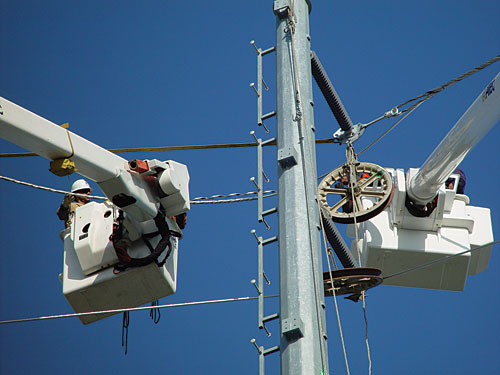
Back in the SW MN 345kV case, the “it’s for wind” NOT line, I’d subpoeaned 3M about its new conductor, probably spring of 2002, because Xcel was planning a high capacity line and I knew this ACCR composite conductor was coming down the pike. Both 3M and Xcel said they weren’t going to use it, and Xcel entered exhibits and testified about it — nope, they were NOT going to use it. Instead, they were going to use a high capacity ACSS:
ACSS – 345kV bundled 954 = 2085MVA
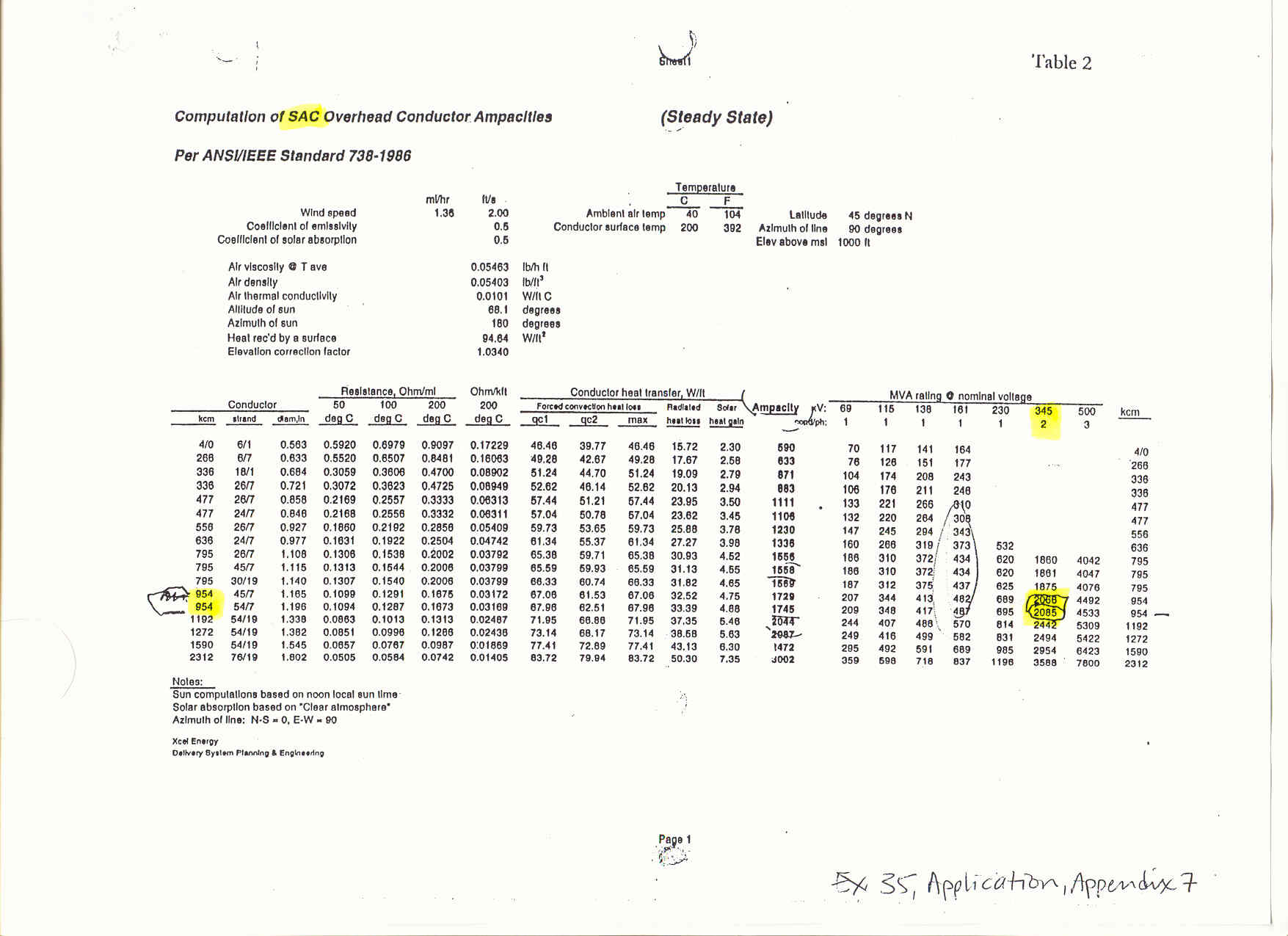
So now how about these CzpX2020 lines “from the coal fields” through Minnesota to Wicsonsin and points east?

Will the 2085MVA ACSS be enough or do they want even more to put even more coal on the wires? And there’s the cost to consider, so probably not — they haven’t got a market… but then again, there’s always the Minnesota ratepayers to pay for their bulk power wholesale transactions!
South Dakota has been looking at this market issue, because they’re realizing that they want to build all this coal and they want to build all this transmission, that pesky Minnesota is in the way, but more importantly, they get that there is no market and that they have to look at creating a market. They get that there’s plenty of electricity and I hope they’re getting that it’s not realistic to think that Wisconsin or Illinois would buy their electricity when there’s plenty right at home and without all that added transmission service and construction cost:
South Dakota Energy Infrastructure Authority – Energy Study 2007
SDEIA Electric Industry Interviews Report December 2006
So they get it — there’s a bit of a market problem. Hence the COALition – there’s Wind on the Wires and AWEA and their unsavory promotion of National Transmission Corridor through Minnesota, there’s RE-AMP and they’re working on “finding a way forward for coal.” Check p. 11 of this Executive Summary:
Good idea… let’s bail out the coal industry… real good idea…
But they cannot do it without transmission. And we all know that CapX2020 really isn’t needed, but for this coal for export scheme — and that’s why they want to be excepted from providing the typical need data with their application:
Comments on their outrageous “the rules don’t apply to US” assertions are due March 19, 2007 .
The Comment period has been extended because Xcel/CapX2020 refuses to use the service list and serve parties on it and they were caught. Again. How dare they!!! How many times do I have to remind them? And what’s next, sue them about it — yeah, real effective use of time. But somebody with additional clout gave them what for and, WHEW, it’s extended.
Now about these high-capacity conductors…

NRG posts $30 million 4Q loss
March 3rd, 2007
 From the Buffalo News:
3/1/2007
NRG Energy Inc., which owns coal-fired power plants in the Town of Tonawanda and Dunkirk, posted a fourth-quarter loss of $30 million on costs for restructuring electricity supply contracts. The per-share loss was 35 cents after payment of preferred dividends, compared with net income of $64 million, or 68 cents, a year ago, the company said. Sales rose to $1.14 billion from $707 million. NRG runs U.S. power plants that can produce about 22,000 megawatts. One megawatt is enough for about 800 U.S. homes.
And from Reuters, stock valuation over last year:
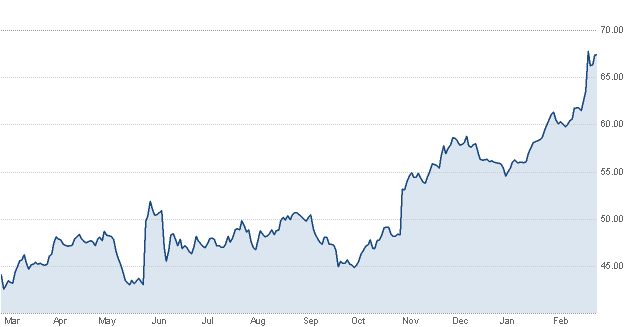
And find their bankruptcy in this 10 year chart:

Is that surprising or what?