IGCC — nuclear folly all over again
June 13th, 2008

This is another one of those “HOW STUPID CAN THEY BE” posts, based on some searching today for what various regional gasbag groups are doing across the country. I was at the Midwestern Greenhouse Gas Reduction Accord site, looking for geographic boundaries, and I stumbled on this in the Allowances Subgroup Conference Call Materials for June 3, 2008:
And now, here’s where I start my rant, this one point jumping out and hitting me over the head. First, let’s be really clear here — they’re talking about IGCC – Coal Gasification:
The goal of the program is too ease financing of a risky capital intensive technology.
Then, they go into CO2 Carbon Capture and Storage:
Federal Department of Energy (or appropriate agency) takes title to and liability for long-term storage of CO2 from selected projects.
DOESN’T ANYONE ON THIS COMMITTEE HAVE THE BRAINS OF A GNAT SUFFICIENT TO THINK ABOUT “TAKES TITLE TO AND LIABILITY FOR LONG-TERM STORAGE” AND THINK OF NUCLEAR WASTE?
For a while now, I’ve been saying that IGCC is the new nuclear, it’s a technology they want to build without experience, without all the questions answered, without the promoters and developers taking responsibility for what it is they’re promoting and building, and now, this hare-brained scheme? HOW STUPID CAN THEY BE?
If you want to know what happens with nuclear waste in this type of scenario:
Short version? They don’t know what to do with nuclear waste and don’t know how to store it long term. In a CO2 context, it’s no different, they don’t know what to do with it and don’t know how to store it long term. Taking title and liability for long term storage does nothing for their inability to do it! We’re still left holding the bag. Recourse? Essentially none. Can’t make them store nuclear waste which they don’t know how to do and can’t do. Can’t make them store CO2 which they don’t know how to do and can’t do. And this does exactly what for global warming and greenhouse gas emissions?
HOW STUPID CAN WE BE? ARE THEY REALLY SERIOUS IN SUGGESTING THIS? WHOSE IDEA WAS THIS ANYWAY? In Minnesota, we should be hyperaware of this issue, and this is a “Midwestern” group. WHAT LUNACY…
HAVE I MADE MY POINT?
… sigh…
Here’s the text in full:
EIX calls for the creation of an incentive program to encourage existing and new players to invest in carbon capture and sequestration (CCS) technology.
The goal of the program is too ease financing of a risky capital intensive technology.
Improve on bonus allowance allocations, by eliminating allowance price risk.
Build on the success of the wind Production Tax Credit (PTC).
Federal guarantee of revenue either as cash payments or a PTC.
10 year term of payment
Reduce financing cost through accelerated depreciation
Federal Department of Energy (or appropriate agency) takes title to and liability for long-term storage of CO2 from selected projects.Auction revenues fund payment for CO2 captured and geologically sequestered.
Program size limited to funding stream created by Bingaman–Specter CCS bonus allowances
CCS Bonus allowances monetized in auction and used to back Federal payments
Incentive payment per ton is calculated using either a:
Regional marginal emission rate at a level that makes the CCS unit competitive, from a marginal cost standpoint, with a combined cycle natural gas generator.
Reverse auction where 10 year Federal fixed price contracts are awarded to the lowest offered cost of sequestration.To Qualify:
Project put in service before 2035.
Project designed to capture and store not less than 65% of CO2 stack emissions
Sequestration facility certified by EPA/DOE.
EPA/DOE to establish certification criteria for geological sequestration facilities.
L-CCMR survey
June 9th, 2008
There’s a simple little survey on the Legislative-Citizen Commission on Minnesota Resources – LCCMR page that you should fill out. From the site, “the LCCMR is seeking ideas and advice on how future money from the Environment and Natural Resources Trust Fund should be spent.” so here’s a chance to weigh in:
Always the party poop, I note that public participation is always important, but this is the place for LEADERSHIP and a Citizen Survey won’t exactly provide that! I would think that anyone paying any attention should have a clue what people think! But what do I know…
IGCC goes overseas
June 9th, 2008
IGCC – coal gasification — it’s getting around…
There are some interesting posts on the majari blog from “the #1 portal for Indonesian engineering students.”
I imagine there will be more. These are well done, getting some of the major points, but overly optimistic about IGCC. Given that IGCC is tanking in the US, I’m sensing a promotional effort by those in the US invested in IGCC to ship this pipedream technology overseas. Why? Because we know how they’ve been trying to infiltrate those IGCC tentacles all over the US — lots of advertising and promotion with zilch about the problems, zilch about the emissions, zilch about water usage and contamination, zilch about high and now skyrocketing costs. And note this advertiser on the site, it’s the “Clean Coal, America’s Power” routine, with their classic image:

And there are others too. The financing in the US was a creative scheme, putting together federal and state doles, cutting equity required of utilities/developers, and shifting the risks and burdens to the ratepayers.
So what I’m seeing is an unworkable technology chasing/making development opportunities overseas, where word may not have gotten out about the problems with IGCC. And what an opportunity for World Bank! And then there’s the Mesaba Project and Excelsior Energy’s Julie Jorgensen’s experience in World Bank:
A couple specific examples she provides:
- Founded a Latin American infrastructure development fund in partnership with the International Finance Corp., a World Bank affiliate, and another independent power producer.
- Advised foreign governments on energy policy in conjunction with World Bank and U.S.A.I.D. initiatives. Participated as expert panelist in Baltic States energy policy conference sponsored by the U.S. Energy Association in Riga, Latvia.
EPRI Feasibility Study on IGCC is disappearing
June 9th, 2008
Funny how this works — a report is important and it keeps “disappearing.”
So here it is:
EPRI – Feasibility Study for an Integrated Gasification Combined Cycle Facility at a Texas Site
A little light reading on a hot and muggy day…
Here’s another study I want to get out there again, can’t find it in the “Library” here, so here it is:
Booz Allen Hamilton – Coal-Based IGCC: Market Penetration – Appendices
Victory over Kandiyohi Midtown Burner?
June 7th, 2008

A win without justice… Kandiyohi’s Midtown Burner is dead — at the Phillips site. That’s a very good thing. But there’s bad news too — it appears a deal was struck and that it may rear its ugly head somewhere else in Minneapolis, SE Minneapolis to be precise. Kandiyohi better not even think about it. That’s one outcome that is not acceptable.
One aspect of the “victory” is legislation about an important issue, analysis of cumulative impacts of a project. This is a statewide issue, as evidenced in the MSI and PolyMet permitting on the Range. In this case, however, language requiring analysis of cumulative impacts of proposed facilities was crafted into language so narrow that only the Kandiyohi Midtown Burner would be affected. The quote from Rep. Karen Clark in the STrib said:
How about just saying NO! “Not taking a position on where it should go” but authoring legislation saying anywhere but here… What about impacts of the very real pollutants spewing from an incinerator ANYWHERE? What’s wrong with this picture? Another community in Minneapolis may have been targeted.
Here’s the language of the bill, now SF 3056, Sec. 34, or Chapter 357:
And we know that Kandiyohi Development Partners will do just about anything to keep this afloat, but if, indeed, “the firm did suggest the South East Industrial Area between the Prospect Park and Como neighborhoods as one possible site,” get ready for another round!
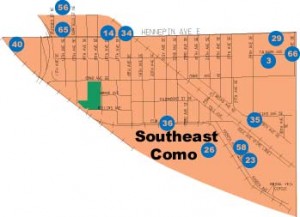
I wonder what the SE Como Neighborhood Improvement Association thinks of this idea?
Here’s the STrib report:
No burner in Phillips neighborhood
The developer of a proposed wood-burning power plant says it gave up on the Minneapolis site in exchange for city help in locating another renewable energy facility.By STEVE BRANDT, Star Tribune
June 6, 2008
The developer of a proposed wood-burning power plant in the Phillips area of south Minneapolis announced Friday that it is dropping efforts to build it on a city-owned site.
Kandiyohi Development Partners said that it was taking that step in light of city promises to help find another site for an unspecified renewable energy facility.
The announcement was a victory for the activists from the Hiawatha-Lake area who had fought the plant on the grounds that the area already had too much pollution. It also recognized the barriers posed by recent legislation requiring added studies before a state permit could be issued for that site, as well as the city’s move to cancel its sale of the land.
The developer met Thursday with Council Members Gary Schiff and Scott Benson, but Schiff said no explicit commitment was made to help Kandiyohi find another site for producing power.
However, he said the firm did suggest the South East Industrial Area between the Prospect Park and Como neighborhoods as one possible site. Another generating facility has been proposed near there to supply power to the Rock-Tenn paper recycling facility in St. Paul.
Kandiyohi said that with more than $2 million invested in planning for the electrical and steam-producing generator, it deserved more clarity early in the project from the state and city, especially regarding environmental challenges in the Phillips area. Among the investors is Council Member Lisa Goodman, a friend of Kandiyohi’s principals.
“We’re happy that it’s not going to be in the Phillips neighborhood,” said state Rep. Karen Clark, DFL-Minneapolis, who helped pass the law requiring study of cumulative pollution in the area. “We’re not taking a position on where it should go.”
Schiff said Kandiyohi expressed an interest in avoiding areas with the high childhood asthma rates that plague Phillips and other areas of high poverty.
Steve Brandt • 612-673-4438
Here’s an article with a quote that says to me that they were having trouble at the MPCA — from the Minneapolis-St. Paul Business Journal:
Friday, June 6, 2008 – 5:12 PM CDT
Kandiyohi axes plan for wood-fuel plant in South Minneapolis
Minneapolis / St. Paul Business Journal – by Sam Black Staff Writer
Kandiyohi Development Partners has scrapped plans for a new $80 million energy facility in South Minneapolis, but it isn’t giving up on finding another location in the city.
In response to an RFP by the City of Minneapolis, Kandiyohi had pitched a plan to build a renewable energy facility that would be called Midtown Eco Energy at the site of a garbage transfer station in the Phillips neighborhood of Minneapolis.
The facility would have reused a former city incinerator at Hiawatha Avenue and Lake Street that closed in the 1970s.
Today the Minneapolis-based firm pulled the plug on its plans due to “concerns raised by the Phillips community regarding the impacts of decades of environmental and land use policies of the City and the (Minnesota Pollution Control Agency) on air and land pollution,” Kandiyohi said in a statement.
The project had come under fire by some residents in the neighborhood and lost the support of some members of the city council in recent weeks as Kandiyohi approached a March 31 deadline to complete its purchase of city land.
The project became a political hot potato when it was reported that investors in the deal included former DFL activist Michael Krause and Kim Havey, a former city official who ran the city’s Empowerment Zone office. Minneapolis City Council Member Lisa Goodman is also an investor in Kandiyohi, although she didn’t vote on the project when it came before the city council in 2006.
Kandiyohi has already invested more than $2 million in the project, which would have burned clean wood wastes and some agricultural byproducts.
Kandiyohi plans to look for an alternative site for a renewable energy facility that would add “green collar” jobs and renewable energy to the city.