The Economist weighs in, now it’s YOUR turn!
May 4th, 2009

I’d wondered why “The Economist” had shown up in my blog stats, and now I know. But from the viewpoint of this article, it’s clear they didn’t do more than scratch the surface of transmission in the Midwest. This is “party line” all the way — I hope they’ll now take the time to read NYISO and ISO-NE’s letter of withdrawal from publication of JCSP!
YOUR TURN! Let them know what you think and why — the registration is instantaneous and easy, so COMMENT AWAY!
Spreading green electricity: A gust of progress
Apr 30th 2009 | CHICAGO
From The Economist print edition

Contact Tax Omnibus Conference Committee TODAY!
May 1st, 2009
The Tax Omnibus Conference Committee meets later today.
SEND AN EMAIL NOW! Send to Conference Committee members (below) and also rep.jeremy.kalin [at] house.mn and sen.rick.olsen [at] senate.mn
Message: The Omnibus Tax Bill’s 272.0275 is not specific enough to protect local governments. Your constituents’ local governments deserve assured compensation for hosting electric generation plants. Two simple changes:
- “siting” must be “host fee” — use of “siting” changes the intent of the original idea, which is to assure that there is a HOST FEE agreement in place compensating local governments. “Siting” could mean anything or nothing, and is not sufficient.
- “school district(s)” must be added.
Here’s the language to change: Add “school district(s)“ and “siting” must be “host fee” — use of “siting” changes the intent of the original idea, which is to assure that there is a HOST FEE agreement in place compensating local governments. “Siting” could mean anything or nothing, and is not sufficient.
103.6 Sec. 6. [272.0275] PERSONAL PROPERTY USED TO GENERATE
103.7 ELECTRICITY; EXEMPTION.
103.8 Subdivision 1. New plant construction after January 1, 2010. For a new
103.9 generating plant built and placed in service after January 1, 2010, its personal property
103.10 used to generate electric power is exempt if an exemption of generation personal property
103.11 form, with an attached siting host fee agreement, is filed with the Department of Revenue. The
103.12 form must be signed by the utility, and the county and the city or town and school district where the facility is
103.13 proposed to be located.
103.14 Subd. 2. Definition; applicability. For purposes of this section, “personal property”
103.15 means tools, implements, and machinery of the generating plant. The exemption under this
103.16 section does not apply to transformers, transmission lines, distribution lines, or any other
103.17 tools, implements, and machinery that are part of an electric substation, wherever located.
103.18 EFFECTIVE DATE.This section is effective the day following final enactment.
Here are the members:
Bill(s): HF2323/SF2074
Description: Omnibus tax bill.
Conferees and Date of Appointment
House: 4/29/2009
Lenczewski; Marquart; Koenen; Loeffler; Seifert;
The GALL of GRE’s Kaul!
April 30th, 2009

Will Kaul, VP of GRE, let loose in response to David Morris’ opinion piece a few days ago. What a doozy! How dare he! Talk about out of touch with reality! Maybe he’d better ask a few of the thousands who showed up and commented on this insane series of transmission projects across Minnesota known as CapX 2020.
You can call him and tell him what you think. Will Kaul @ GRE (763) 241-2380!

Will Kaul: Citizens have plenty of input on utilities
The facts on three new power lines came out in dozens of public events.By WILL KAUL
Last update: April 30, 2009 – 11:05 AM
The above quote, “to be a formal intervener, an individual or group simply had to sign up,” is false, and the utmost in arrogance. Kaul … read more sure wasn’t at the CapX proceeding that I was at, and it looks like he hasn’t read the transcript. If he had, he’d know that a couple weeks into the hearing, the judge issued an Order to Show Cause to two intervenors, the Prairie Island Indian Community and United Citizens Action Network to explain why they shouldn’t be booted out! Prairie Island Indian Community said they’d withdraw and maybe intervene in the siting docket. U-CAN, landowners in the route corridor, succinctly told the judge they had every right to be Intervenors, there were no requirements for level of participation, and btw, they were in the middle of condemnation proceedings for the MinnCan pipeline (another of her dockets and recommendations!) and didn’t have resources to do much in CapX. The judge then graciously allowed them to remain in the proceeding. nocapx2020.info/?p=324 Electric use is down, down, hence NoCapX 2020’s Motion to Reopen (November and last month), and soon, Motion for Reconsideration and then appeal. The forecasts are old, 2004-2005, and Xcel admits in its SEC filings that 2007 and 2008 saw declining beaks, SIGNIFICANTLY declining peaks, over 11% in just two years rather than their 2.49% increase, 1.5% increase, or whatever other number was dreamed up for the occasion. Those two years alone push any claimed need for this project way out there in time. And even if there was the “need” that they claim, the physical conductor is way over-spec’d, many many times what’s necessary for even the most generous forecast, and then they have the nerve to upsize it, doubling it, with zero justification! “The PUC upheld the recommendation of the judge…” Of course, they’re supporting MISO’s economic dispatch, rather than ratepayer interests, rather than the public interest. It’s time for a shake-up, not the usual shake-down. Yes, the many pages of transcripts, testimony, exhibits reflect the facts, but the ALJ recommendation and PUC decision do not reflect those facts or the purpose and reality of CapX 2020. From the utility squeals, it’s clear David Morris hit a nerve by being right on target.
An April 24 opinion piece by David Morris (“If it’s citizens vs. utilities, utilities win”) criticized the process state regulators use to review and approve new transmission lines and questioned whether Minnesotans had an opportunity to participate in the recent proceedings concerning three 345-kilovolt lines proposed by CapX2020, a group of 11 utilities.
The piece also made a rather bizarre comparison between sports stadiums and electric transmission lines. Electricity is an essential service that every Minnesotan depends on 24 hours a day, seven days a week.
The state regulatory process encourages public participation. It requires an independent review to ensure that utilities’ plans undergo a thorough and comprehensive vetting.
In the CapX2020 case:
•The Minnesota Department of Commerce held 10 public meetings, and an administrative law judge held 19 public hearings. Any interested citizen could attend and speak.
•To be a formal intervener, an individual or group simply had to sign up.
•The utilities hosted more than 100 public meetings and made more than 150 public presentations about the projects.
Following that extensive review, the Minnesota Public Utilities Commission voted unanimously that the three lines are needed. The decision upheld the recommendation of an administrative law judge, who reviewed thousands of pages of testimony and public comments and conducted seven weeks of evidentiary hearings and three weeks of public hearings.
Among the points the utilities made:
•Since the last major transmission system upgrade in Minnesota 30 years ago, much has changed. Electricity consumption has doubled, as has the number of electricity customers. Communities such as St. Cloud, Alexandria, Rochester and the Twin Cities have experienced significant growth and are facing serious electricity reliability issues.
•Despite today’s economic slowdown, electricity use is projected to continue growing, particularly peak electricity use.
•The transmission system must be designed to withstand the loss of one line by instantaneously transferring power to other lines.
•Minnesota has the most aggressive renewable energy standard in the country, requiring that 25 percent of electricity be from renewable sources by 2025. The Buffalo Ridge in southwestern Minnesota is one of the country’s greatest wind resources. Transmission lines are required to move that energy to customers.
The CapX2020 transmission lines aim to ensure that Minnesota communities continue to enjoy reliable electricity service and that the state’s renewable-energy mandate is met. The regulatory process aims to ensure that citizens have a say in determining whether the lines are needed and where they should be routed.
Will Kaul is vice president of transmission for Great River Energy and is chairman of the CapX2020 organization.
Sen. Amy gets visit from Micheletti!
April 30th, 2009

WASHINGTON, D.C. — This morning, at “Coffee and Potica” or Minnesota Morning with Senator Amy Klobuchar, who should be there but Tom Micheletti! Yes, Excelsior Energy’s Tom Micheletti was there. And he was there on the eve of the DEADLINE, the day before the PUC said it would pull the plug on Excelsior Energy’s Mesaba Project.
The legendary Alan Muller, Green Delaware, was in Amy’s office this morning too! He got there, and “the only other person I knew in the room was Tom Micheletti.” Too weird. And here I had to stay home and dogsit. DAMN! I could have used the aerobic exercise of duking it out with Tom again.
Sen. Klobuchar’s energy staffer, Charlie Moore, said he wasn’t in on the conversation between Micheletti and Klobuchar’s chief of staff, Alan said they were huddled together for quite a while. Moore also said that he didn’t know that there was a May 1 deadline. Oh, really? Not good. It’s bad enough that we have to worry about what Micheletti might be saying, but now we’ve also got to be concerned about what he isn’t saying.
And sorry, no photo, yes, I’m MOST disappointed, oh well… but there’s a photo of Sen. Klobuchar with Alan in his Neighbors Against the Burner shirt.
Will it happen? Will they pull the plug? They sure better, they’ve been stalling long enough.
Here’s Excelsior Energy’s filings in their attempt to keep the PUC from FINALLY pulling the plug on the Mesaba Project:
So let’s just let this thing die. Xcel doesn’t want it, the Minnesota municipal utilities don’t want it, the PUC doesn’t want it, and mncoalgasplant.com sure doesn’t want it and neither does Citizens Against the Mesaba Project.
Susquehanna-Roseland Xmsn Interventions OK’d
April 29th, 2009
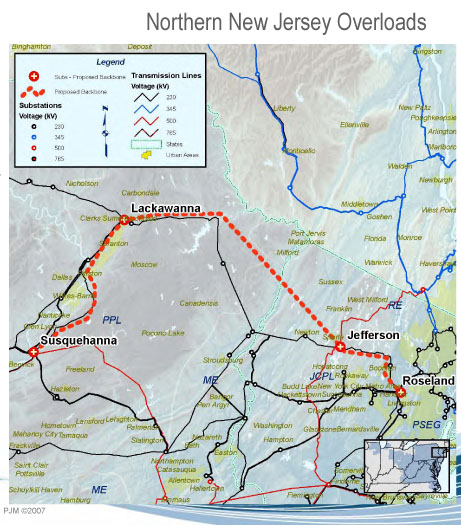
Day before yesterday, New Jersey’s Board of Public Utilities met to make determinations on the Motions for Intervention of a large number of parties. Stop the Lines, of course being one! They’d objected to our Intervention:
… but had no objection to my Pro Hac Vice… go figure. And the feeling I had from the BPU is that they were honestly encouraging interventions. SO, what happened?
State: 17 groups may intervene in PSE&G’s power line proposal
By Colleen O’Dea • Daily Record • April 27, 2009All 17 groups that sought to be part of the hearing process on Public Service Electric and Gas Company’s proposed transmission line project may do so, the state Board of Public Utilities decided today.
Meeting in Newark, the board also directed PSE&G to meet with the intervening parties – several municipalities, environmental organizations and citizens groups – to negotiate an agreement on the establishment of an escrow account from which the groups could pay for expert witnesses.
“Super,” is how Dave Slaperud of the 300-member Stop the Lines, one of six groups the utility had sought to bar from intervening in its application to add 500 kilovolt lines along a 46-mile transmission corridor from Pennsylvania through Morris County to Roseland, described the BPU’s decision.
“We would have been really surprised if we had been denied intervener status,” said Slaperud. “There are so many of us living along the line who are affected and not all the municipalities are getting involved in the process.”
Among the government bodies that are involved are East Hanover, Montville, Parsippany and Byram townships and the Montville Board of Education. Interveners are allowed to request discovery documents, cross examine witnesses and present their own expert testimony.
And more:
Groups cleared to speak at powerline hearings