Garbage incinerator increase delayed
June 9th, 2009
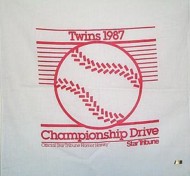
Naries filter — A new use for a Homer Hanky???
Last night’s hearing was a start – the Minneapolis Planning Commission is thinking about the implications and impacts of increasing the “throughput tonnage” (makes it sound so innocuous) for the HERC incinerator, the incinerator right next door to the new open (polluted) air stadium. Care for some tire PM 2.5 with that hot dog? New use for “Homer Hankies?”
There was good representation of a number of opposition views.
For some who were not able to be there, I was also able to get into the record letters from (and will post if they arrive electronically):
Carol Greenwood – Seward Neighborhood
And some decent media coverage! From Fox9 News – check out the video with John Schatz and Andrea Kiepe testifying:
And in the STrib today:
Minneapolis may set limit on pollution from burner
Covanta and Hennepin County, for which it operates the incinerator, are seeking permission to burn an average of 1,212 tons of trash daily. The limit in the city’s original 1987 zoning conditions for the facility is 1,000 tons per day.
Read the rest of this entry »
HERC Burner Expansion in the news again
June 5th, 2009

Well, would ya take a look at this! I would guess that Minneapolis is getting the message that there is indeed opposition to this stupid idea…
Minneapolis pushes to burn more trash
Some opponents have urged the county to compost more garbage as an alternative to burning it.
Dept of Health releases Wind White Paper
June 5th, 2009

Iff we could harness the energy of Katie V. Troe! Her work on the Bent Tree Wind Project has a measurable impact. Here’s one example — the long awaited Minnesota Dept. of Health Wind White Paper has been released, and here it is:
Here’s the short version:
The Minnesota nighttime standard of 50 dB(A) not to be exceeded more than 50% of the time in a given hour, appears to underweight penetration of low frequency noise into dwellings. Different schemes for evaluating low frequency noise, and/or lower noise standards, have been developed in a number of countries.
…
Unlike low frequency noise, shadow flicker can affect individuals outdoors as well as indoors, and may be noticeable inside any building. Flicker can be eliminated by placement of wind turbines outside of the path of the sun as viewed from areas of concern, or by appropriate setbacks.
Prediction of complaint likelihood during project planning depends on: 1) good noise modeling including characterization of potential sources of aerodynamic modulation noise and characterization of nighttime wind conditions and noise; 2) shadow flicker modeling; 3) visibility of the wind turbines; and 4) interests of nearby residents and community.
VII. Recommendations
To assure informed decisions:
- Wind turbine noise estimates should include cumulative impacts (40-50 dB(A) isopleths) of all wind turbines.
- Isopleths for dB(C) – dB(A) greater than 10 dB should also be determined to evaluate the low frequency noise component.
- Potential impacts from shadow flicker and turbine visibility should be evaluated.
Any noise criteria beyond current state standards used for placement of wind turbines should reflect priorities and attitudes of the community.
This seems to me to be recommending either local control of siting criteria that actually addresses these issues (and what county government will?) or state criteria change reflecting issues raised by local communities and recommendations that the people have brought forward.
Hiawatha Transmission Project Update
June 2nd, 2009

Xcel’s Hiawatha Transmission Project, through the heart of the Phillips neighborhood in Minneapolis, was on the PUC’s agenda last Thursday. I had some deadline or other and couldn’t go, but here’s what happened:
Of course MOES thought everything was just ducky…
Midtown Greenway filed a Comment:
There was no Petition for a Contested Case filed, but a Contested Case was ordered because Xcel has taken the mandatory Contested Case route. There were no Petitions to Intervene… There was only ONE comment filed…
Here’s the PUC’s Order:
Here’s the Dept. of Commerce’s view of Scoping for the full-blown Environmental Impact Statement:
So there we are… Bill Storm of MOES is assuming that it’s an EIS we’re doing, that’s a good thing. Check the DRAFT scope, though, and note how narrow it is.
There’s a public meeting for scoping (hmmmm… I wonder if I got notice… $50 says no — Bill says yes, and where’s the $50, but, “It would be WRONG,” she says, speaking into the lampshade…):
DOE-MOES – Notice of EIS Scoping Meeting
Thursday, June 18, 2009 – 6:oo p.m.
Midtown Global Market
920 East Lake St.
Mpls, MN
Comments accepted until July 10, 2009
Send to:
Bill Storm, Project Manager
MN Dept of Commerce
85 – 7th Place East, Suite 500
St. Paul, MN 55101
or
bill.storm@state.mn.us
OK, folks, get to work!
- Now’s the time to read the application (Xcel’s Hiawatha Project Page HERE) and draft a Comment about what should be included in the EIS.
- Now’s the time to put in your requests to be on the Citizens Advisory Task Force
- Now’s the time to Petition to Intervene! (well, it’s not to late… YET…)
Chisago Transmission Line Comments in thus far
June 2nd, 2009

It’s all about this short section of the Chisago Transmission Project. This is a cropped portion of a map in the DoC’s Environmental Assessment, Map 4 to be precise.
To look at the entire docket, go to:
then to “eDockets” and search for 06-1677
A little light reading:
And the Comment period ends TODAY! ENDED! It’s history… Some Comments received — in alpha order:
My big question, which OAH couldn’t answer, was whether THE Agreement was filed in that OAH docket way back in 2000, was it filed in the EQB docket, filed in any docket???