dollarsbigpile.jpg

Xcel is trading a bunch of paper for a bunch of money, 21,850,000 pieces of paper to be precise.  How much money is that?  Seems to be $469,775,000,  or $408,500,000, gross, or $396,245,000 net to Xcel, depending on what numbers you look at, or what they sell at!

Xcel’s 424B2 filed with SEC August 4, 2010

What will they do with it?  According to the prospectus, and an article written about it:

“Xcel Energy intends to use any net proceeds that it receives upon settlement of the forward sale agreement described above, or from the sale of any shares to the underwriters to cover over-allotments, to repay outstanding commercial paper and make capital contributions to its operating subsidiaries.”

Here’s an article from Marketwatch:

Xcel Energy Announces Pricing of Common Stock

Doesn’t this have the feel that they’re desperate for cash flow?  We know they can’t get their construction capital to build the Brookings transmission line, and they’re hot to trot both about PUC ordained rate recovery, which they did not get and their Motion for Reconsideration (PUC Docket 09-1048) went nowhere.

Here’s Seeking Alpha’s Xcel 2Q Earnings Call Transcript!

Seeking Alpha Xcel 2Q Earnings Call Question & Answer

And a choice answer snippet from the Q&A:

Ben Fowke

Transaction transmission will be a very big part of our capital profile as you get to the middle and latter part of the decade it’s a result of all the years of efforts we’ve already put into project like CapEx 2020. It takes a very long time to get these things done.

Word of today’s NYT article came in over the wire today, and it’s an interesting concept to deal with a very real problem, but not nearly enough!!!

Turbines to Loud?  Here, Take $5,000

My clients raising noise issues in wind project dockets at the PUC, including the “Public Health Impacts of Wind Turbines” (09-845) have noted, “how will we be compensated for having to live with all this noise?”  In our capitalist culture, $$$ is compensation.  Offensive projects aren’t shut down, money is offered.

Minnesota Noise Rules don’t take into account ambient noise, they just set standards for noise, a binary limit on certain types of noise.

Minnesota’s legislature acknowledged that people don’t want to live by transmission lines, and enacted “Buy the Farm” (in full, below)which gives landowners facing a transmission line on their property can opt out, and force the utility to buy their full parcel, not just an easement.  Why not the same with wind projects?

Here’s the actual waiver that the wind developer is asking them to sign:

Noise Easement – North Hurlburt Wind, Caithness Corporation

And check this sentence, regarding the Compensation which is outlined in “Exhibit C” attached to the agreement:

Exhibit C shall be redacted from the recorded version of this agreement.

It seems to me that for the blanket “right to offend,” the offers reported are way too low, and waivers are one-sided.  From the article:

Ms. Pilz, the local Caithness representative, did not volunteer the information that Caithness offers people money to sign noise easements, though she eventually confirmed in an interview that it did. She also would not say how much money it offers, though several property owners said she had offered them $5,000.

“What we don’t do in general is change the market price for a waiver,” Ms. Pilz said. “That’s not fair.”

Some people who did not sign said that Ms. Pilz made them feel uncomfortable, that she talked about how much Shepherd’s Flat would benefit the struggling local economy and the nation’s energy goals, and that she suggested they were not thinking of the greater good if they refused.

Don’t change the market price?  Well, that says there’s a price and that there’s a market.  Caithness does not control the market — they’d better get clear on that right quick.  I’ would presume that as this becomes more of an issue the price will go up!  LET THE MARKET DECIDE!!!  I love it when that happens…

+++++++++++++++++++++++++++++++++++++++++++++++++

Minnesota’s “Buy the Farm” law:

Minn. Stat. 216E.12, Subd. 4.Contiguous land.

When private real property that is an agricultural or nonagricultural homestead, nonhomestead agricultural land, rental residential property, and both commercial and noncommercial seasonal residential recreational property, as those terms are defined in section 273.13 is proposed to be acquired for the construction of a site or route for a high-voltage transmission line with a capacity of 200 kilovolts or more by eminent domain proceedings, the fee owner, or when applicable, the fee owner with the written consent of the contract for deed vendee, or the contract for deed vendee with the written consent of the fee owner, shall have the option to require the utility to condemn a fee interest in any amount of contiguous, commercially viable land which the owner or vendee wholly owns or has contracted to own in undivided fee and elects in writing to transfer to the utility within 60 days after receipt of the notice of the objects of the petition filed pursuant to section 117.055. Commercial viability shall be determined without regard to the presence of the utility route or site. The owner or, when applicable, the contract vendee shall have only one such option and may not expand or otherwise modify an election without the consent of the utility. The required acquisition of land pursuant to this subdivision shall be considered an acquisition for a public purpose and for use in the utility’s business, for purposes of chapter 117 and section 500.24, respectively; provided that a utility shall divest itself completely of all such lands used for farming or capable of being used for farming not later than the time it can receive the market value paid at the time of acquisition of lands less any diminution in value by reason of the presence of the utility route or site. Upon the owner’s election made under this subdivision, the easement interest over and adjacent to the lands designated by the owner to be acquired in fee, sought in the condemnation petition for a right-of-way for a high-voltage transmission line with a capacity of 200 kilovolts or more shall automatically be converted into a fee taking.

.

pseg_logo

Yes, indeed, PSEG is making things work for us…

PSEG has announced through its 2Q report that the Susquehanna-Roseland transmission line will be delayed until at least 2015.  Just like the Brookings line part of CapX 2020!  Funny how that works.

PSEG – 2nd Quarter – Press Release

Here’s what they said in this about D-E-L-A-Y of the Susquehanna-Roseland transmission line – two little snippets:

Ralph Izzo indicated that PSE&G has notified the PJM Interconnection that the in-service date for the eastern portion of the Susquehanna-Roseland transmission line has been delayed by 2 years to 2014 with the in-service date for the western portion of the line delayed until 2015. He added, “We are disappointed by the delay, but look forward to meeting the region’s reliability requirements in partnership with our regulators and PJM.”  The delays are due to on-going environmental permit reviews.

PSE&G notified PJM that it has not obtained certain environmental approvals that are required for completion of the Eastern and Western segments of the Susquehanna – Roseland transmission line. Consequently, at this time, we do not expect the Eastern portion of the line to be in service before June 2014, and we do not expect the Western portion to be in service before June 2015.

You can learn more about the Susquehanna-Roseland transmission project at www.stopthelines.com!

Interesting 2Q report, some pretty juicy dry numbers here, look how far down their net income was, and look at how their bottom line recovered — it’s those “excluded items” that make the difference:
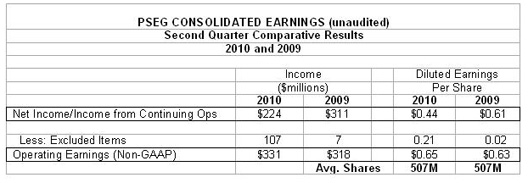
chart1

As Business Week notes:

PSEG 2Q profit falls 21.5 percent

It’s hard to type that headline without two or three exclamation points!!!

Here’s the report from the Star-Ledger:

PSE&G delays construction of controversial Susquehanna-Roseland power line


Published: Friday, July 30, 2010, 4:14 PM
Brian T. Murray/The Star-Ledger

Public Service Electric & Gas announced this morning a three-year delay in completing its controversial Susquehanna-Roseland transmission lines, which will cut across New Jersey’s protected, water-rich Highlands.

PSE&G broke the news in its second-quarterly earnings report, explaining that obtaining environmental approvals has taken longer than anticipated. The announcement came just days after the state Department of Environmental Protection found the company’s wetlands permit applications incomplete.

Now, the $750 million power project the company hoped to complete by 2012 will not be done until 2015.

The New Jersey Highlands Coalition and the New Jersey chapter of the Sierra Club, two groups opposed to the project, said it may be the beginning of the end for the power line. But PSE&G said it plans to move forward, contending the power lines are needed to prevent blackouts and keep the region’s power grid reliable.

“We are disappointed by the delay, but we are going to work with the regulators. … We are still committed to constructing the line. It’s just going to be delayed,” said PSE&G spokeswoman Deann Muzikar.

Already approved by the state Board of Public Utilities and the New Jersey Highlands Council, the project involves a 500,000-volt transmission line along a 146-mile route between Pennsylvania and northern New Jersey and erecting 500-kilovolt transmission towers along a path where smaller, 230-kilovolt towers already exist. The main hurdle has been the National Park Service, which must approve a western leg of the line to run through the Delaware Water Gap National Recreation Area, Middle Delaware National Scenic and Recreational River and the Appalachian National Scenic Trail.

PSE&G split the project into two segments earlier this year, hoping to at least begin construction this summer on an eastern leg between Hopatcong in Sussex County and Roseland in Essex County. But that strategy caused trouble for its wetlands permit reviews by the DEP, which noted the BPU had approved the project in one piece, not in a bifurcated process.

Additionally, the National Park Service has stood firm on its plan to delay action until 2012, as it holds public hearings and considered alternative routes for the line. Three hearings are scheduled for Aug. 17 through Aug. 19 in Pennsylvania and Sussex County.

Environmental groups, contending the project will ruin sensitive land and promote polluting, coal-generated electrical plants in the west, applauded the park service for its careful approach.

“PSE&G has been playing a high-stakes game of chicken with the public and regulators, whom they are now blaming for their not getting their permits on a fast track. This doesn’t surprise us, considering the vast environmental and scenic damage that will be imposed on the Highlands for this risky, ill-conceived, and expensive project,” said Julia Somers of the Highlands Coalition.

The  “Beige Book” report for the 9th Federal Reserve District, HQ’d in Minneapolis, is out.  It’s a bunch of anecdotes put together for the economic whizzes — what I don’t understand is what use  such an informal compilation of snippets would be?  If they’re looking for guidance in making their decisions, I would think they’d want something with greater substance?!?!?!  Or if they want “info light,” just go for a drive around the district!

The name, “Beige Book,” on its own draws analogies to depression of another variety — maybe whoever came up with that wasn’t thinking beyond this little task, but it leave us with no doubt what’s in between those covers!  Pass the Prozac!

Beige Book – Minneapolis – 9th District

Three sentences stood out:

In contrast, a heavy infrastructure contractor in Minnesota and Wisconsin saw improvement in its market segment.
… and…
An engineering firm that supports the mining and energy sector noted an increase in activity.
… and…
A Minnesota energy management consultant noted an increase in orders.

HERE’S THE LINK TO THE ENTIRE REPORT

mark-roberts

Well, a busy couple of days.  Mark Roberts, M.D., Exponent, toady for whatever project developer has the dough to pay him, made appearances in Goodhue, Minnesota for a hearing on the Goodhue Wind project, and in Wausau, Wisconsin, for an open house for a proposed biomass plant.  How much of a toady is he?

Dig this, he was “Corporate Medical Director of BP.”  Yes, our friend British Petroleum!

LINK TO PROFILE – MARK ROBERTS, M.D.

Wednesday, he was here in Goodhue, a puppet for the developers.

Here’s a link to the rest of the story: Goodhue Wind Truth

Thursday, he’s in Wausau, WI, a puppet for the developers.

Here’s a link to the rest of the story: Saving Our Air Resource, opponents of that Wausau biomass plant.

From Faux News 55:

Here’s from the Wasau Daily Herald:

Rothschild residents preview Biomass plant plans

By Kathleen Foody • Wausau Daily Herald • July 23, 2010

OTHSCHILD — The mood at the open house hosted by We Energies on Thursday about a proposed biomass plant in Rothschild was calm, though discussion about the project has become heated.

About 110 residents attended the sessions, one each in the afternoon and evening, at the Holiday Inn in Rothschild. Staff from We Energies and Domtar stood near displays and video monitors, explaining the plant plan and its effects on the community.

The proposal to burn woody biomass as fuel to create electricity for sale by the Milwaukee energy company and steam to power the Domtar paper mill is pending before the Wisconsin Public Service Commission. Since the plant was proposed in September 2009, We Energies has tried to get ahead of critics with direct mailings, community meetings and door-to-door consultations.

Many residents who attended the Thursday meetings said they were undecided or in favor of the $250 million project and felt satisfied with answers to their questions about air quality, jobs and traffic around the plant.

“I want to make sure it’s safe. My grandkids attend (Rothschild Elementary School) across the street (from the mill),” Andy Champine of Weston said. “I walked in neutral to get the facts.”

Barry McNulty, a spokesman for We Energies at the event, said the company was pleased with turnout and the questions posed.

“No one particular issue stood out,” he said. “Residents asked very similar questions (as at the February open house), and we tried to give them a better understanding of what we do and how we do it.”

Rob Hughes, a member of Save Our Air Resources, a citizen group that has opposed the plant, said he applauded the open house events. But he’s not satisfied with We Energies’ responses to his requests for specific information on air quality if the plant is constructed.

“They had a doctor there saying this is good, but thousands of doctors have signed on to a letter (in Massachusetts) saying these plants are bad for people’s health,” Hughes said.

Hughes was referring to the Massachusetts Medical Society, and its December decision to oppose three biomass plants, citing respiratory problems that air pollution can cause or worsen. The organization also asked state governments to discourage the construction of biomass facilities.