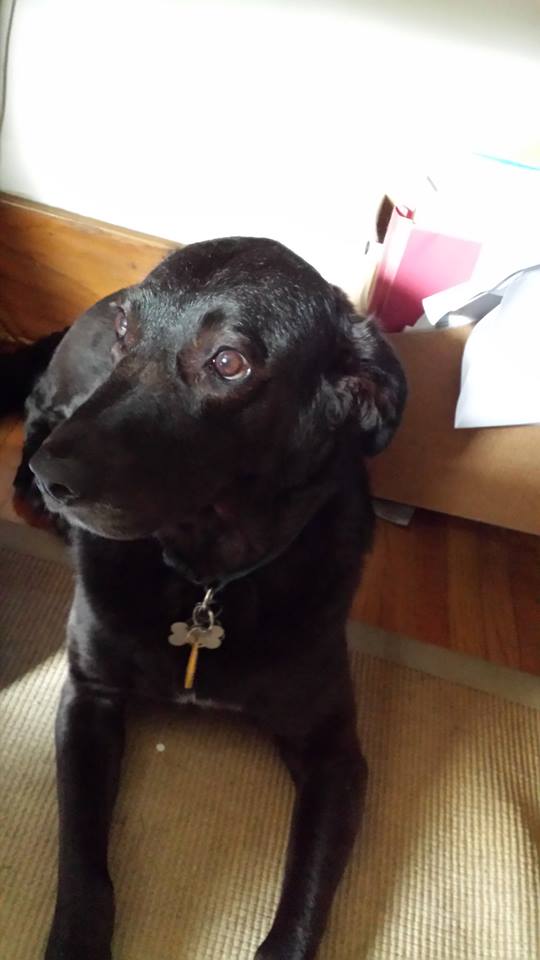
Oh so true!! That’s how it is in all infrastructure proceedings I’ve been involved with and observed. And as I sit here with a terrified doggy coping with a storm and fireworks, I’ve got time to look into it. She’s watching the storm come in from the west, have the office screen door open, oh, she’s a freakin’. Not drooling, that’s a start, Xanax might be doing something, but not much…
Anyway, a gas pipeline group I’m in was posting articles about this, and so I started with the post, no link… read the article, with many links, but no link to the Inspector General report, so followed the links, still no report. OK, fine, it’s GOOGLE TIME!
The bottom line? There is an Office of Inspector General Audit, a NRDC commissioned report, AND FERC published notice of a comment period, NOTICE OF A COMMENT PERIOD 4/25/2018 AND A COMMENT PERIOD THAT ENDED 6/25. BUT IT’S BEEN EXTENDED!
Here’s the Notice in the Federal Register, April 25, 2018:
Should FERC develop more prescriptive standards for reviewing applications for new pipelines, in light of the increasingly uncertain forecasts of the need for incremental pipeline capacity? Do changes underway in both the gas and electric industries – and the increasingly strong interrelationship between them – warrant a more integrated assessment of sectoral demand and electricity market forces in assessing natural gas pipeline need in Section 7 proceedings? Should FERC require regional planning regarding gas transportation resources similar to the regional planning requirement imposed on electric transmission owners? Should FERC apply a higher threshold standard and greater scrutiny with respect to demonstration of need, market demand, and public benefit where an affiliate (e.g., gas LDC, electric utility, and/or independent power producer) is involved in the proposed project? Should determination of need for a proposed pipeline project be the threshold determination (instead of the current threshold determination, which is whether the project could proceed without subsidies from existing customers)? Should FERC’s balancing of benefits against adverse impacts be expanded to include noneconomic factors (e.g., should environmental impacts be among the adverse impacts FERC considers while applying the balancing test)? Should FERC give deference to state regulatory approvals (e.g., of contracts between pipeline companies and affiliated shippers, including either local distribution companies or power plants) only when such approvals involve a regulatory review of whether such contracts represent the least-cost method of serving such demand, taking into account other strategies (e.g., energy efficiency in the case of an LDC contract, or dual-fuel capability at the power plant, or application of technologies to increase throughput on existing pipeline capacity)? Should FERC require a demonstration of need and public benefit based on a showing that non-pipeline alternatives have been considered as options to meet the demand of shippers (e.g., an integrated gas/electric resource plan or an integrated gas/electric reliability study, energy efficiency programs in the case of an LDC contract, dual-fuel capability at a power plant, or adoption and application of technologies to increase throughput on existing pipeline capacity)? Should FERC impose a greater burden to show that a pipeline is needed when it is proposed to gain market share rather than to meet new market demand? How should FERC’s policy take into account the views of a variety of interested constituencies (including competitors, customers, landowners, local communities, and others affected directly and indirectly by the pipeline and by the impacts of gas combustion), many of whom may have limited access to resources to participate as full parties in specific pipeline-review cases? How should FERC weigh the relative distribution of benefits and burdens across those interested and affected constituencies? How should FERC take into account the potential for stranded costs of new pipeline capacity that is later determined to be no longer needed in light of changes in the nation’s current and future energy mix? Should FERC consider new ways for pipeline applicants to internalize the long-term monetary and non-monetary risks associated with near-term capacity investment decisions?
There was also a NRDC report, done by Susan Tierney:
And listing factors that should be considered in updating FERC procedures:
Key Factors Warranting a Refresh of FERC’s 1999 Policy Statement:
Significant industry changes led to adoption of the 1999 Policy Statement, but rapid industry changes and trends since then call into question the policy’s continued appropriateness.
A new, generic proceeding is a better forum than individual case dockets for addressing implications of wide-ranging industry changes and trends.
The meaning and application of FERC goals have evolved over the decades.
The interaction of gas and electric industries suggests a need for integrated assessment of both markets.
Other factors originally highlighted in FERC’s 1999 Policy Statement remain important but warrant a reassessment in light of changes. Changes in the gas and electric industries and an increasingly active and oppositional context in which FERC’s pipeline certification cases occur indicate the need for review of factors FERC initially emphasized. These factors include:
the relevance and magnitude of pre-certification contractual commitments and/or precedent agreements;
the nature of relationships between pipeline developers and natural gas LDC, electric utility, and/or independent power producer affiliates;
the balancing of public benefits against adverse impacts in an era of debate over power system reliability implications and accelerating evidence of and concern over GHG emissions and climate-change risks resulting from current and future combustion of natural gas;
complications in assessing need and impacts across pipeline owners in an era of rapidly expanding changes and growth in production regions and consumption patterns; and
trade-offs across the interests of gas-consuming populations and those of communities impacted by gas infrastructure.
This is a good assessment of where we’re at. BUT, the many things raised by Tierney in NRDC’s report were not addressed in the FERC Office of Inspector General report. And yes, those things addressed by the Inspector General are also oh-so-relevant. So there’s a lot to do!
Catching up… Thanks to Bloomberg for finding this — a May 29, 2018 “confidential” memo, now attempting to use a “National Defense” framing to subsidize the failing coal and nuclear power industries:
This is on the heels of his prior attempts to push coal and nuclear generation. The claim is one of grid necessity, to keep it stable, don’t cha know. Right… If it weren’t of such immense scope and cost, I’d be Snorting Out Loud. Instead, it’s the other SOL!
No, just no. It’s obvious that tRump can’t change the market, the free market has spoken. What would the cost of this be to us? MASSIVE! So now they’re trying every excuse to prop them up at OUR expense, our expense as rate-payers, and our expense as tax payers. No, just no…
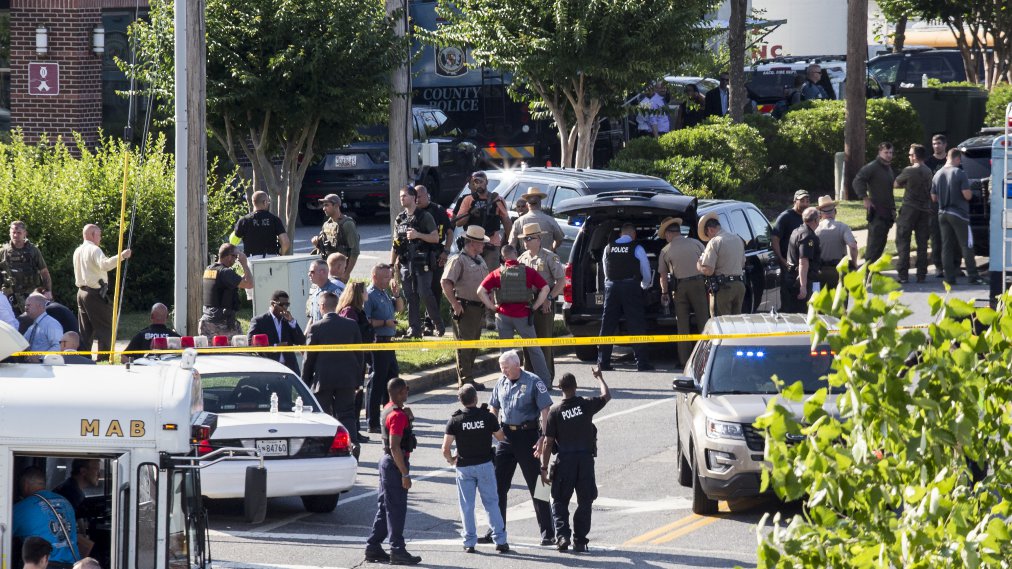
Let’s be really clear. This is not about mental illness. This is about dysfunctional thinking, this is about “ME FIRST” and damn everyone else — kill them, jail them, deport them. This is about our country’s normalization of these attitudes, vocally and aggressively led by our Twit-in-Chief.
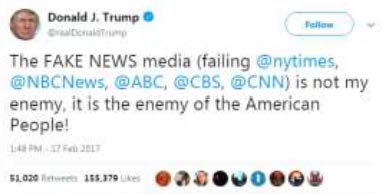
I-N-C-I-T-E, this is what Herr Drumpf does. How many times has he ordered his supporters to remove people from rallies, to inflict bodily harm on them and state that he’d cover their legal expenses? (would the check clear?) Ranting about “FAKE NEWS” whenever he’s challenged with REAL NEWS about his administration, and his declaration that the press is the “Enemy of the American People” less than a month after taking office. On and on, over and over, whipping people into a frenzy — he must be held accountable.
President Trump, in an extraordinary rebuke of the nation’s press organizations, wrote on Twitter on Friday that the nation’s news media “is the enemy of the American people.”
Even by the standards of a president who routinely castigates journalists — and who on Thursday devoted much of a 77-minute news conference to criticizing his press coverage — Mr. Trump’s tweet was a striking escalation in his attacks.
At 4:32 p.m., shortly after arriving at his Mar-a-Lago home in Palm Beach, Fla., Mr. Trump took to Twitter to write:
The message was swiftly deleted, but 16 minutes later Mr. Trump posted a revised version. Restricted to 140 characters, he removed the word “sick,” and added two other television networks — ABC and CBS — to his list of offending organizations.
The president has referred to the media as the “opposition party” to his administration, and he has blamed news organizations for stymieing his agenda. But the language that Mr. Trump deployed on Friday is more typically used by leaders to refer to hostile foreign governments or subversive organizations. It also echoed the language of autocrats who seek to minimize dissent.
“Oh boy,” Carl Bernstein, the journalist who helped to uncover the Watergate scandal, said on Friday, after a reporter read him Mr. Trump’s tweet.
“Donald Trump is demonstrating an authoritarian attitude and inclination that shows no understanding of the role of the free press,” he added.
Historians pointed out similarities between Mr. Trump and Richard M. Nixon, who in 1972 told his national security adviser, Henry A. Kissinger, “The press is the enemy.
Mr. Bernstein said the president’s language “may be more insidious and dangerous than Richard Nixon’s attacks on the press.”
“But there is a similarity in trying to divide the country, and make the conduct of the press the issue, instead of the conduct of the president,” he said.
Mr. Trump and his top advisers strongly believe that an elitist news media lost its credibility by failing to anticipate his political rise.
Still, the notion of the news media as an enemy of the public — especially when voiced by a sitting president — went a step beyond Mr. Trump’s usual rhetorical turns.
Mr. Trump’s tactic of pitting the press against the public was mirrored in a survey distributed by the president’s team on Thursday, which urged Trump supporters “to do your part to fight back against the media’s attacks and deceptions.”
Survey questions included, “Do you believe that the mainstream media has reported unfairly on our movement?” and “On which issues does the mainstream media do the worst job of representing Republicans? (Select as many that apply.)”
Mr. Trump has deleted tweets in the past, sometimes to correct for typos or to refine his message, and publications are keeping track of these fleeting missives.
On Thursday, Mr. Trump expressed his distaste for journalists in more populist terms, saying, “much of the media in Washington, D.C., along with New York, Los Angeles in particular, speaks not for the people, but for the special interests.”
“The public doesn’t believe you people anymore,” Mr. Trump added. “Now, maybe I had something to do with that. I don’t know. But they don’t believe you.”
Correction:
Because of an editing error, an earlier version of the headline with this article misquoted the tweet President Trump wrote. He described the nation’s news media as the “enemy of the American people,” not the “enemy of the people.”





 Fair use from Rolling Stone