tRump promoting COAL! And crude oil and natural gas…
April 12th, 2019

Here is is, hot off the Federal Register:
The point of this is to push crude oil and natural gas production, to do what it takes to get it to market (regardless of risks); to revise (gut) the Clean Water Act; to renew leases on federal lands that are now on hold; whether there are “trends” in energy investments and whether proxy voting and regulations should be changed; and to determine whether states’ exercising of their rights is a “barrier” to the national energy market.
There’s a lot between the lines, but in essence, the plan is to put tRump energy policy over states’ and sovereign rights, to put market over safety and environmental concerns. The “market” has already decided, so how does he think this will operate, and what of the cost of these market manipulations?
Massive agenda at PSC tomorrow, and we’re at the tail end!
April 10th, 2019

Here’s the agenda, Badger Hollow and the acquisition docket, #28, 29 and 30!!!
Watch it here: LIVE WEBCAST Starts at 9:30 a.m.
Xcel’s IRP
April 3rd, 2019
Alan Muller and I went to a meeting last night about Xcel Energy’s Integrated Resource Plan – coming soon to a Public Utilities Commission near you! Here in Minnesota, it’s expected to be filed July 1, 2019. Right now they’re filing a lot of documents in the prior IRP, PUC Docket 15-21. To search it go to PUC SEARCH PAGE and search for “year” 15 and docket 21. After they file their 2019 IRP, it will be given a new docket number and filings will be in that docket.
Here’s their presentation from last night:
I found this slide particularly troubling because of the overstatement of demand:
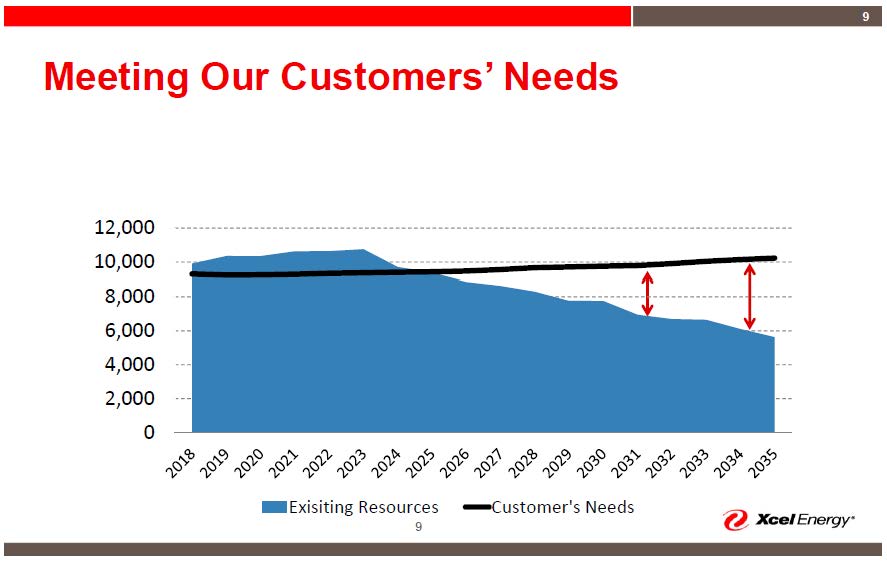
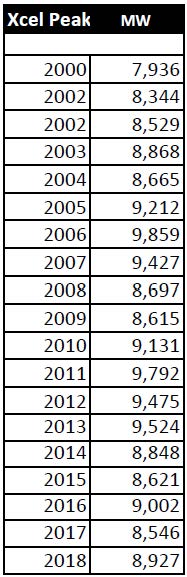
Reality, well, they say “existing resources” are at 10,000MW and peak demand at 9,400 or so… but, peak demand from Xcel’s SEC 10-K filings:
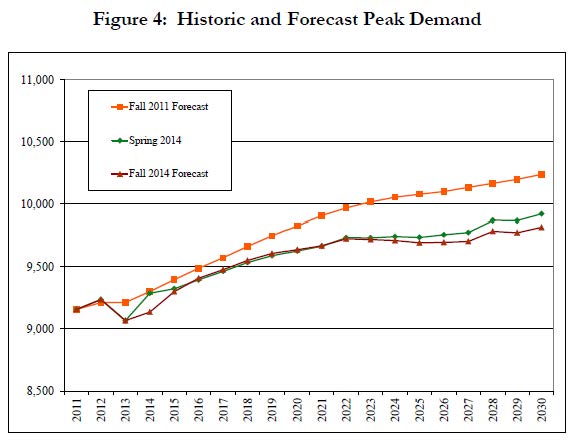
There are indeed issues with Xcel and its forecasting, almost always overstated. Remember the CapX 2020 “forecasts” of a 2.49% annual increase? Here’s Xcel’s forecast from the last IRP, Docket 15-21 (as above), p. 45 of 102:
What is Xcel doing to reduce peak? There’s a statutory requirement to reduce demand by 1.5% annually, so don’t think it’s going up anytime soon.
What is Xcel doing to shift the useage from peak to off peak?
And one thing that really sticks in my craw… Sherco 3. The turbine crashed/blew up/fell apart, and did a lot of damage. Sherco 3 was down for 22 months, and we did just fine without it. BUT Xcel proposed, and the PUC agreed, to rehabbing Sherco 3 at tremendous cost to us ratepayers. Now it’s back in service, and they’re agreeing to shut down Sherco 1 and Sherco 2 in the future, and then shut down Sherco 3 further out. Why did this happen? Why spend all that money to rehap Sherco 3, when we likely didn’t need it then, and THEN shut down Sherco 1 & 2. Why wasn’t Sherco 3 left closed, and then shut down Sherco 1 and 2 in the future? Why revive Sherco 3?
I also don’t at all like the way they call nuclear “carbon free” because it is NOT, look at the fuel cycle, and look at all the other problems. Nope, not OK.
And what is Xcel doing to partner with local governments, big box stores, warehouses, apartment buildings, over parking lots, to get solar on thousands of acres of rooftops?
What is Xcel doing to get PV solar, hot water solar, and simple solar heaters on every residence?
And what is Xcel doing to put up solar on brownfields, such as closed sand mines, closed coal plants, closed turkey-shit plants, closed garbage burners (Red Wind did put up solar at its closed incinerator site, but its small, need MORE!)?
Sooo, here we go. Xcel is trying to get everyone on board so there will be no serious challenges to their IRP, just as they did with e21 Initiative (what a load that was… grrrrrrrr).
Contact A.G. Barr daily!
March 28th, 2019
Every day until it’s released, take 2 minutes and send A.G. Barr a simple missive:
RELEASE THE FULL MULLER REPORT NOW!
Call the Department Comment Line: 202-353-1555 or use their Contact Form: https://www.justice.gov/doj/webform/your-message-department-justice
While you’re at it, send a missive here too, every day: https://www.whitehouse.gov/contact/
Published today – FERC Inquiry – Transmission
March 28th, 2019

In today’s Federal Register:
Inquiry Regarding the Commission’s Electric Transmission Incentives Policy
Initial Comments are due June 25, 2019, and Reply Comments are due July 25, 2019.

So what’s this about? My guess, big picture, is that they’re rethinking the wisdom of subsidies of transmission, these incentives that have, well, incentives, to build transmission that isn’t needed. We’ve got enough! The claimed purpose of “incentives” was to benefit consumers by “reducing cost of delivered power by reducing transmission congestion” and “promoting capital investment” and “providing an ROE that attracts investment…” FR 11762. Well, they sure did that! Utilities and transmission owners can make a lot more ROE by investing in, building transmission, than they can selling electricity, and that’s not considering providing transmission service, that’s separate.
FERC does ask some specific questions, my favorite section is about “risks and challenges.” FERC can provide a guarantee of ROI if the project doesn’t go forward, as they’ve done for Cardinal-Hickory Creek (is this anything more than a financing leg-up?). For example:
Where’d that Dairyland one go?
FERC is also asking questions about benefits, but in this case, they don’t ask the question most important — who gets the benefits? The “benefits” claimed in MISO’s MVP 17 project portfolio, of which the CapX 2020 Hampton-La Crosse line was one, Badger Coulee was another, and right now, the Cardinal-Hickory Creek transmission project is one to take a close look at. First, from MTEP 2012:

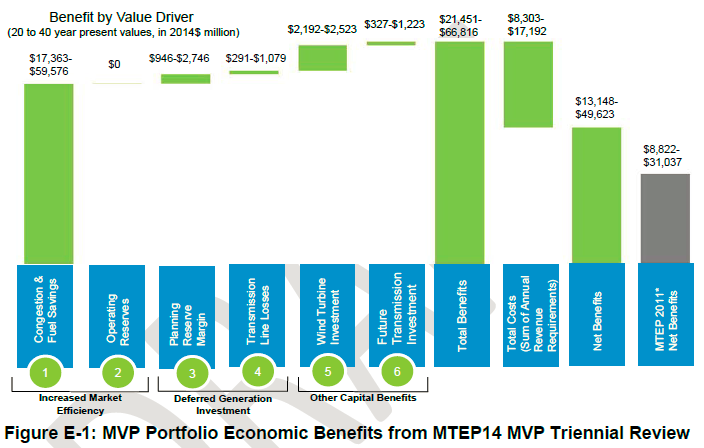
And where are we today, or more currently? Let’s look at the MTEP17 MVP Triennial Review:
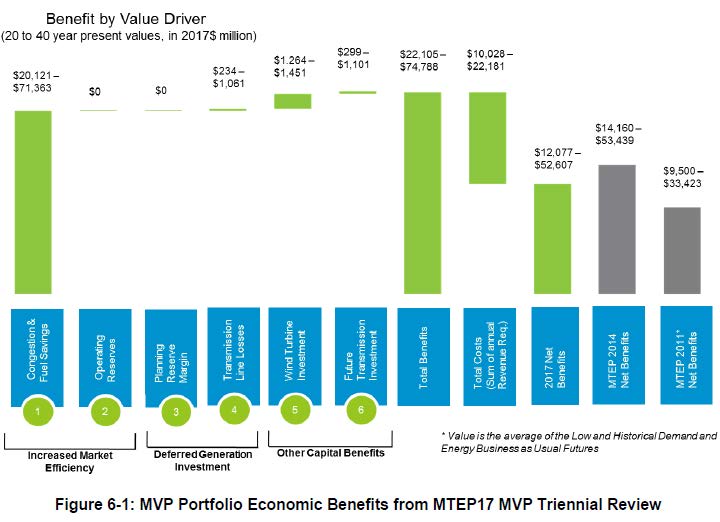
The categories are absurd… BENEFITS?
And in the Badger Coulee proceeding at Wisconsin’s PSC, the Applicant’s Henn admits that the benefits accrue to the utilities, and any benefits to Wisconsin ratepayers are not distinct or identifiable — shame MISO’s Schedule 26A and MM of the MISO tariff didn’t get in that record:
I mean, the savings of the project are to our interconnected utilities. How they pass those savings on to the ratepayers is, you know, within their tariff and pay structures and things of that nature. So, you know, I personally can’t speak to, you know, to a direct savings of any magnitude to the ratepayers of Wisconsin or, in fact, the ratepayers throughout the MISO footprint. to a direct savings of any magnitude to the ratepayers of Wisconsin or, in fact, the ratepayers throughout the MISO footprint.
Henn. Tr. Vol. 8, p. 9, l. 13-20. DOH!
It’s about time FERC took a look at this.
Remember, Initial Comments are due June 25, 2019, and Reply Comments due July 25, 2019.