Respectful wind siting NOW!
May 24th, 2018

The Red Wing Republican bEagle ran my commentary on wind siting, all of it! Short version? Respectful wind siting now! The community must consent!
Viewpoint: Respectful siting process for wind turbines long overdue
By Carol A. Overland, Red Wing
It’s taken a decade, but the Minnesota policy battleship is turning regarding siting of wind projects. State agencies, in their rush to site wind, have dropped the ball — they have failed in their charge to regulate and protect the public and the public interest. We need a respectful siting process, and that is 20 years overdue. If Minnesota doesn’t correct our wind siting process, the legitimate pushback will make siting a wind project difficult at best.
Recently an administrative law judge issued a recommendation that the Freeborn Wind Project be denied because it had not demonstrated it could meet the state’s noise regulation, or in the alternative, give the developers some time to demonstrate how it will comply with noise standards at all times throughout the project footprint.
The Public Utilities Commission will make a permitting decision, typically a month or more out. It’s not final, but this recommendation is a crucial step.
The Freeborn Wind case involves many “firsts.” It is the first project in Minnesota to be sited using the siting criteria of the Power Plant Siting Act (criteria in Minn. Rules 7850). It is the first project in Minnesota where the siting permit was subject to a contested case proceeding, in essence a trial, where the applicant had to prove up its application before an administrative law judge. It is the first project where an administrative law judge has recommended the permit be denied.
Lax rules
Minnesota wind siting has been lax and much of that falls directly on the Department of Commerce. The Environmental Quality Board no longer has siting authority. It’s been that way since 2005, when the Energy Omnibus bill shifted it to Commerce, doing siting “analysis” for PUC — in addition not to using Power Plant Siting Act criteria, and until now, no contested case.
There is no environmental review, no environmental assessment worksheet, no environmental impact statement, required for wind projects. Wind projects, until now, were separated out from the Power Plant Siting Act and permits issued citing the wind statutes and rules Minnesota Statute 216F and Minnesota Rules 7854, which have NO siting criteria at all? All wind siting permits cite only Statue 216F and Rule 7854 as permitting authority! That compartmentalization is the doing of the Department of Commerce.
There are small wind “standards,” which were ordered in 2008, but that was not a rulemaking. It was a process that was a too fast response to a legislative mandate, and in essence, the PUC took small wind standards and stamped them as “Large Wind Energy Conversion System” standards.
Nothing has been done since, despite pre- and post-construction complaints, suggestions, interventions and rulemaking petitions. State agencies, in their rush to site wind, have failed in their charge to regulate and protect the public and the public interest.
Issues are real
Wind projects are by definition the nuisance moving to the landowners. All are sited where there’s an established community, and the wind projects lease land in patchwork sites for their projects. Communities are steamrolled. The way projects are sited, it’s inevitable that homes are surrounded, and turbines are close to homes.
Noise issues are real. Noise modeling isn’t necessarily predictive, and siting often doesn’t allow for margin of error. Shadow flicker is real, but landowners are provided with blinds to live in the dark or are told to take a trip to Florida during times of heavy shadow flicker. Eagle nests are not accounted for, or in one case, blown away by helicopter, and in another, removed after getting a permit.
It’s time to develop thoughtful and respectful siting; It’s long overdue. We can establish standards and rules so that wind projects are projects people can live with. We can require modeling that provides for margin of error. We can take into account the feelings of non-participants who already live in the area and will be affected by a project moving in. The community must consent.
Looking forward, if Minnesota doesn’t alter siting regulations and practices, it’s going to be very difficult to site wind projects.
There’s also a problem looking backward, for there are people now living in the midst of improperly sited wind projects. Not only does Minnesota need to address siting issues, but Minnesota needs to develop policies for those living near and affected by wind projects, as has been done for other types of utility projects. There are at least two wind project permits now before the Public Utilities Commission regarding noise and
Minnesota’s noise regulation. Wind turbines are massive structures with 55-foot diameter concrete foundations — it’s not like we can just pick them up and move them.
Permits say that if there are violations, the violations must be corrected, or the permit can be suspended and/or revoked. In short, solutions to problems in existing wind developments are not easy, and few options are practical.
What to do? A start is to revamp Minnesota’s permit complaint process, which is occurring now in one docket. The revised complaint process, after public comment and a hearing, should be applied to all permits.
Another step is to enact an “opt out,” similar to the “Buy the Farm” option for transmission (Minnesota Statute 216E.12, Subd. 4, where affected landowners can make the utility buy them out rather than live under a transmission line.
Other ideas include a promulgation and revamp of PUC and MPCA rules, which is a multi-year process.
Policy takes a long time to change. Will Minnesota’s agencies, utilities, wind developers, landowners, and legislators work on the changes or will it be a continued fight? Do utilities want to site wind projects in Minnesota?
With the developments over the last year, I’m encouraged that Minnesota will work toward respectful siting. Let’s make it happen.
Carol A. Overland is a Red wing attorney who represents Association of Freeborn County Landowners.
p.s. Minnesota’s existing Wind Standards and Exhibit A.
WE WON!!! ALJ Recommend Freeborn Permit be DENIED, or…
May 14th, 2018
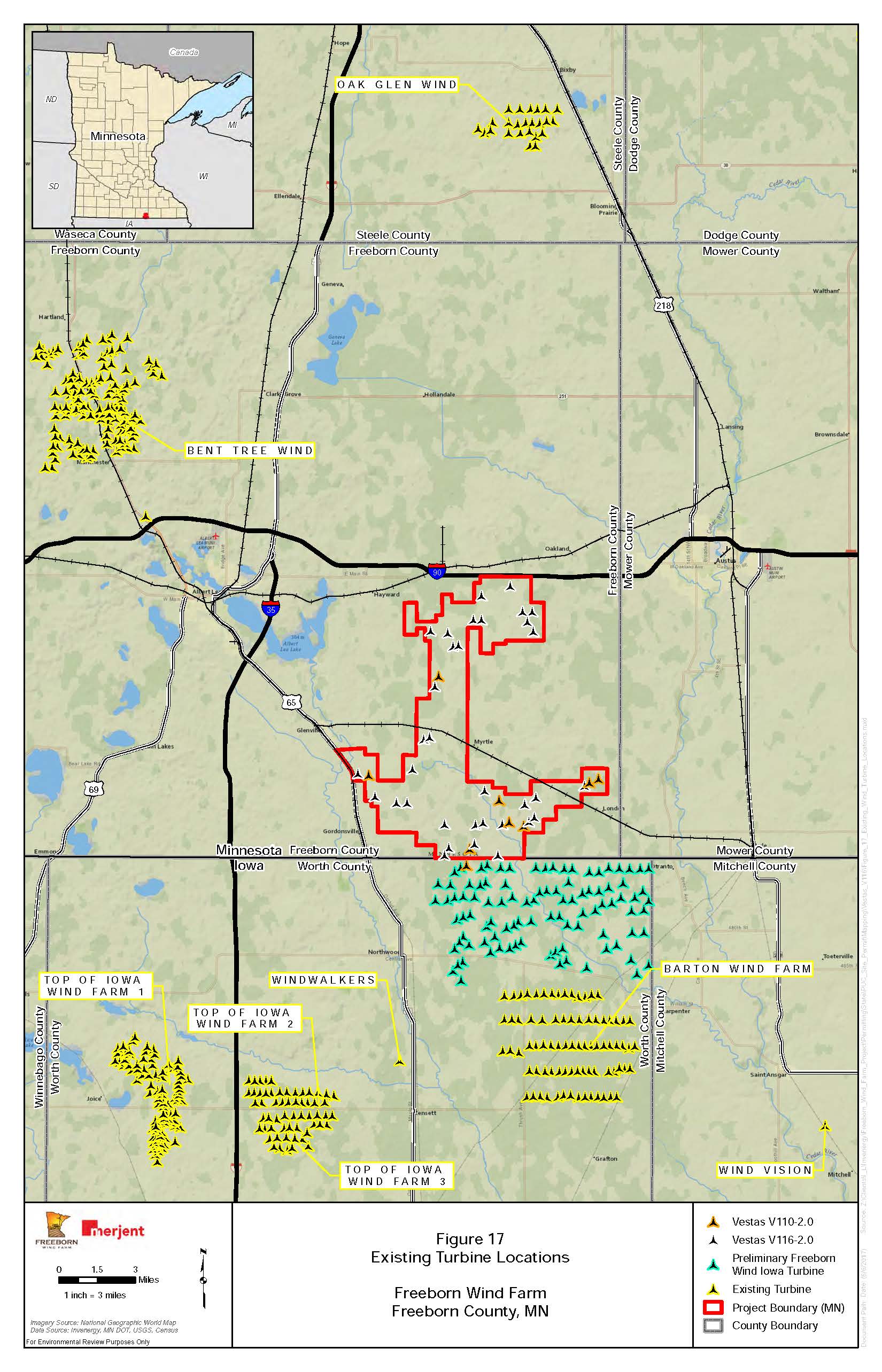
Bottom line:
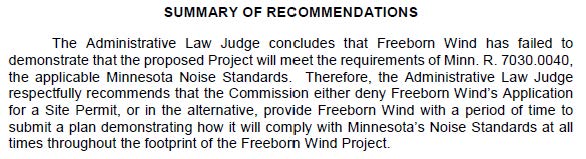
This was the first ever contested case for a wind permit in the state of Minnesota, which has sited many, many wind projects. Finally they’re doing it right, under the Power Plant Siting Act. AND in this first ever contested case in Minnesota, the Administrative Law Judge has just recommended that the permit be denied, or Freeborn Wind show how it would comply. LIKE WOW! Is this exciting or what!
Here’s the ALJ’s full Recommendation to the Public Utilities Commission:
OAH+80-2500-34633+Final+Order
Noise is real, and Minnesota has been lax about siting. That will change!
Next stop, the Public Utilities Commission! Can’t wait!
YEAAAAAAAA!
What’s going on with Bent Tree?
May 1st, 2018
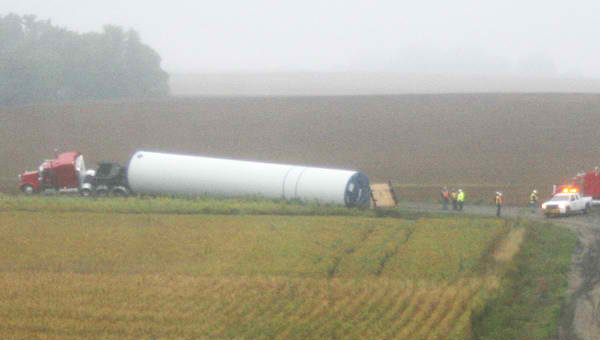
Update on Bent Tree. Filed earlier, Notice of Settlement Agreements:
And today:
And yesterday from EERA-Commerce:
20184-142562-01_EERA_Commerce_Comments
As for process going forward, Commerce recommends:

From WPL yesterday:
Next up – Public Utilities Commission meeting, the sooner the better.
More FAKE NEWS from Center of the American Experiment
April 21st, 2018

Center of the American Experiment is at it again, twisting obvious facts, and losing credibility in the process, well, not that they have any… They must be getting paid big bucks to continue this distortion and disinformation campaign. And maybe it’s just an attempt to get their name out there, as if they’re a “think” tank, and not a tank of hot air.
Your Taxes, My Friend, Are Blowing in the Wind
There are issues with wind, particularly about siting — the way projects steamroll into communities, putting up turbines too close to people who are already there — bringing the nuisance to the people where the community does not consent. Very valid issues, particularly where wind companies, on top of that, are violating their permits. We as a society need to address these issues now so that people are no longer steamrolled, and we need to figure out a way to deal with projects already improperly sited. If not, well, it’s hard to imagine how any wind project could be sited going forward!
What’s Center of the American Experiment up to? This time, it’s about wind subsidies, and they’re again milking that bogus report for whatever they can — please read it carefully and rip it apart — it’s not worth the mb it’s printed on:
What’s wrong with their take on subsidies? Well, they’re on a rant about taxes and pick out wind subsidies, because they want to bash wind, but they don’t address the subsidies for all other sorts of generation. DOH! That means that the issue isn’t subsidies, it’s wind.
Worse, they start out about Warren Buffett and tax benefits he gets from his wind projects. Yup, that’s there. But earth to Mars, he has a lot more invested in coal.
Warren Buffett owns BNSF which ships coal around the Midwest. BNSF is also a major Bakken BOOM! oil transporter, the impetus for the $5 billion Amtrak deal with BNSF for rail, crossing, and safety upgrades.
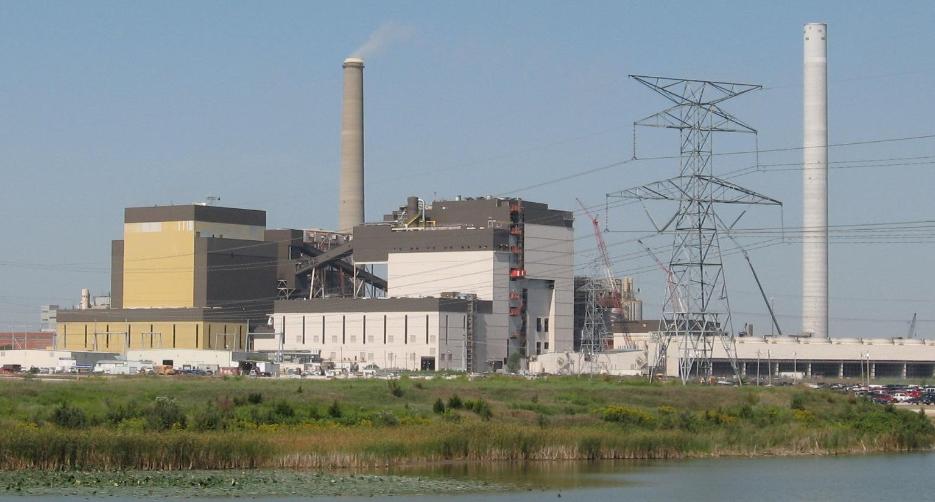
Warren Buffett owns the MidAmerican Energy Center, 4 coal plants, which includes the “Walter Scott, Jr. ” 790 MW coal plant — the largest in Iowa. It cost $1.2 billion to build, and was completed in 2007, just in time to start utilizing the biggest transmission build-out in history!
Just the Facts – Walter Scott, Jr. Energy Center’s New 790 Megawatt Unit
Center of the American Experiment says about transmission that:
Transmission is needed for all generation, none but rooftop solar is at the load. Cost of transmission is not in any PPA. FERC requires that transmission not discriminate against or favor particular types of generation — what is there is what goes over the wires. And whatever the generation source, cost of transmission does show up in rates. Utilities get more from capital investments, a/k/a as transmission, than from selling electricity.
And then there’s the basis for that transmission build out — to displace natural gas with coal:
And “the cost of running conventional power plants as backup sources of electricity” Natural gas peaking plants are what’s used for backup for wind, they kick in only when needed, and that’s not often. Further, solar follows peak. Back up occurs when the variable source isn’t running, it’s not simultaneous, not duplicative, DOH! It’s duplicitous!
As to rates: Xcel’s rate case 15-826, is there for reading, but you seem to ignore the filings. Center of the American Experiment has been silent on Xcel’s e21 “business plan” rate scam and the current bill to change cost review and rate recovery for Prairie Island. Where’s theirconcern about rates when rates are at issue? Oh, right, weighing in on a rate case might involve facts.
Enough of Center of the American Experiment’s repeated disinformation, misstatements… just stop.
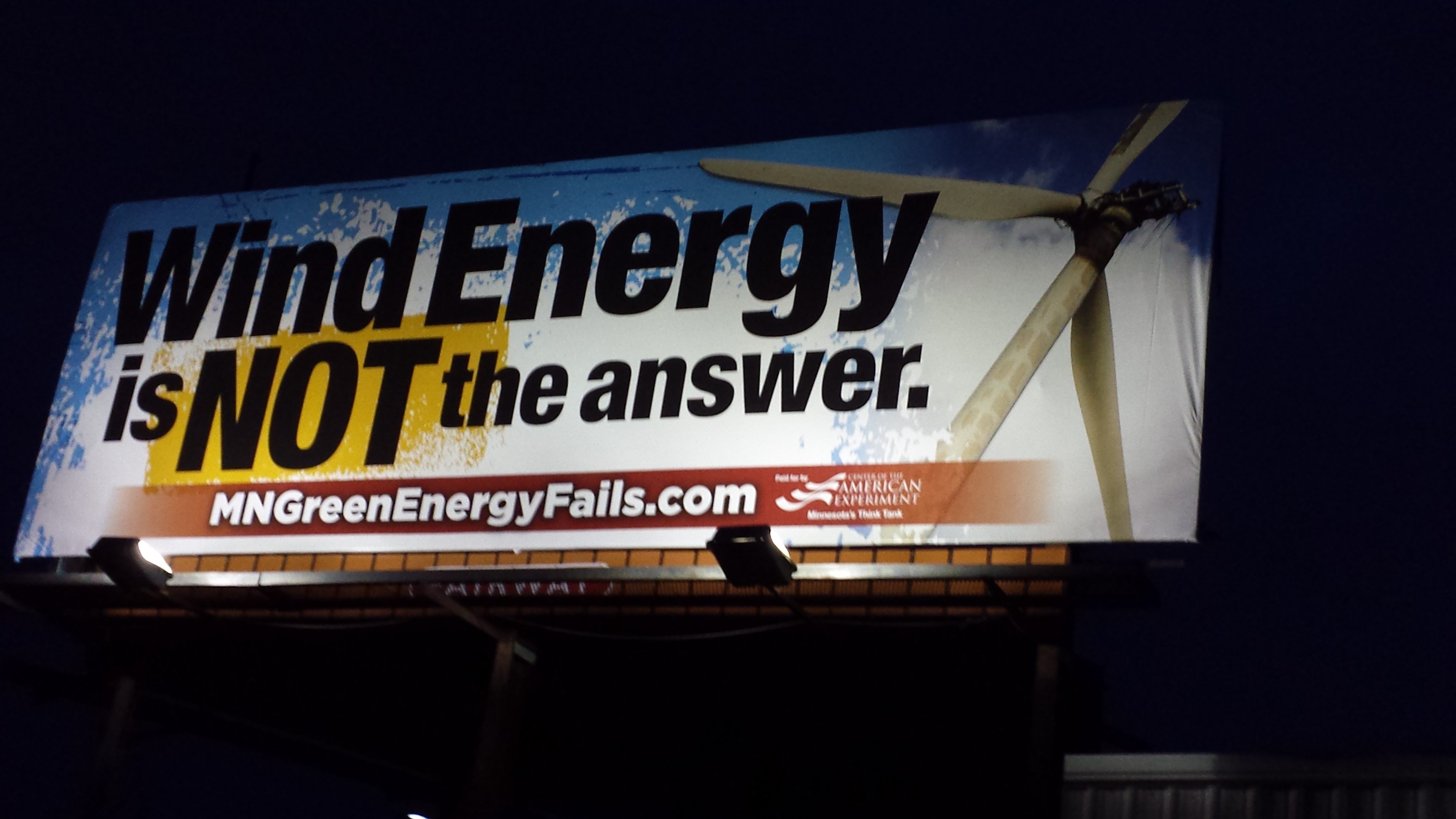 Seen on I-35 last night, right across from Cabelas
Last week, I saw the above sign on I-35 across from Cabelas. Today, Sunday, I saw another, just north of the Clarks Grove/251 exit, between the 19 and 20 mile markers. I’d guess with these two, there’d also be ones along I-90. There’s another one on Main in Albert Lea, near the lake; and another eastbound on I-90 near Hwy. 46 exit by Austin. Anyone see other billboards?
Where is Center of the American Experiment getting the money for this disinformation campaign? You may ask why I say “disinformation campaign.” Read on…
Check this out, the “report” they keep recycling:
Legalectric post from October:
Adding Power Purchase Agreement cost AND overnight cost (cost of developing and constructing) will of course be higher — you can’t have it both ways — pick one or the other!
Who benefits by CAE making arguments that don’t hold up to 30 seconds of research? CAE does of course, they’re filling their coffers. But they’re just on this because the funders want this result. The funders? I don’t presume that it’s as simple an answer as “The Koch Bros.” The false claims they use tells me it’s more nuanced, because they’re setting people up. Those who are sucked in to these arguments, who buy into these false claims, will be shot down by regulators and legislators who know the truth of what goes into rates, and who understand that CO2 reduction only happens by reducing burning, DOH! (not by increasing wind, increasing wind only changes the percentages). They’re sabotaging legitimate issues with wind siting, and they’re ignoring the groundbreaking recent demonstrations that wind projects DO violate the noise related permit conditions and Minnesota’s noise rule (Minn. Ch. 7030). They’re ignoring that the Minnesota Public Utilities Commission HAS ordered the violators to take action (too late, not enough, but a start). When there are legitimate issues, why would they ignore them and go for fake news? Why release the bogus CAE report a month after the Bent Tree Phase I report comes out? Hmmmmmmmm…
REAL NEWS:
Bent Tree_Noise Monitoring Phase I_20179-135856-01
Bent Tree Post-Construction Noise Monitoring Report Phase II Report
REAL NEWS: Freeborn Wind project is first ever wind siting contested case! For info, go HERE and search for docket “17” (year) “410” (docket number). Good reading!
These Minnesota Public Utilities Commission actions should be well known to CAE if they’re going to be doing a campaign like this. CAE should be spreading this info far and wide… but noooooo….
An example — the day before yesterday at the legislature, there they are touting this report again:
American Experiment Testifies in Front of MN House of Representatives Committee on Job Growth and Energy Affordability Policy on Wind Energy
Soooo, who benefits? Who benefits from CAE’s big PR push? Who benefits from uninformed people jumping on the CAE bandwagon, only to lose their credibility by spewing these CAE bogus arguments? I think this is a very well crafted disinformation campaign. Who is paying for it? Usually the Wizard is Xcel Energy, manipulating behind the scenes, spreading money far and wide to whoever will take it. Here? We shall see… And is any of this related to Senate File 3504/House File 3708 (they are identical) introduced on March 15th and 12th 2018?? Circumventing the PUC to get instant rate recovery for rehab of Prairie Island nuclear plant? We know how Monticello came in at twice the cost. How would that go here? PUC review of that might hamper Xcel. Can’t have that, can we… and we know CAE loves nuclear.
Registrant ContactName: Peter ZellerOrganization: Center of the American ExperimentStreet: 8421 Wayzata Blvd., Ste. 110City: Golden ValleyState: MNPostal Code: 55426Country: USPhone: +1.6123383605
Email:@americanexperiment.org